Tuesday, November 15, 2011

Announcement

Reader, for several reasons that I will not get into here, I have not had the time or the energy to create material that can thusly be posted here. Maybe if/when things work out I'll be back in business.

However, I am currently updating two tumblr blogs that can always use suggestions and contributors.


If you're on Tumblr, follow me! Maybe I'll follow you in return. :)

Sunday, October 30, 2011

"After the Apocalypse": A Review

One of the books I bought at the Boston Book Fest was a new release from a local publisher of alternative fiction, Small Beer PressAfter the Apocalypse by Maureen F. McHugh. Being a relatively short collection of stories, it was manageable with my busy schedule. Stories of the apocalypse--and the aftermath--always intrigue me, if in a morbid way, so I thought I'd enjoy it. And I must say, I've never read any science fiction like it.

The cover art's cool, too.
It's not just that it's short fiction (most of the sci-fi that I've read has been long-form). McHugh's stories focus on a very small social group of humans, whether it's fragments of a family or a group of diffident individuals, affected by a catastrophic event--an apocalypse of sorts, but more along the lines of Junot Diaz's definition in a Boston Review article published earlier this year. Not the kind of apocalypse you'd expect. In the zombie story, "The Naturalist," zombies have been confined to a small area in Ohio, where they send convicts to be punished. In another story, an avian flu epidemic in Asia decimates China's population, creating ripe conditions for capitalist greed to thrive, at the expense of survivors. In another, a dirty bomb goes off in Baltimore, killing countless civilians and triggering a teenager's dissociative personality disorder. Most of the stories take place in the aftermath of such events as a disease epidemic, economic crash, and terrorist attacks. These are only minor compared to the popular definition of apocalypse. In fact, the only story that comes close to such a definition is the title story, caused by a combo of terrorism, economic disaster, and sweeping electrical failures (all exacerbated by a corrupt and inefficient government, no doubt).

Most of the reader's knowledge of these events is confined to the characters, who are all everyday people, so they'd be hard-pressed to know the whole story behind what happened. They're mechanics, factory workers, store managers, and unemployed--the closest one gets to a career typical of the sci-fi genre is an entry-level computer programmer. In this way, McHugh's stories fit the sci-fi elements neatly into a microcosmic realism. Some stories, like the purely realistic "Honeymoon," are barely sci-fi at all, the events and time period only slightly out-of-sync with contemporary reality. The result is stories that are worthy of just about any literary tradition, challenging the conventional view of the sci-fi genre. These characters are among the most developed and diverse I've found in sci-fi, as  characterization in the genre often takes a back seat to concept. These stories are no more unrealistic than any other work of fiction--just because a deadly chicken disease or sweeping southwestern drought haven't happened, doesn't mean they won't. They certainly can happen, under certain circumstances. Needless to say, this realistic element (due in part to the character-driven nature of the stories and no need for world-building) made the stories incredibly moving and engaging, and I wished some of them were longer. "Special Economics" had nice pacing for the most part, then rushed through the plot towards the end, and I wanted to see more of what happened in "Going to France" (like, why were the flying people going to France, of all places?). Of course, not all the stories charmed me so. A couple of the stories, like "Kingdom of the Blind," got bogged down in nebulous technical jargon that strained my comprehension of the plot, and distracted me from the story. McHugh is sometimes gratuitous with exposition and character description in a way most good writers are not, baldly inserting brief character descriptions that disrupt the flow of the narrative. The averageness of the characters made them interesting, but frustrating for someone who's more interested in their world than they are. Still, I kept reading, interested in the circumstances and how it would all end. Hell, I even cared about some of the characters.

Though there probably should have been at least one other proofreader looking at it, since I found a few embarrassing errors in the text. But since the book's coming from a small indie publisher, it's an unfortunate side-effect of a small budget. Some of the stories I was hard-pressed to define as "apocalyptic"--though it's not just the end of the world. The most literary moment in the collection occurs in the last story, with a July's People-style conclusion. It also sums up all the preceding stories, too, in a way. These characters seek freedom from their suffering, like we all do; it's just that their circumstances compel them to take it up a notch. And that's how fiction makes life more interesting. The apocalypse, whatever its shape or form, is brought to us, as real as any 9/11-style disaster. And as profound.

Overall, I give it 3.5 out of 5 stars, with my favorite stories being "Special Economics," "Useless Things," "The Effect of Centrifugal Forces," and "After the Apocalypse."

Tuesday, October 18, 2011

Are Books For Hipsters?


This past weekend, I attended the Boston Book Festival, where writers, readers, and thinkers of all most stripes could convene and share thoughts and ideas; learn more about local bookstores, publishers, and nonprofits; and get free stuff. I left the festival with enough reading material to last me at least a month, plenty of free shit, and a lighter wallet. It was a great day, and I had a pretty good time.

But, I noticed something I had noticed at a different event last month (that being a Primus concert). But for some reason I'd never really noticed before.

Man, are these people white.
Courtesy of Hot Guys Reading Books
At the BBF, there were some Asians (both east and south), and maybe a couple black people. All of the presenters at the panels I attended were white (though some people of color presented at other events). And it wasn't just the whiteness that took my notice. It was the similarities between these people that you could identify what type of reader they were. Nonfictioners dressed conservatively, passing for mainstream professionals dressed casual, but not too casual. Most were probably older than 30, and made good money. Younger nonfiction readers (whom I saw plenty of in the line to Chuck Klosterman's book signing) were textbook hipsters, though many could pass for normal on a liberal-arts college campus. Klosterman himself looks kinda like that. I didn't really notice a significant male-female ratio disparity, but plenty of the younger guys had beards. Hipsters cross over into fiction, their favored genre being literary fiction. I'm kinda glad I didn't go to the Jennifer Egan panel (though I do want to read her book), because that was probably overrun with hipsters. There are also nerdy readers, who dress unconsciously and often sport facial imperfections; you find them more often in science-fiction and fantasy circles. There's also the artsy nerds, who pierce their bodies and dye their hair and wear black, and maybe cosplay (if they're more nerdy). These folks were at the graphic novel panel, and maybe at the Steampunk one, too. As for the other people over 30, they basically looked like regular people or professors (or regular professors). Maybe a smattering of artsy or nerdy--I imagine that most people tone down their look as they get older. One thing was for sure: a person wearing Abercrombie and Fitch or (Science forbid) Ecko would look out of place in this crowd.

The predictable makeup of this book-buying demogrphic speaks to the current limits of the written word--or at least, the marketing of it. Plenty of people of color write thought-provoking books, so why weren't more of them featured? Did the organizers of BBF realize they were inviting a whole lot more white people--or maybe other nonwhites theyasked were busy that weekend. Is it really just a symptom of a greater issue in publishing, where whites get all the attention?

I think it speaks to an even greater issue: education. The BBF is a showcase for writers and intellectuals, most of whom have at least a Master's Degree, and have little to no recognition among mainstream readers. Romance, thrillers, horror, and other trashy genres are not represented here. However, these genres (as well as YA, which actually has a place in "higher" literature) are the books most people read, and pay for the more intellectual and artistic ventures. In this way, higher literature is more of a subculture, with a small, concentrated demographic. Just like any other subculture, they adopt a certain way of dressing and talking to identify themselves. These people graduated from liberal arts colleges (or that part of the university), work in academia or publishing, vote Democrat, and hold corresponding liberal views. Obviously, there's a lot of overlap with the hipster population. Though I think the lack of radicals was because they're all at Occupy Boston.

So why are books largely considered to be the realm of the educated? Well, it takes education to read, and more to make sense out of what you read. It takes even more to talk about it in a reasonable, rational manner with others. And the thing is, most people don't get that education, whether it's because they're poor, received little encouragement at home, or are otherwise dissuaded from reading (eg. favoring the instant gratification of TV and video games over books). Most of the BBF attendees were of European or Asian descent, races that are often better-educated than blacks, (and so goes the earning potential) and liberal because, well, we're all smart, and truth has a "well-known liberal bias". Whites, moreso than other races, are encouraged to "follow their dreams," and therefore are more likely to pursue unlucrative artistic careers like writing. (disclosure: this is from personal experience only) Whites also make up the majority of faculty members at many univerisities.

This, of course, all boils down to economics: whites make up the majority of rich people in the US, and therefore are more educated, because they go to better schools and can afford a good college, and therefore are more likely to read for fun. The unfortunate effect is that reading is becoming an elitist activity, especially as the gap between the rich and poor widens, after-school programs get cut, and public libraries closed down. As they say, knowledge is power, and if knowledge becomes less accessible, the possessors of said knowledge grow more powerful. While I doubt that this avid book-reading demographic's going to take over America (money is more powerful), we have to get people interested in reading and writing again, if only to harness untapped critical thinking skills and open people's eyes to the injustices committed towards them and their community every day. Then we can make a change.

So, back to the original question: are books for hipsters? Yes. And everyone else, too.(There's way more non-hipster books out there, trust me) Literature has something for everyone, if you look hard enough.

Saturday, October 15, 2011

The Peculiar Whimsy of Bender's Lemon Cake

Aimee Bender is another author that caught my interest back in college, when I was first exposed to her work. Her particular style of magic realism, blending in otherworldly concepts with an otherwise straight-up vanilla (literally) realist narrative, stood out amongst a sea of orthodox, straight realism that is acclaimed by the literary elite. As someone who is fond of the strange and fantastical portrayed as everyday life, I snapped up her first story collection, The Girl in the Flammable Skirt, and quite liked it. When I heard last year that she had a new book out, on my reading list it went. Finally, this weekend I got to read it, and though I'm not a fan of the title (I get its significance, but the wording's just awkward), I enjoyed the novel like any other piece of magical prose.

SPOILERS AHEAD

The Particular Sadness of Lemon Cake follows Rose, the narrator, as she grows up, from when she first tastes her mother's feelings in her ninth-birthday cake to young adulthood, where she ends up as a chef trainee. This talent for tasting feelings in food is more of a curse than a blessing, however, prompting her to avoid not just home-cooked meals, but a sense of intimacy with anyone. This turns out to be somewhat hereditary, as Rose learns later: her father and brother are already presented as avoidant in nature--she has few meaningful interactions with either of them until towards the end--her father never sets foot in hospitals, and her brother eventually succeeds in avoiding all human interaction by disappearing, intermittently at first, then later for good. But there's no judgement on Rose's part whether each person's way of dealing with this curse (of sensing others' thoughts and feelings, somehow) is the "right" way. In fact, she seems just content at last to have a special connection to them. Her relationship with her mother, meanwhile, also gets stronger with time after her brother disappears, though there will never be true understanding: her mother, after all, is still hollow inside, and she, too, would rather hide it than have to confront that feeling.

Like in many of her stories, the magic of the world--the existence of a sort of emotional telepathy that can be sensed through any part of the body--fits into the narrative, a key facet of the whimsical and haunting prose. The moment when Rose catches her brother half-disappeared gave me goosebumps, and though it wasn't scary per se, it was reminiscent of the quietly scary moments one may remember from a dream--or from reading Goosebumps. Perspective gets a little muddled at times, with a younger voice permeating the point-of-view of an older Rose.

Though Lemon Cake is sprinkled with several common nuclear-family tropes--the depressed homemaker mother, prodigies, workaholic dad, to name a few--they grow organically into their own characters, suiting better to this somewhat unusual story. I also kind of felt that the characters should just get over it, or at least go to therapy--it amazed me that the subject of therapy never came up. It seemed like a logical step, like, maybe something's wrong with their head? The affair storyline never really goes anywhere, and I wonder how Rose's mother kept it under wraps for over five years.

Sentences are often short and blunt, characteristic of someone who's not wordy and tends to conceal emotions. It also makes it easier reading--reading over 50 percent of the book on a bus and 5 hours of sleep, I could not slog through dense paragraphs of ornate prose. The story was often sad in a way, too, with self-imposed isolationism and her family's insularity preventing them from finding a way out of their unhappiness, and closing them off from getting to know new people. Rose's brother, for example, only made one friend in school, and seemed content to just stick with the one. He didn't disappear until after they were separated after high school. The psychological drama that unfolds as a result of this curse is subtle, interpreted by the reader through Rose's sparse narration. The nonexistence of quote marks echoed the deliberately self-reflective tone of the novel. These feelings are pretty exemplary of the American psyche: focus on yourself, or the bubble that you live inside of. Rose adapts to her own curse by turning it into a talent, letting go of the secret and letting others in. She may never be truly happy, but no one ever is, right?

Once you read through the first chapter, Rose's story will have you disappearing into her world. This is a story I will remember for a while. I give it 4 out of 5 stars.


Friday, September 30, 2011

Player Piano: A good, old-fashioned Dystopic comedy

The first thing I ever read by Vonnegut was Breakfast of Champions, which I read last year. By then, he had constructed a layered universe whose rabbit hole split into different stories which sometimes spilled into one another.

*as always, SPOILERS!*

  Player Piano, Vonnegut's first novel, predates the universe, and takes place in an alternate version of the 70s or 80s, as someone in the 1950s imagines it. Far enough in the future that it's difficult to foresee, but not so far that no one in the story remembers the present day. In his pessimistic (dystopic, really) vision of this unspecified time in America's future, machines have taken up all manual labor--and more--from humans, leaving the most high-level jobs for the highly intelligent; specifically, managers and engineers, who are put on a pedestal in this American society. For those who don't make the elite, there is only the Reconstruction and Reclamation Corps (nicknamed the "reeks and wrecks") or the army. 

The protagonist is Dr. Paul Proteus, the son of one of the most successful engineers in recent history, and who had once held the highest level in the land (not the presidency--that at this point is a figurehead position). Like all dystopian protagonists, Paul is unhappy, but can't figure out why, until his old friend Ed Finnerty shows up and exposes him to discontented thinking. Proteus' gradual breakaway from his comfortable life at Ilium Works--and eventual revolution--is broken up by snippets of an Arab tourist and the man who shows him around, uncovering stories of other discontented people they meet on their tour. In the end, the revolution fails, and Paul and his co-horts turn themselves in.
  Player Piano is suspenseful, fast-paced, and bitingly humorous, characteristic of many of his novels. I didn't want to stop reading--though I did for other reasons. The fiction he presents us bears an eerie resemblance to today's reality (machines do more than they did 60 years ago; in fact we rely a ton on machines today--though of the digital variety; Vonnegut's machines are more analog) showing how technology transforms society. More people are unable to find jobs in the private sector, since machines do the job they would have had; therefore, the government gives them jobs and keeps them comfortable (with pension, health care, and even pre-bought furniture) to forestall a revolution.

 What is in place is far from the American Dream; instead, the class system is upheld by intelligence aptitude tests; those who don't pass remain in their class. Paul, as the son of a successful engineer, was set from the start. The biggest thing Player Piano didn't take into account was the advancement of women and minorities--their representations in the novel (as housewives and secretaries and simple-minded and invisible) are strictly retro. So today's world is a bit more complicated. Our new service economy favors what is now known as "women's work." Universal Health Care is a good thing. We have a black president. We're afraid of Muslims. But of course it's fiction, not meant to be a prediction.

  Player Piano is a classically dystopian tale,though a lot funnier than your average read. It gets you thinking about men and machines, and whether all progress--especially mechanization and digitalization--is completely a good thing. We lose contact with other human beings, with the earth from which all life comes--can we regain these connections, or is the damage done? Vonnegut's answer, like many dark comedies, is not a hopeful one. I rate 4/5 because of the cartoonish depictions of women and minorities and the trivialization of American Indians (i.e., blatant racism and sexism). Note that I am giving the novel a high rating, however--I am not super-offended (and it was a different time, after all: one can hardly expect a white dude over 25 to be progressive in the 50s).

Tuesday, September 20, 2011

Album Review: Scurrilous by Protest the Hero

This is my first crack at a music review, so we'll see how this goes... Disclaimer: as much as I would love it, I'm not a musician (nor can I play an instrument, other than my voice--it counts!!!--though I'm sure I could learn if I tried and had the time/energy) so I'm not going into music-y jargon, since I'm only somewhat familiar with it. Scurrilous, the latest record from proggy metal Canadians Protest the Hero, came out in March this year, so it's not super-new. But I wanted to choose something by an established band that came out this year...and as far as recent music goes I've mostly been listening to relative unknowns for the most part this year, so it's one of the only albums that came out in the past six months that I've listened to a few times. Of course, I'll show the unknowns some love later on...I just need to get a feel for this.
Anyway, the opening anthem, "C'est La Vie," is a frenetic, campy, dance up and down the musical ladder, setting the perfect scene for the tone of the rest of the album. I think that one may just be my favorite, though "Tandem," "Dunsel," "Termites," and campy "Sex Tapes" also exemplify the best of Protest the Hero. The rest of the album flows in much the same vein, a fast-paced journey along the frets of the bassist and guitarist. at moments, the bass, often buried beneath the combined melodies of the two guitars, rises to the top of the track with a frenetic slap rhythm. Rody Walker's vocals often stride the line between clean and screams, matching the smooth/grating sliding scale on the accompanying guitarists Tim Millar and Luke Hoskin's riffs. The 80s-hairmetal vocal flourishes that made Fortress's "Sequoia Throne" stand out from more typical breakdown-heavy metalcore that's sprung like daisies in the past five years or so add an even more flavorful layer to Scurrilous than in their debut. While the guitars are solid and often command more attention than the vocalist, like in many metal bands, they don't spill into sprawling solos that some prog bands often do. Scurrilous's often campy lyrics and vocal style, in addition to the fast pacing of the instrumentals, can invoke the cartoonish, and may be suitable for proggers with shorter attention spans. Prog metal for the internet age! like the guitars up and down the frets, Walker's vocals slide back and forth from the smooth clean singing to the more grating screams, with varying degrees in between. Walker's lyrics also help set the band apart, with such comical verses as the following from "Sex Tapes": "The Jonas generation's got rings wrapped 'round their dicks/The whole world waits with patience for one of them boys to slip" In addition to the clever use of rhyme, the lyrics have come comedy aspect to them, making the music more fun than a bummer (but still awesome) and the vocals create the over-the-top theatricality of the lyrical themes. I daresay it's poetic. The best songs, though, slow down and take a breath. Perhaps because I like the occasional clean vocals in heavy music, but when Walker breaks into full-on melodies and the rhythm slows down, I'm ready to sing myself. There are many hallmark signs that a musician has effectively engaged the listener: headbanging, toe-tapping, air-guitaring or -drumming, lip-syncing, or (in certain circumstances) singing or dancing. Protest the Hero makes me want to do all of these things. Their riffs and refrains are catchy as fuck. There is no question that these guys know their shit: the guitars are so fast I imagine that it would be difficult for an amateur to keep up with them. In another comparison to Fortress, Scurrilous sounds better produced and mixed, lending to a higher-quality, better-blended sound (or maybe it was just my shitty copy of Fortress). Because nothing's perfect (example: the guitars can overwhelm the other musical contributors), I give it a nine out of 10 stars: their best album yet.

Tuesday, August 30, 2011

Freedom Isn't Free...except at the Library

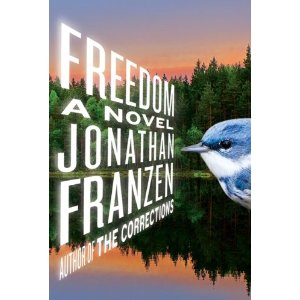
I have to admit, I decided to read Freedom by Jonathan Franzen, this oft-acclaimed novel by an oft-acclaimed author with much prejudice against it. It was this book that caused a kerfuffle in the literary world and sparked conversation about how women writers are not given their due as men are, even though more women are participating in writing programs these days. So, I kind of resented Freedom at first because it's by a dude, and sounded overrated. Another novel about middle-class white people by a middle-class white dude, hooray.

But I heard some positive things about it (or at least Franzen) from my co-workers, so I decided to put my re-reading of the Harry Potter series on hold, and give this book a shot. I was being unfair about not reading it, anyway.

And...it was well-woven web. Franzen can write an artfully crafted sentence, when he tries. Though at over 500 pages and with very lengthy chapters, it was easy to forget what was happening in the first place. Focusing on character development is an admirable achievement, but sometimes the reader can lost in pointless meanderings.

**WARNING: SPOILERS**

The premise is outlined in the first section, "Good Neighbors," in which we're introduced to the central family of the story: Walter, a rabid environmentalist; Patty, a passive-aggressive housewife; Jessica, their "good girl" daughter; and Joey, the spoiled but charming son. Life is mostly good, until their neighbor gets a new beau and Joey moves in with them. His smothering mother is severely upset (compounded by the fact that he's sleeping with the neighbor's daughter, whom she didn't like very much) and Walter practically bursts a blood vessel about it. This results in about five years of estrangement between the parents and son, with very little interaction between them.

But the real story revolves around Walter and Patty's marriage--a love story, of sorts. It appears at first to mostly have been a one-sided thing, with Patty lusting over Walter's best friend Richard (who of course is a musician...almost nothing is sexier) even before they started going out. Of course, they both cheat on Walter one summer by sleeping with each other. Freedom is, above all else, a character study on this couple and how their relationships and personalities change and affect one another as time goes on. This is obvious because the years before they met are confined not even to one chapter each.

At various points throughout the book, I found each main character to be very, very annoying. Walter was annoying because of his bottled-up rage at everybody, and having the hots for his assistant Lalitha (who in turn was annoying because of course she had the hots for him!), Joey was annoying because he was a selfish prick (though he learns the error of his ways), and Richard--the least annoying of the bunch, for he was cool and more honest than his bff (the second-best character)--annoying for giving in to Patty's advances and fucking everything up. Patty was all-around annoying at almost every turn, redeeming herself at the very end--like, the last chapter the end. I did not understand her appeal. So I didn't like any of them. Yet I stuck with these people for 500 pages, I guess the story was compelling enough. Though I wasn't rooting for Walter and Patty to stay together.

But--oh, man, the buts. Perhaps I was just looking for something to hate, but I didn't like how the main women were all typical, except maybe for Patty. And we get to see her as more than just a housewife and ex-basketball player because a good chunk of the story is told in her voice. All the other female characters are fuzzy and flat: we get most of the input about them from the main characters (e.g: thus, Lalitha is the sexy, earnest, hot-for-her-boss assistant archetype we've all seen before). It also irked me that Joey gets more of the spotlight than Jessica--we get his background and perspective, why not hers? Though now that I think of it, a lot of the characters were pretty cookie-cutter (see descriptions above). I also think Lalitha was totally fridged at the 500-page mark to allow for a nice, clean resolution. Yes, I didn't like her much, but I resent plot twists that pop out of nowhere in what is supposed to be "literary" fiction and not pulp chick lit (which is what this book would be if it wasn't so long and meandering and political).

The ending was...cute. Everyone kind of got what they wanted and found their happiness. Which is...again, cute. Perhaps not the feeling Franzen was going for?

Then there's the premises: a failing marriage, cheating, hypocrisy. Plus the freedom thing. We've seen it before in different incarnations. As I read on, I started to think, I'm not the target demographic for this. And I'm definitely not: this novel is more for college-educated adults in their 30s-50s, and grad students who have gotten over their experimentalist phase. Franzen is probably unpretentious, even down-to-earth, if we are to go by his in-depth portrayals of a "modern" American family (that's still white, middle-class, and patriarchal). This perspective is all too familiar to me, which makes the subject matter somewhat tired. Perhaps it's my youth, but I crave fiction that's new and different, in a way.

Which begs the question...why is the title "Freedom"? What does "freedom" have to do with it? There are several allusions to it in the book, mainly when characters are discussing walking away from marriage, plus the phrase "how to live" pops up frequently. As hard to define "freedom" is, it could be applied to just about everything in this novel--and that's the point. The freedom to fuck up and make up? To leave your spouse, your family, and still hope to come back someday? To do what you want? Probably all of the above. Obviously it's meant to provoke thought. But seriously, reading this book gave me realism fatigue. It's the only way to describe it. I don't want to think about this effing book anymore. 3/5 stars. Back to Harry Potter!

*In addition to realism, I will also be taking a break from book reviews for a little while. Maybe I'll put up some reviews about music, movies, or TV. Stay tuned.*