Showing posts with label criticism. Show all posts

Thursday, September 25, 2014

We're back, for now; Calvino's Cosmicomics

I'm back! For the time being. Another site is in the works, as I plan on moving to a place with much more aesthetically pleasing free themes. News of that will soon follow...

I first heard about Italo Calvino's Cosmicomics in a New Yorker podcast. Some author read one of his stories and I was intrigued. When I saw an English language copy of the collection in a bookstore in Copenhagen (read it before NPR, bitchez!) a year later, I decided to buy it and check it out. It is quite an imaginative collection, with setting in all stages of the universe expertly composed and translated, many of which were delightfully meta and fantastic.

However timeless they may feel, or the subject matter is, it was very difficult to forget the time in which these stories were written, and the perspective of learned Italian men such as Calvino. Calvino famously believed that there was nothing more to do with traditional realism, thus he turned to other sources of inspiration. He may have been right, in terms of the Western white male perspective, that is. Women and other minorities have plenty to add to the traditional realism canon. This just goes to show Calvino's limited point of view, even as he writes stories with seemingly unlimited possibilities.

This most often took shape with a heteronormative male/female dichotomy, even when the characters aren't human!  I suppose this makes sense given that the characters are also anthropomorphized, and as this was originally written in the highly gendered language of Italian, such a dichotomy
is inevitable, but it became so lazy and tiresome after a while. Calvino could have been even more imaginative in this regard by refraining from using anthropomorphized or even gendered language at all. After all, not all species on Earth, let alone all the possible species that exist in the universe, have two sexes. 

I realize these stories tend to have a mythical feel, where the same shit often went on, but it was too often the story of a presumed male character in pursuit of a female character. Though the settings and ideas put forth were drastically different, the plot would be the same. It got on my nerves at times, that the female was always the pursued and preferred things the way they were before (which somehow imparted some wisdom on the male character) and hardly ever the one to take action herself. In some instances, one could argue that Qwfwq is an unreliable narrator, or that it's not been the same incarnation of Qwfwq, per se (this would explain why no other names recur). At the very least, we can't take his opinions of other characters' motivations at face value.

One that particularly stood out to me in a bad way was "The Soft Moon," an otherwise excellent story providing an alternative history of how the earth and moon came to be. There is another female character who is calm and expectant even as the world around them crumbles, and we flash forward to what the world looks like circa the 1970s, and right up until the last line of the story I'm there. But that last line... Qwfwq better be an unreliable narrator, bitter from a bad breakup, because the last line creates a caricature that completely flies in the face of Sylvia's character up until then. It made me so mad I stopped reading for a few days, because I would like to hear someone justify the reason for that line.

Most of the other stories I wasn't jazzed about didn't have such offensive lines of prose as that one did, but it started to become the same story over and over. At least in "Night Driver," the weak love pursuit premise dissolves into a pure thought experiment, devoid of any traditional trappings of story at all. The last few additions to the collections, like "Nothing and Not Much" and "Implosion," exist in the grander universe and bring up some though-provoking concepts while giving us settings and character forms I had never come across before. The stories really do improve, in my view, over time, when they're not so fixated on one-sided amorousness.

But there are instances where I find it difficult to excuse such blatantly male-centered storytelling in stories that don't even necessitate gender. It just ain't my thing. Hence I'm not a big fan of the first collection or the first part of "Time and the Hunter." Once I got into "Priscilla", the stories became more varied and interesting, relying less on the pursuit of woman plot. I much preferred "Spirals" to "The Spiral" - they were pretty much the same story but the former was more conceptually developed and experimental while the latter relied on the desire trope that I just got tired of.

This is not to say that I didn't enjoy the collection; I enjoyed the "Priscilla" trilogy and the new stories from "World Memory," among others. Many were the kind of heady, out-of-this-world stories that I like from that era. But whenever a so-called love story became apparent, I just thought, "Here we go again." As always, the presumed male character was the actor, the driving force in these stories, whereas the female characters did not so much at all, except settle down with another male character. 

So overall, not a bad collection of stories. I more highly recommend the latter parts of "Time and the Hunter" and the later stories, as opposed to the original "Cosmicomics." They're all very imaginative and full of wonder but if you're a feminist you might get annoyed, so don't read them all at once. It remains that these otherwise visionary tales fall short due to Calvino's patriarchal and heteronormative views, which certainly took away from my ability to fully enjoy this collection. I give it just three stars for not being imaginative enough.

Sunday, December 8, 2013

Success Somewhere Else: Five Star Billionaire by Tash Aw

We hear a lot of things about China, from its oppressive government to how it's going to take over the world (wouldn't count on that). But there is another way to understand what's happening in China, and that is to read the stories of people who actually live there. Oppressive the government may be, but it is one of the more economically prosperous countries in the Asian continent. Tash Aw's place story Five Star Billionaire accounts for a more nuanced perspective on the way life is in modern China, especially city life.

The five characters who come to Shanghai, China's largest city and the most populous city in the world, each want a chance to succeed in ways familiar to Western audiences. The Chinese economy is fully capitalist, and the protagonists' goals start out, at least, as purely material. But committing oneself to the capitalist agenda casts out the virtues of humanity that these characters, one by one, realize they have lost, perhaps irrevocably. In this entangled narrative, Aw shows us that capitalist ideology has the same effect here, to the detriment of the environment and humanity, in the most effective way possible: through small, individual stories.


The tale starts out strong, with an immersive introduction to Phoebe, one of two heroines in the book...though none of the characters can hardly described as heroic. She's an illegal immigrant but desperate to achieve materialistic and romantic success, expressed beautifully in a scene with a wealthy-looking young couple. This first chapter, which weaved in backstory with a wonderfully immersive scene, hooked me immediately.

The other characters, however, had less gripping introductions, Aw dropping the backstory almost all at once for the rest--most notably, Justin and Gary. Justin is the heir and proprietor to the massive family business of LKH Holdings, but we come in just before the moment of collapse. Gary ends up having a similar breakdown and drastic change of fortune, except he's a famous pop star, having won the genetic and marketable talent lottery, who ends up resenting his own fans and hating fame. The other female protagonist, Yinghui, is a successful businesswoman, but is feeling the stigma of being a "leftover" woman. Her introductory chapter is also excellent.

There is a fifth protagonist, who reveals his backstory slowly, recounting moments in his youth and more recent history to give us hints of his true motivations for success, remaining an ever-mysterious figure even as he enters the narratives of the other characters. And the reason why he is so successful may surprise you.

Naturally, as a lot of these novels go, the characters' lives each intertwine at one point or another. In a few cases, it's unknowingly, but we, the reader, are clued in. Seeing how these characters' lives connect is part of the fun in reading, so I won't reveal to much plot, but they all have a few things in common: they all are not native Chinese (all except Gary are from Malaysia), they all have achieved financial success (except for Phoebe, who manages to get there through deception), and they all are lacking in the personal life department, as none of them are married or have steady relationships. In the end, they all feel empty inside, as it turns out that financial success alone does not complete one's life.

The characters are also very calculated in their interactions with most of the people they meet, figuring out how they could use the other person and how the other person could use them. Often, the characters lie their way into success and out of sticky situations, and when they're finally honest with someone else, they get burned in the end. The culture of Shanghai seems to compel them to act this way, and the characters fail hard before they learn from their mistakes and move on to find true happiness.

The plot may appear cliched, but the different setting and culture gives the story a freshness that it may not have in a Western setting. Setting is important in this story, as well, and it is richly depicted in the prose description and characters' colored points of view. However, the women characters became engaged in stereotypically feminine behaviors that does not occur likewise for the male characters and I can't help but cry bias. I got tired of Phoebe's relentless pursuit of men, when I wasn't all that clear on what it was that she really wanted, and Yinghui's growing interest in dating made me sigh and roll my eyes occasionally. Other than that, however, the narrative hardly annoyed me.

Overall, this story is an engrossing portrait of the capitalist dream in Shanghai, which will chew you up and spit you out just like in pretty much every major city in the world. You may be able to save face, but only if it's not too late. Four out of five stars.

Tuesday, October 22, 2013

Aimee Bender's "The Color Master:" a Three-Part Review, Part Three

The third and final section of this underwhelming collection was...maybe not the best, but I enjoyed every story in this section, up until the very end. It seems that the theme of this collection is primarily unsatisfying endings that make no sense.

I really enjoyed the story "Wordkeepers," a kind of fabulist tale of modern-day distraction, even if the narrator was exasperating. I identified more with his love interest, who insisted upon correct grammar and complete sentences, fighting back against this new realm of easy forgetfulness, but the subject matter was topical and the ending was actually satisfying in its own way--a rarity in this collection.

The next story was the title story and the star of the collection, "The Color Master," was indeed one of the best stories in this collection. The setting was odd, as it was at once fairy-tale and modern-day Europe (a fantastic facsimile, more like) and there wasn't much world-building--not that I would expect any from a literary short story. But the process of choosing colors (as the Color Master did) and the vivid descriptions of color, as well as a well-threaded fairy tale plot in which the protagonist grows into her own and the kingdom is saved, were all expertly woven and a delight to immerse myself in. The final line, though, left me going "huh?", because even though I figured the story of "Donkeyskin" referred to the deposed king, why is the story "hers"--i.e. the Color Master's? Because she knew what was happening all along? Or is the Color Master the "her"? Once again I found the ending needlessly confusing whereas throughout the rest of the story I had been able to follow along and pick up the thematics pretty well. So either I'm not "getting it" or it's just plain nonsense.

The third story, "A State of Variance," was not particularly memorable, a story of a legacy of freakish symmetry and finding love and happiness in the opposite. In a way, though, the story starts out one way--a woman who can no longer sleep for more than an hour and thusly experiences dream states while awake--and then turns into the story about a too-symmetrical young man's hangups and his dealings thereof. Interestingly, she didn't get too much into the boy's dad, and the trend of not naming characters continues.

The fourth story, "Americca," was one of the more interesting ones, and contained plenty of echoes of Lemon Cake: an ordinary family encounters some extraordinary small occurences. But unlike in Lemon Cake, the inexplicable giving mysteriously stops after a while, and happens only once more. One of the most difficult things to pull off in a short story is the flash forward--in this story it would be revealing whose voice it was all along--and this story is not an example of such a device being well-done. The voice was not quite that of an adult (in fact she's a child for most of the story) but all of a sudden she is 27 and crying over some delicious curry, presumably because it was the last gift and it will never be given again? Didn't work for me. I'm not a fan of the title, either. Otherwise, though, Bender's usual talent was on form.

The final story in the collection, "The Devourings," stood out in that it's a very fairy tale type story. For one, it has ogres and honest-to-God magic in it. This is also one of the top five best stories in this collection. From the single narrative of a woman in love with an ogre springs forth two narratives related to devouring, and like the concluding events of the story, neatly wraps in on itself. It's a nicely put together, if strange, story that lends itself more to the Brothers Grimm school of fairy tales than it does to what most people are familiar with. (Then again, most people won't be reading this book)

In the end, the collection had mostly okay stories, and some good ones, as well as a few bad ones. I did not enjoy this collection as much as her first, and I'm starting to think Bender is getting too comfortable with a certain formula. It seems that even experienced writers forget that the formula doesn't always work, and you got to mix it up a little bit to keep your stories fresh and prevent writers' atrophy. I give it 2.5 stars out of five.

Thursday, October 17, 2013

Aimee Bender's "The Color Master": A Three-Part Review, Part 2

So, after a disappointing first part, I didn't hold much hope for the rest of the collection. But, I bought the damn book, so I kept on reading. Luckily, the second section improved in quality overall.

"The Fake Nazi" started off as a quite compelling and expertly constructed story, revolving around a man who believed he was a Nazi--even though he wasn't. Through three different people--the man himself, his brother, and a curious legal clerk--we learn more about the strange psyche of this man and the intersection of coincidence and fate. But then, when the legal clerk visits the man's brother at his apartment, she...lets him feel her up on her visit? It was another example of sexism and objectification in a story in this collection that I can't tell if it's showcasing a character's internalized mentality or the author's own.

"Lemonade" is an overall good story--Bender really got the voice and psychology of this insecure and somewhat strange teenage character down to a T. The thing was, though, that at first I thought they were 13, 14 years old--but later it is revealed that they are old enough to drive. (so, 16?) And they use cell phones--so we're talking the year at the earliest is like, 2006. (mayyybe a couple years ealier, maybe) They live in LA. And they're hanging out at a fucking mall? They did some paltry shopping there, but like, nobody goes to malls anymore if they have their fucking driver's license, except maybe to go shopping, I guess. And the voice of the narrator especially seemed so young--I guess because she's a little naive compared to the other characters? And again, the ending was kind of "meh" for me.

"Bad Return", which is another story about two young-ish female friends who are very different from each other, is much more interesting. This also has a scene between a young woman and an old man, but it doesn't get sexual, thank God: instead, it becomes a faintly magical and creepy encounter that brings the protagonist to a profound conclusion about her friend. Perhaps it's more conventional than the other stories, but I certainly enjoyed it.

The next story, a short one, "Origin Lessons," was absolutely fantastic. It captures the students' insatiable questioning and curiosity and the professor's increasing difficulty in being able to explain the origins of the universe. Though I wasn't sure how old the kids were at first, and again, with the ending, the traditionally feminine imagery, that I keep hating for some reason. But this one I liked a lot.

The last story in this section, "The Doctor and the Rabbi," also deals with big questions, asked by a very specific character. I thought it was cool the rabbi was a woman (I wasn't sure rabbis could be women), and this story is expertly crafted, intertwining big questions and personal revelations, teetering on the edge of being "profound on purpose" (a made-up term for something I often loathe in literature) but not going too far.

So this section was a great improvement. I look forward to reading the next (and final) section...maybe it just keeps getting better? Or do we turn back around to worse?

Friday, August 30, 2013

The Wonder of Childhood and the Wisdom of Experience

Welcome to the weekend, and the end of summer, in which I might get more time to devote to this blog (maybe; I have to admit that lately, other things have taken higher priority). So today, a short post about a short novel: Neil Gaiman's The Ocean At the End of the Lane.

The story follows a boyhood encounter with a mysterious magic world that is full of peril for the mere mortal, leading him to experience a thrilling, strange, and terrifying adventure. It's framed by a middle aged man remembering this period of his life, and the entire story is tinged with a nostalgic atmosphere. It's technically a novel, but flows as smoothly and slowly as a short story.

Neil Gaiman is an experienced writer, and it shows. His language is air-tight, and he paints the secret, forbidden world with vivid detail. I won't give away much here, because I think it should be experienced first-hand, this introduction to this world. Gaiman also captures the psyche of an imaginative little boy wonderfully, full of the curiosity, wonder, and fear of an imaginative seven-year-old. While the story takes place when the unnamed narrator is seven, there is a sense of experience, of darkness, perhaps imposed by the presence of ancient beings, that may appeal more to older audiences--or precocious children. That said, anyone with adequate life experience to understand that things were different "back then" will take some enjoyment from the story.

In some ways, the tale subverts the genre of boyhood adventure, as he becomes scared an powerless the being and forces too great for him to overcome alone. His troubles begin and end with the Hempstocks, a family of women whose origins and existence remain a mystery. Another interesting point is that all the named characters are female, suggesting that it is these characters who are the real actors in the story--the boy is just along for the ride.

That's not to say that the boy's problems were purely fantastical. There's a not-so-subtle implication that his father has abusive tendencies, which is not explored further when the traumatic incident is snipped out of his father's memory. We get a sense of disconnect of the boy from his family, right in the beginning when he's moved out of his own small bedroom into his sister's. While he cares for his mother, he doesn't seem to be close with her at all. In all, the bland family situation, aside from the time when they rent out the boy's room to lodgers, is pretty run of the mill family drama type stuff. It's almost unfair how the boy's adventure seems that much more fantastic, as his family and his own life are so mundane.

Gaiman leaves us with incredible, beautiful, shocking, frightening images from this boy's encounter with the magical realm. I found myself verbally reacting to the turns of events of each chapter as the story revealed that the world of what could be called "magic" can be dangerous and scary, possibly resulting in existential threats. The language is perfectly immersive, the work of a master of his craft, creating a lasting impression on the reader. I finished reading the book about a week ago, and the story still holds fast in my memory. I will definitely read it again at some point.

In The Ocean at the End of the Lane, Gaiman presented a world that is vivid, wonderful, and terrifying that I had never seen before, a world within a world that follows its own logic. and this was the story of one little boy's encounter with it, and his death (or near-death) because of it. Because it is so perfectly constructed, I have to give it 4.5 stars.

Tuesday, July 2, 2013

A Summer Reading Series: "Game of Thrones," and Why I Hate George RR Martin

I have never been a big reader of epic fantasy. It's not that I dislike the genre, necessarily; I'm just not that interested in it. I have never read the Lord of the Rings books (though I have seen the movies) and do not care to. It wasn't until I heard a lot of my friends talking about Game of Thrones--and raving about it--that I decided to give it a shot. More on that in a minute.

Reading Game of Thrones made me think about why I don't read epic fantasy. It's not because those stories are relegated to the genre ghetto (I still read some genre books)--though that factors into it a bit. But typical epic fantasy takes place in other realms modeled after Medieval Europe--a period of time in that place to which I'd rather not return. The notion of absolute monarchs and nobility is so outdated, and both sexes are allowed so little flexibility in their predetermined roles. And the focus on the higher classes, while a decent escapist route for other people, does not appeal to me in the least. What about all the people they allegedly rule over? And why are the Middle Ages so intriguing? I don't even want to pretend about it. It was a terrible, shameful period in the history of Europe. The promise of magic isn't really enough for me--I can get plenty of magic in Harry Potter-like fare. Even more socially conscious epic fantasy stories don't especially intrigue me--I guess any Medieval trappings in general are bound to turn me off.

So then why, you ask, did I decide to read Game of Thrones? This fantasy world resembles Medieval Europe even more closely than other epic fantasy stories, and even more blatantly racist and misogynistic--to a point teetering on the brink of problematic. And though I found a lot of such content in the first volume, I was nevertheless enthralled in the characters and ever-evolving intrigue as the story progressed.

A brief synopsis, for those who don't know: Game of Thrones follows the Stark family as each member gets pulled into national politics (in modern terms) and uncover a plot to kill the king and secure the cunning Lannister family into greater power. Each chapter follows a different point of view, most of them members of the Stark family, with the exception of the dwarf Lannister son Tyrion and the tangential story of the last Targeryen (the family that had been deposed by the current king) Daenerys, who at 14 is married to a Dothraki khal by her brother and whose experiences compel her to help bring back the age of magic and monsters.

Game of Thrones is obviously meticulously constructed (fyi, I'm obviously just referring to this first book, of course), with each chapter advancing the plot and pov character's arc in some way. Even the seemingly pointless deaths, for which many claim are pervasive in the book, serve the greater narrative in one way or another. And with each event (or almost every event) serving such a purpose, the tension rapidly rises and the stakes raised. And as I got to know each of the p.o.v characters, I came to like them more, or else my feelings toward them changed over the course of the narrative. By the middle of the 800-page tome, I had characters I was rooting for, characters I loathed, and characters I felt pity for.

But George RR Martin seems especially cruel, not just with the grim portrait of a Medieval-esque land, but also in how he constantly beats down his characters the second they have something to hope for. Whether it's murdering characters they care about, allowing them to be tricked or make mistakes for an inordinate amount of time, have them lose, and lose again, or laying bare the misogynistic culture that seems to respect women as much as cattle, Martin is one cruel god. This is not necessarily a bad thing, as it sustains narrative tension, but all the hardship makes me want to put down the book after a while. Sometimes, it gets to be too much.

Another reason to put down the book? It's too long. Now, it's not that the book is uninteresting, but there were moments later in the book where something that happened earlier is referenced and for a second I'd thought it was a previous book. Too much happens--and I'm sure the overall word count could have been reduced in other ways. I can certainly appreciate a lengthy novel that meanders slowly through the plot and soaks itself in details and character studies, but this is epic fantasy we're talking about here. It's meant to be consumed quickly--and for that it was too damn long.

So, while Game of Thrones may not be the best that epic fantasy has to offer, or even my particular cup of tea, but it is an entertaining and often thrilling read. 3.5 stars out of 5.

Tuesday, June 18, 2013

Paddy Clarke Ha Ha Ha ain't so funny

Roddy Doyle's Booker prize-winning novel isn't your typical novel, even among the literary types in which Paddy Clarke Ha Ha Ha fits so well. There's no real overarching plot tying all the episodic occurrences together, rather, a thin thread of feeling and a sense of security that changes over time--a length of time that is imprecise and imperceptible, as we are given only a vague sense of the order of events that occur in the novel. It is also all told from a 10-year-old boy's perspective, who learns a lot but still is very ignorant about much of the world. This structure may be off-putting to a lot of people, but if you take your time with this subtly pensive tale, you may find the story absorbing and enjoyable.

The story takes place in 1968 Barrytown, Ireland, a very specific time and a very specific place, but Doyle presents the context--even in the eyes of a ten-year-old boy--quite adeptly, so one gets a fairly accurate impression of the setting, and even the prevailing attitudes of the time. The titular protagonist gets into fights, picks on his little brother, participates in gross and masochistic dares, steals from certain shops, and looks down upon the boys who live in the newly constructed corporation housing. Like all his friends do. But slowly, over the course of the novel, the boy changes, and no longer fits in with his boorish peers. Coincidentally, or not so coincidentally, his parents' fights come to a breaking point and his father leaves the household for good, and he is drawn to one of the more aloof Corporation boys, Charles Leavy. The change is not much, but profound.

The story is strongest with its authenticity in detail and in Irish manners of speech, transporting to you to this very distinct setting. Roddy Doyle is nothing if not authentically Irish. That said, you'll need to put your context clue sleuthing skills to the test at times if you're not familiar with a lot of Irish-isms, or else have Google handy.

The structure of the novel is a major weak point, however, as each (mostly short) section is individually compelling, and not so much builds up a collectively compelling read. Though the book is under 300 pages, it took me longer than usual for a book of its length to read, largely because I wasn't dying to read more, only reading a few sections in a sitting and satisfied with that. It could be a purposeful device, allowing for deeper ponderation and a more true-to-life look at Irish boyhood, but a few sections likely could have been cut out without impacting the overall story very much. But to each their own.

In sum, Paddy Clarke Ha Ha Ha is an engaging, sometimes funny, and occasionally shocking portrait of one Irish boy's life at the age of ten. 3.5 stars out of 5.

Monday, June 3, 2013

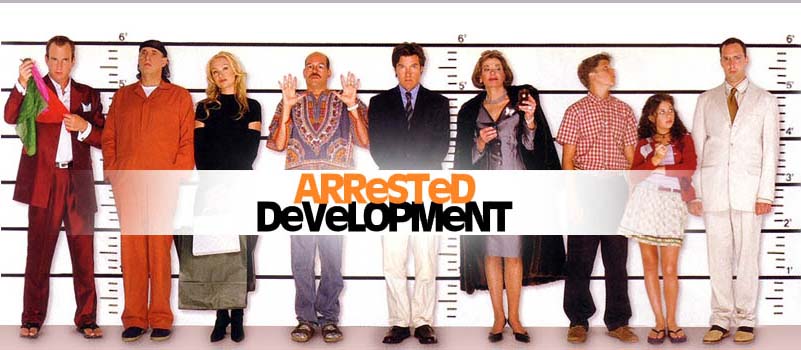
Thoughts on the new season of "Arrested Development"

At long last, I've powered through the debut season of the new Arrested Development. I've been a fan of the show since a year after it went off the air and discovered its wonders from my peers (did somebody say "wonder"?). Now I'm as big a fan as they come, and AD remains one of the greatest comedies of the 2000s. I expected it to be a little different this time around, what with the different format and the longer episodes. I think it's well-suited to the style of AD, with the interwoven narratives that close the knot (and leave some open for another season...which we may in fact have!). It unfolds much like a novel, with unanswered questions that will get you to read the next volume. On a related note, if this format catches on, we could replace the word "season x" with "volume x" like graphic novels.

Old promo image...
Warning, spoilers....

In this season, each episode focuses on a different character, and at this point the Bluths have gone their separate ways, more or less. Not all of the Bluths are in every episode, so you may miss a character from time to time (I did), but then you'll also realize which characters you missed the most. (Mine: George Sr. and Lucille, GOB,  Maeby, George Michael) The episodes are also longer than 22 minutes, which sometimes bogs down the funny in service of the story. So it's a little slower-paced, with some overextended gags and yet a great deal of information packed in...with some intriguing incomplete moments acting as missing pieces of the puzzle, as it unfolds. The season definitely starts to pick up as it goes on, though, and it's most fun the moments those pieces fall into place.

There are some moments that are a little silly, like Lindsay's beau the Ostrich Man (and his farm), Maeby staying in high school a few years longer than when she should have realized it was a fruitless endeavor, and Michael's downward spiral (as of right now) feels a little far-fetched. But there are some classic Bluth moments, and the new format, in which we follow the story of a single character (and where their paths cross) works quite well considering the fact that all the characters are inter-linked and will interact with one another from time to time. But don't worry, you'll laugh: I laughed out loud quite a few times every episode, and will probably laugh more the next time I get around to watching this season.

New promo image

A lot of critics have mentioned how dark it is, and how unlikeable Michael has become in this season. And I wonder, have they not been paying attention? This family is as unlikeable as they come, and haven't been able to mask it well over the course of the original series. It would only be a matter of time before each of them "got theirs". On the one hand, we feel bad for them, because thanks to the brilliant writing and acting, we actually kind of like these characters, even if they're selfish and racist and generally horrible people. They redeem themselves every once in a while. But on the other hand, the Bluths as a whole are horrible, and do horrible things to others for their own gain, each Bluth varying on levels of pitiability and horriblility. And in this season, the more things change, the more the Bluths stay the same--to a degree. I do feel bad for Maeby and George Michael, though, since they didn't ask to be a part of this dysfunctional family.

The idea that Michael would turn out to be a failure when he struck out on his own and then get into the movie business in a meta-arc is a stretch, but not entirely implausible--like a lot of the situations presented in this season. Michael has made many Bluth-worthy mistakes in the past. I found George Michael and Maeby to be the more relatable characters, anyway, though maybe that's because I'm a young'un. But the dark, cringe-worthy comedy is hardly alien to intelligent American viewers, and sure, it's not everyone's cup of tea, but you would think the critics would get that.

Wednesday, May 1, 2013

Labor Day is Today

While I don't normally use my online platform(s) for political purposes--though I am pretty passionate about many politicized issues--this post is in honor of International Workers' Day, also known as Labor Day throughout the world. May Day bears a lot of significance for many movements--namely, the labor and anarchist movement, and I've come to view this day as the "true" Labor Day, not the September U.S. "Labor Day" that is a joke of a holiday. Do we ever discuss workers' rights that weekend? Anyway, now for a short post...

The labor movement has taken a lot of bad hits lately. Proposals to raise the minimum wage, as was recently in New York, are met with intense resistance, as are measures to require paid sick and maternity leave--both of which are claimed to hurt "small business." Attempts to unionize have been promptly quashed and strikes of teachers and service workers can often fizzle. (though the recent fast food strike holds promise) A more recent phenomenon has been the reduction of hours for retail and food service workers so that employers don't have to give them health insurance when the Affordable Care Act kicks in (among other reasons). These reasons alone justify organized labor, though there are plenty more.

Ironically, I found this on a .com
While there are many worthy criticisms of labor unions today, one has to keep in mind that all power needs to be kept in check. That is how the Founding Fathers structured the federal government, so that the three branches would check and balance each other's power to keep them in line (whether that holds true today is another story...). Government alone cannot be counted on to keep corporate power in check--besides all the lobbying and schmoozing, government is not sufficiently opposed to a corporation to be considered a proper check to its power, anyway. What does this leave us? Labor unions, and for the previous few decades, both the government and corporations have been attempting to chip away at the power of labor unions (see: Wal-Mart and Wisconsin) in order to assert their own.

Unions, perhaps, are not the most ideal solution in a world that is increasingly run on the work of service, freelance, and independent contract workers. The volatility of the economy and the increasing necessity to change jobs or even careers has created an environment hostile to the development of strong, stable unions. But the only significant power that unions can have is in numbers. The more people that join unions, the more powerful the unions can be. This is reflected in the history of the United States. "Divided we are weak; united we are strong" never rings so true as in the case of labor.

The dichotomy of "labor" and "management" may become antiquated as an increasing number of people choose to be their own boss (and employee, out of necessity), but there will always be people who have the money and control of production, and those who produce. And us producers always have to keep in mind that together, we can remind management who gets the real work done around here.

Thursday, December 20, 2012

How I became a Whovian

Sadly, over this past month  I have been way too busy to update this blog. (not unless I wanted to lose even more sleep anyway)

But over the hiatus I had also been undergoing a transformation. I am now a follower of the Doctor.
(The BBC's Doctor Who, that is)

Currently I'm catching up on the new series rapidly, just finished series 4--such an epic and emotional ride--and I already know that I will cry when 10 goes.

Oh, for those of you who have no clue about what Doctor Who is: it is a science fiction series that started in 1963, chronicling the adventures of the mysterious Time Lord known only as "The Doctor," and his many companions. The show has gone on for so long in part to the writers' invention of regeneration, allowing for a completely different actor to take over when the current one retires.
Doctor Who is so huge now it won the fan favorites cover!

The effects can be cheesy at times, (and since it's TV, I can forgive it) and there are a lot of last-minute scrapes they get out of that make me go like, "woah, wait a minute, shouldn't you have died?" But I love it all the more for it. Some people also criticize it for its pseudoscientific explanations for everything, but as to that, I agree with Steve Moffatt, the current showrunner, that tales of the Doctor are more of a "dark fairy tale". The Doctor really is more of a mythic figure than anything else. I mean, come on, anything with time travel is basing the science on dubious conjecture at best.

I started off with the new series, as that's what's hot right now. It got off to a shaky start, but a few episodes in, I was reeled in far too deep to escape the captivating, imaginative stories and complex characters that made up this new series. Even with all the work I had to do I'd go on Doctor Who binges, watching several episodes several days in a row, and when I went a day without watching it I wanted so badly to watch it the next day, filling the times in between with thoughtful speculation about the characters and the "who"-niverse. I have not gotten like this about a TV show since... um....

...I don't usually get like this about TV shows. I tend to watch comedies, and they aren't exactly the cliffhanger-y, adventure-type stories.

So, why? I am an adult woman, and this is a "family" show.

I guess it's a family show because the most sex it has in it is thinly veiled innuendo, and the characters don't do more than hold hands or kiss (on-screen, anyway, tee-hee). There is a shit-ton of violence and death, though--which is a whole other thing that's a series of posts worth. But very little blood. In the US, it's hard to say if we would have called this a "family" show. Evangelicals sure wouldn't (violence and blasphemy!).

For starters, I am naturally drawn to stories that are mainly set in the "real world," but have incredible things happen, or incredible things lurking just behind that door. Harry Potter, magic realism and other "low fantasy" stories,  dystopias and other soft science fiction (the future as present, I like to call it), even Sailor Moon and other superhero/magical girl stories kinda fit this description. Doctor Who also includes genre-bending and mind-bending stories. I love those things in my fiction, too. So, really, this is the kind of sci-fi TV I dig, a kind of combination of The X-Files (I enjoyed what little I have seen of that show), Monk, and James Bond with its constant changing of the lead actor (and leading ladies).

These stories tend to be imaginative and compelling. Some of my favorites include "The Empty Child," "The Girl in the Fireplace," "The Satan Pit," "Blink," "The Shakespeare Code," and "Fear Her," not just for the often genre-bending and excellent tension-building, but also the creative storylines and thematic depth that these stories have. It's not always the simple "good vs. evil" storyline, even though the antagonists are most often enemies who must be defeated somehow.

And that brings me to the other thing I love about Doctor Who: the characters. Without interesting characters, your stories are the equivalent of a pop-up book (and a cheap one, at that). And boy, is the Doctor interesting. He's a good guy, but even the good can be conflicted and complicated. Sometimes he has to choose between one person dying and another. Sometimes he chooses to kill when he could otherwise spare their lives. Often he puts his companions in danger--though to be fair, they generally know what they're signing up for. He's an enigmatic, tragic figure, having lost most of his own kind and always losing people he comes to care about. He's emblematic of how a long lifespan is not always so lovely.

Monday, August 27, 2012

Introducing a New Rating Rubric!

Before I post my next review, I'd like to take some time to explain a second dimension with which I will be rating books, movies, and the like. In case you haven't noticed by now, I'm pretty lefty, and I usually take a paragraph or two to point out any problematic content in the story in question. So, why not build upon that and add a handy rating system to gauge the severity of the oppressive content?

As my overall rating is based on five, and we all love multiples of five, this "Oppression Scale" will be based on 10. 1 means little to no oppressive content (which will be few, I'm sure) and a 10 will be OMG RACIST SEXIST CLASSIST HOMOPHOBIC BULLSHIT! Most likely, a "good" book will have a low oppression score, and a "bad" book will have a high oppression score. I predict that many will score around 3-7. Now, this score is obviously entirely subjective, as different people will be bothered by different content to varying degrees. And no, cliche's will not be counted--unless they're racist cliche's.

Let's take an example: The Hunger Games (book). It features a strong female character, a diversity of races (shown in a good light), and is critical of violence and reality TV. However, I don't think Collins goes far enough in portraying the horror of forced violence, and is inconsistent in Katniss's reactions to violence and death. Overall, these are pretty weak criticisms, so I'll rate it a 2. I don't think we need to be too concerned about this book.

As for an example on the other end of the spectrum: Fifty Shades of Grey. There is nothing redeemable about this book. Christian and Ana's relationship is abusive, yet the author tries to make it seem like an ideal romance. And given that so many women seem to think that this is OK, that makes it even worse. I haven't actually read the whole thing myself--I credit Jennfer Armintrout and her wonderful recaps for cluing me in on the details. And since I haven't read the whole thing, I'll just give it a 9: highly oppressive.

So, that's how it works! Look for it in coming reviews!

Tuesday, July 31, 2012

The Long, Winding Road of Unemployment

This blog has been sadly neglected over the past couple months because I am unemployed, and as I recently relocated I have doubled down on the job search. I say "unemployed" because although I am certainly working sporadically in my spare time on occasional freelance projects (and the major writing project I took up a few months ago), it's making a negligible amount of cash, and like I said, I have debts to pay off.


This is Part 2 of my personal problems confessional--though, like in my last post, these problems are certainly not unique to me. Today, I discuss the issues of unemployment.

I have never had a "regular" job: that is, one with not only full-time, regular hours (I've had those), but also a salary, benefits, and a guarantee that you'll be working there for more than a year. Not so surprising for a person my age these days. And at this point, I'm not so sure that I want one. Not with all the trouble the search for one has been causing me.

Source
Many of my friends, at least, have a job--even if it's not in their chosen field. Others don't have all this debt to worry about, so they can live in a city for a couple months looking for work--provided they find something within those months, of course. And some people have it worse than I do. But at what point do I give up my pride and do something that I'd rather not do? After less than three months of my relocation, I am all but prepared to take drastic measures for my situation to change. I am sick of debt, sick of no fun, sick of putting up with my parents' maddening idiosyncrasies. There was a reason why I left in the first place, and I'm already being driven insane.

Oh, I've gotten the interview--twelve times so far this year. And that's not even counting the ones I had since last August. And that's good, I guess. But life has no meaningful buildup, so it tells me nothing, other than the fact that I look good on paper. I have some ideas for Plan B's in the event of a failure to find gainful employment--go abroad, follow through with that startup idea, work with my mom at her dreadful dead-end job--but this will require discarding my debt, either actually or just ignoring it. And that won't be so easy.

Coming across this old article in the New York Times the other day, then, obviously struck a blow close to home for me--and it rings quite false. I want to go places, but I would prefer to not own a car for at least two more years; did the author take into account the fact that many young people live in cities with good public transportation systems? How expensive everything is? And what is so bad about attributing luck as a major factor is success--because it is true! Not to mention that a lot of college grads are riddled with debt--it's quite understandable that we aren't so keen to accumulate more debt when we're so uncertain whether we can pay off what we already have.

Sure, I don't have typical career aspirations, so as long as I don't give up hope that I will make a name for myself. But I'm just so tired of spending so much energy on this, and I want it to end--my last interview  was on Tuesday, and I was thoroughly exhausted for the next two days. I want this to be over. I want things to change, but I have hardly any power to do so. Some days I feel like I'm not doing enough, and other days I feel fine. Fridays are the worst. I'm angry at a lot of people, including myself. I wonder if I shouldn't have relocated, if I should've started looking for internships earlier, if I should've tried harder at networking. I'm tired of waiting. I'm tired. I'm so, so tired.

I can only console myself that it isn't my fault, and just try harder next time. Perhaps this will be over sooner than I think, but if I've learned anything throughout this agonizing search, it's that I can never, ever get my hopes up.

*now that all that's off my chest, we will return to your regularly scheduled programming*

Sunday, June 17, 2012

The Girl Who Owned a City is Pro-Capitalist Propaganda

Recently I read the post-apocalyptic children's novel The Girl Who Owned a City (which is apparently the only book the author, O.T. Nelson, ever wrote). Even though it was an obscure book by a non-author, it's made enough of a splash to have a graphic novel adaptation. And boy howdy, is this book a doozy.

The premise of the situation is that a plague wipes out all people over the age of 12 for some reason, with the children left behind having to fend for themselves. The main character, Lisa, ends up taking charge not just of the household (she has a younger brother to take care of), but also of the entire neighborhood, establishing a "city" in their old school. But not everybody wants to do things her way, much less the violent gangs of kids who prowl the ruined town. One gang forces her out and takes over, so she has to plot how to take back her city.

Some post-apocalyptic scenarios, such as this one, require some suspension of disbelief; so I just set aside the traumatic implications of such an event and marvelled at Lisa's ingenuity and persistence. (of course, there was the other disbelief I had to suspend, which was--if this highly unlikely scenario were to occur, would children really act like this? I know they are more independent than people give them credit for, but still) It's written well enough, and the character of Lisa is a strong and intelligent female character--more of a rarity when it was first published in 1977--though the writing isn't spectacular, even overly simplistic at times.

 But something funny started happening halfway through the novel, and hit me right in the face in the second part. At this point, the decision to build a city in the school had been made. The words "hard work" and "earned" were repeated ad nauseum, Lisa dismissed the concept of sharing, and called the city her property. But it all clicked in a scene when she is arguing with one of her close friends and the doctor-in-training about claiming the city as hers: "Freedom is more important than sharing." That's when I realized what the story was really about.

It's pro-capitalist propaganda.

Perhaps propaganda is a strong word, but that's the only way I can describe it when the minds of the target demographic are so malleable. In any case, it endorses the values espoused by extreme libertarians, which is that selfishness is a virtue and that people should get only what they deserve. That is, rich people deserve to be rich, for they have earned their riches (to say nothing of those who were merely born into wealth), poor people deserve to be poor, and if we give them what they need they won't work to better themselves. These ideas are present in Lisa's reasoning that the city was hers, and that she has to earn her city back (although it is laughably easy), and that Jill has coddled the younger children too much. In this particular context, where of course there is no monetary system and everyone is equalized in every respect but for their ability to "use their heads" as Lisa puts it, some of these values are actually ok: using logical reasoning to sort out problems, material possessions aren't everything, and yes, the value of hard work, though Lisa comes off as inflexible and self-centered when she tells other people about these virtues. But the idea that working hard will reap its own rewards rings false in a highly unequal society. Not to mention that they didn't elect her as their leader, per se. She may be a benevolent leader, but she's still a dictator.

Of course, the dogmatic nature of the story isn't its only problem: the uneven pacing, the gaping holes in believability of both the children's behavior and the scenario, the anti-climatic ending, Lisa's annoyance with Craig for wanting to farm instead of command an army (there's also a pro-military message in this story, as well--she's hell-bent on forming an army before she can return to her city). I can't help but think that her victory was short-lived. Soon enough, the food would run out, and they would have to go to the farms. Then she better hope Craig will want to share his crops! (see, Lisa? Sharing is caring!) What is wrong with all of this is fit for another post.

Of course, the author is free to write a children's book on Objectivist philosophy, just as others are free to promote communist, democratic, and anarchic ideals in their stories (and they certainly have in children's literature). We don't have a problem unless there is only one type of philosophy allowed. But if you're going to write this kind of propaganda, at least tone down the preachiness--and make your stories more compelling. I give this book two out of five stars.

Monday, February 6, 2012

This Post Was Going to Review Memory Wall, But...


The last book I read was a collection of short stories by Anthony Doerr, called Memory Wall. It's six stories, and they're all linked thematically, to an extent. Memories do play a big role in them, for one. I liked the one story of his that I'd read in a writing class, called "For a Long Time this was Griselda's Story." It was a little outlandish (the title character becomes a magician's assistant) and folktale-y, but was presented in a very real way. I spotted this book in the library, and decided to take it out, even though I really shouldn't have. I liked it, especially the stories that featured women prominently (that was actually most of them) ... But I don't really want to sing its praises. Turns out I'm still suffering from the Franzen fatigue that came over me last September...I'm just not in the mood to read that kind of shit anymore. Or review it, really.
Books: By dudes, for dudes since 1700

Doerr isn't as infuriating as Franzen, as he doesn't use tired and annoying plot twists and character tics and doesn't stick to reality 100% of the time. Doerr actually brought some new ideas to the table, like visions of the Afterworld through epileptic seizures, and memories recovered through clunky cartridges and viewable by machine. I almost feel bad that I'm not giving this book a review; it's not really that bad--plenty of other people liked it, too.

Not to steer the conversation towards Franzen, but part of what I don't really like about him is how much everyone sang his praises--and I hardly heard anything about last year's National Book Award winner, a Black woman. I read this article, published in last week's Phoenix, that criticizes the publishing industry, the New York Times, and NPR for gender bias in terms of who they publish and how much publicity they get. As a woman who likes to write fiction that doesn't necessarily adhere to realistic boundaries, much less convention, it's discouraging that someone like me will (still!) have greater difficulties in rightful recognition than a male writer writing about men (hell, aside from the fact that I naturally gravitate toward writing about women, aren't there enough stories about men?) And I am also guilty of reading more books by men than women, though I often prefer books by women, rather than men.

Anyway, I've been feeling this way since I went to a reading last weekend--five men went up to read in a row. Once I realized that no women had went up to read, I didn't stick around to find out if there would be any--the fact that none had gone so far said enough to me. The worst part was that I hadn't even noticed until the fourth man went up to the mic. There is the idea that women are generally more timid, and therefore reluctant to share their work--after two years of workshops with a bunch of other writers, and hearing how hard it is to be published, my confidence was crushed. Though I know I have more than potential. If women do need more encouragement, then we need to do that. These problems pervade not just the literary world, either--it's a problem in all media, to varying degrees. It's sad that we still can't get past the fact that women are just as capable as men at creating art (sometimes even more so) and that their stories and perspectives are just as relevant. I appreciate writers like Doerr who do bring in other perspectives--in addition to elderly women, he writes about other countries, like China and South Africa--we could also bring in people who've actually had these experiences, with less risk of objectifying and exotifying them.

But there's something else in that kind of fiction, aside from the narrow worldview--it's hard for me to put my finger on what it is. I do know how to describe it: BORING. Finally, after four years of indoctrination by literary "experts," I can finally admit that straight-up literary realism bores me to tears! That's why no one reads these books--because they're all about the SAME DAMN THING. I'll take robots, wizards and warlords over a broody middle-aged man any day!

All told, I think I'm done reading this kind of fiction for a while. This is not the kind of fiction I want to write, so why should I waste my time with it?

*note: this post was originally written a week ago (1/29/12) so temporal references are a week off. I'm just feeling too lazy to change it.

Tuesday, November 15, 2011

Announcement

Reader, for several reasons that I will not get into here, I have not had the time or the energy to create material that can thusly be posted here. Maybe if/when things work out I'll be back in business.

However, I am currently updating two tumblr blogs that can always use suggestions and contributors.


If you're on Tumblr, follow me! Maybe I'll follow you in return. :)

Saturday, October 15, 2011

The Peculiar Whimsy of Bender's Lemon Cake

Aimee Bender is another author that caught my interest back in college, when I was first exposed to her work. Her particular style of magic realism, blending in otherworldly concepts with an otherwise straight-up vanilla (literally) realist narrative, stood out amongst a sea of orthodox, straight realism that is acclaimed by the literary elite. As someone who is fond of the strange and fantastical portrayed as everyday life, I snapped up her first story collection, The Girl in the Flammable Skirt, and quite liked it. When I heard last year that she had a new book out, on my reading list it went. Finally, this weekend I got to read it, and though I'm not a fan of the title (I get its significance, but the wording's just awkward), I enjoyed the novel like any other piece of magical prose.

SPOILERS AHEAD

The Particular Sadness of Lemon Cake follows Rose, the narrator, as she grows up, from when she first tastes her mother's feelings in her ninth-birthday cake to young adulthood, where she ends up as a chef trainee. This talent for tasting feelings in food is more of a curse than a blessing, however, prompting her to avoid not just home-cooked meals, but a sense of intimacy with anyone. This turns out to be somewhat hereditary, as Rose learns later: her father and brother are already presented as avoidant in nature--she has few meaningful interactions with either of them until towards the end--her father never sets foot in hospitals, and her brother eventually succeeds in avoiding all human interaction by disappearing, intermittently at first, then later for good. But there's no judgement on Rose's part whether each person's way of dealing with this curse (of sensing others' thoughts and feelings, somehow) is the "right" way. In fact, she seems just content at last to have a special connection to them. Her relationship with her mother, meanwhile, also gets stronger with time after her brother disappears, though there will never be true understanding: her mother, after all, is still hollow inside, and she, too, would rather hide it than have to confront that feeling.

Like in many of her stories, the magic of the world--the existence of a sort of emotional telepathy that can be sensed through any part of the body--fits into the narrative, a key facet of the whimsical and haunting prose. The moment when Rose catches her brother half-disappeared gave me goosebumps, and though it wasn't scary per se, it was reminiscent of the quietly scary moments one may remember from a dream--or from reading Goosebumps. Perspective gets a little muddled at times, with a younger voice permeating the point-of-view of an older Rose.

Though Lemon Cake is sprinkled with several common nuclear-family tropes--the depressed homemaker mother, prodigies, workaholic dad, to name a few--they grow organically into their own characters, suiting better to this somewhat unusual story. I also kind of felt that the characters should just get over it, or at least go to therapy--it amazed me that the subject of therapy never came up. It seemed like a logical step, like, maybe something's wrong with their head? The affair storyline never really goes anywhere, and I wonder how Rose's mother kept it under wraps for over five years.

Sentences are often short and blunt, characteristic of someone who's not wordy and tends to conceal emotions. It also makes it easier reading--reading over 50 percent of the book on a bus and 5 hours of sleep, I could not slog through dense paragraphs of ornate prose. The story was often sad in a way, too, with self-imposed isolationism and her family's insularity preventing them from finding a way out of their unhappiness, and closing them off from getting to know new people. Rose's brother, for example, only made one friend in school, and seemed content to just stick with the one. He didn't disappear until after they were separated after high school. The psychological drama that unfolds as a result of this curse is subtle, interpreted by the reader through Rose's sparse narration. The nonexistence of quote marks echoed the deliberately self-reflective tone of the novel. These feelings are pretty exemplary of the American psyche: focus on yourself, or the bubble that you live inside of. Rose adapts to her own curse by turning it into a talent, letting go of the secret and letting others in. She may never be truly happy, but no one ever is, right?

Once you read through the first chapter, Rose's story will have you disappearing into her world. This is a story I will remember for a while. I give it 4 out of 5 stars.


Sunday, May 15, 2011

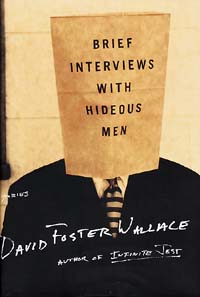
Critical Response Archive: Brief Interviews with Hideous Men

And now finally, just in time for graduation, the final critical response from my postmodernism independent study, featuring one of my all-time fave writers, David Foster Wallace!

***

The subject matter of David Foster Wallace’s short story collection Brief Interviews With Hideous Men is nothing new (relationships between straight men and straight women), nor is the dominating perspective (ostensibly white middle-class men). However, the experimental style of Wallace’s prose breathes new life into tired themes and perspectives, taking postmodernist literature to the next stage in its evolution. As a successor to the likes of Robert Coover, Vladimir Nabokov, and John Barth, David Foster Wallace is a natural heir, building upon such techniques as the non-linear linear tale (several stories are annotated tangentially a la Pale Fire), authorial presence and involvement, meta-fiction, and a dry and detached sense of humor. In some cases Wallace literally extends these postmodernist ideas, with long multi-clause sentences and footnotes, keeping the reader from getting too lost in the story and paying attention to his rather exhausting structure of lengthy-but-spare paragraphs and complete sentences. By synthesizing and building upon the style of the canonical postmodernist writers, Wallace continues their legacy and brings postmodernism to contemporary times.

The most striking thing about Brief Interviews is the non-linearity of the arrangement of the stories, and the interviews of the title story. None of the interviews printed in the book are arranged in a particularly numerical or chronological order, nor are the numbers consecutive. It’s clear that these interviews are the only ones “selected” for publication, since not all of these interviews are featured. These interviews are scattered throughout the text, divided into four parts, fragmenting them. This was definitely intentional, perhaps only for the superficial reason that the particular style of “Brief Interviews” may get tiresome for the reader or because they went on too long. A variant example of this fragmentation is “Octet,” which in fact has only five sections, and the fifth discusses how the eight sections became four among the other facets of the formulation of the story. “Octet” most obviously contains the classic characteristics of postmodernism, referring to itself, explaining itself, describing how its existence as a story came about, disregarding the conventional notions of character and plot altogether. “Adult World (II)” in fact disregards all formal pretense in its structure, reduced to a mere outline of the plot and character developments. Since it’s such a radical change from the preceding story, one might think that Wallace deliberately changed the tone to avoid and flout convention.

Wallace exhibits the detachment from his characters peculiar to postmodernist writers in a new way, writing of them as an unattached observer, with so much focus on detail that people and plot are all but forgotten. He utilizes this technique in “The Depressed Person” (who is referred to as that throughout the story), “Death Is Not the End,” and “Suicide as a Sort of Present.” The observational (though not usually objective) and often scientific language of these and many of the other stories cultivates the humor that pervades within them. In spite of the tragedies many of these characters endure, the reader can laugh due to the absurdly detailed and matter-of-fact voice of the narrator. Of course, the reader feels sorry for these characters, who often come off as victims of their own circumstances or pawns of plot, but in an abstract and distant way. Even the narrators who are an obvious part of the story (as in “Brief Interviews” and “On His Deathbed, Holding Your Hand”) reveal this sort of detachment from the characters they’re interacting with, due in part to their roles as listeners rather than speakers.

Wallace’s satirical and long-winded prose has evolved obviously from the postmodernist writers of the 60s, and his observational narrative style a more modern adaptation of their detachment from their subjects. He took postmodernist literature to new lengths, showing that even a movement that had become old hat could be revitalized and made anew in the face of a new century. After all, literature, like all art forms, always has room to evolve.