As a writer, anyway. I haven't met her in person, so maybe she's not super-awesome. After reading that lug 1Q84 I definitely wanted to follow up with some lighter reading, but with my copies of the Hunger Games trilogy back at my parents' house, and a collection of Lydia Davis short stories on my shelf, I decided to read me some short stories. And a lot of them were short: like, really short. Like, one sentence. So I couldn't really quote them in case I get chased down for reprinting without permission. At least in this particular collection, Varieties of Disturbance.
Aw, fuck it. Here's one of her miniscule gems in its entirety:"Collaboration With a Fly"
"I put that word on the page,
but he added the apostrophe."
The collection contains 57 stories, most of them really, really short. The topics range from the ritual of TV watching, explaining sex to children, caterpillars, babies, and the relationships between friends. Sure, sounds banal, but the stories aren't your typical stories: most of the characters are not named, their focus is somewhat single-minded (on the topic at hand), and there is hardly any scene or dialogue (if any, just one). Some, like the one above, even have line breaks, like poems. Davis certainly blends the two in cool ways: and not just as punchlines.
Some of them go on for several pages, though, resembling more typical stories, though not quite. "We Miss You" is a lengthy "analysis" of letters written in a fourth-grade class sometime in the fifties or sixties, written to a classmate who was in the hospital. The narrator picks apart these grammar-school exercises in formal writing quite thoroughly, noting the specific phrases and instances of complex sentence structure in each of the letters. Another story, which is much longer, "Helen and Vi," is a report of three women who have lived to be quite old--and the third, Hope, who defies the conventional notions of what it takes to stay healthy and live long, is mentioned peripherally.
Some of the stories are so abstract, terse, and just plain short, I question whether Davis even edited some of these stories, and just submitted them after jotting them down thanks to some inspired train of thought. It certainly puts the idea that writers are supposed to slave and suffer over their drafts into question: sure, you can agonize over perfecting a single sentence, but how much agonizing can you do when that's all the story is? Of course, I don't really know if Davis slaved over her writing or not.
The shortness of many of her short stories/prose-poems also enable re-readability: something that busy poeple such as myself do not really have time to waste with. This increased my enjoyment of the stories as I could easily read them again. And on some occasions, I dwelled on a story for much longer than the time it took for me to read it. Whether the short ones are hit-or-miss, they certainly require thinking
about the relationship of the title to the sentence, which is not always
apparent.
Lydia Davis's style is reminiscent of David Foster Wallace, with clever and absurd turns of phrase accompanying the ennui and hopelessness of everyday life, in addition to reality-bending realism. However, Davis is much more abstract and much less concerned about details than Wallace was; in fact, a lot of her stories are quite anti-Wallace, the prose vague and bare and conceptual (rather than meticulously detailed and concrete); thus her stories average only a few pages, while Wallace's go into the double digits. Her stories address storytelling and other meta-narratives in much a similar manner, in much less space; so it made me think why I had never heard of her before? Is it because she writes fiction/prose-poetry and not essays too? Because she wasn't in journalism? Because she's a woman? Of course, Wallace is still one of my favorite authors, but I think Lydia deserves some love too.
The short, terse style of Lydia Davis's stories are the real future of American short fiction, which is currently oversaturated with tedious depictions of everyday life for a specific (often based on a real person) character as they go through a change (usually aging or death). Writers: you've learned what the rules are; if you want to know how to shatter them completely, Lydia Davis is a must-read writer for you.*
A rare 5 out of 5 stars for this one. (Not perfect, but I'm grading on a curve here)
*I am basing this after reading just one collection, so I could be incorrect in saying that Lydia Davis eats nails instead of bran for breakfast, if you know what I mean.
Reviews and Analyses of literature, film, and pop culture. Because critical readers will never be obsolete.
Showing posts with label David Foster Wallace. Show all posts
Monday, April 16, 2012
Wednesday, July 6, 2011
More Posthumous Praise for David Foster Wallace
The other day at work I had the pleasure of proofreading an anthology of essays by contemporary writers, thinkers, and journalists, which featured two essays by the one and only David Foster Wallace. I also just recently finished reading his essay collection A Supposedly Fun Thing I'll Never Do Again. I've written a bit about him before, and I'd like to expand my thoughts to his nonfiction, which bears a lot of similar characteristics to his fiction--albeit less tangential and unorthodoxically structured.
Wallace is one of those writers whom you like more and more as you get more familiar with their particularly peculiar style (like that great guy who's a little rough around the edges, a new bicycle, or prog-rock bands). The first work of his that I read, I liked enough to read more, and after reading three whole books by him (Infinite Jest, Fun Thing, and Interviews), he's become one of my favorite writers. I read Infinite Jest too early to truly enjoy it, as I think I'd like it better now that I'm more accustomed to Wallace's style. Perhaps I will read it, in bits and pieces, again.
But what's much more remarkable about Wallace's writing is his voice. This is most apparent in his essays, as his fiction isn't always third person. The details he gives in both genres are so intricate and yet so strange and striking as to almost be hyperbolic, making the mundane and generally not very interesting (tennis, state fairs, Caribbean cruises, among others) absurd and extraordinary. Wallace's journalistic style is observational and honest to his point of view. He also meanders from topic to topic, though it all underlies the same basic themes of the essay.
One of the numerous praises included in this edition of the book called Wallace, unimaginatively, "smart and funny"...and that really sums up his narrative voice (though the phrase "clever and humorous" better reflects his writing level). Though the more carefully crafted writing voice is not necessarily indicative of an individual's speech abilities, I can imagine that Wallace would be rather a pleasure to converse with--and it makes me all the more sad that I will not be able to meet him, at least in this life (not that I'd ever have the guts to approach an admirable writer at a book signing or whatever).
What's more (and this is what I was originally getting at) is that his writing voice makes him a person who's so--likable. Part of it is the fact that he does not write himself out of the nonfiction story he's telling (very often because he is experiencing the subject), so we get a lot of his perspective. And I found that I could identify with his various thoughts about a given situation, since he reasoned them so well. And I don't agree with Wallace on all things, by all means. He does acknowledge his privileges and shortcomings (though he doesn't feel entirely good about it), and he's nonjudgmental. Wallace occasionally ribs on a strikingly funny character of a person, and certainly expresses pity for and admits an inability to identify with ordinary folks, but does not accuse anyone of anything. Rather, he almost admires these ordinary people who end up in his essays, as he himself feels like a dysfunctional member of society. Though perhaps they could stand to be a bit more thoughtful (not in a condescending way, though).
It's impossible for me to say whether his writing style was indicative of his true self--one would think that such thoughtful prose would only come from the heart of the writer, as it often is. And from some of the posthumous articles I've read about him, it seems as though it does ring true. There's enough to say about David Foster Wallace to make up an entire dissertation (if someone hasn't already, I'm sure they're on it now that his oeuvre is complete), but for the sake of brevity, I'll stop here. If unusual, funny, and absurdist fiction or nonfiction floats your boat, check out his writing!
But what's much more remarkable about Wallace's writing is his voice. This is most apparent in his essays, as his fiction isn't always third person. The details he gives in both genres are so intricate and yet so strange and striking as to almost be hyperbolic, making the mundane and generally not very interesting (tennis, state fairs, Caribbean cruises, among others) absurd and extraordinary. Wallace's journalistic style is observational and honest to his point of view. He also meanders from topic to topic, though it all underlies the same basic themes of the essay.
One of the numerous praises included in this edition of the book called Wallace, unimaginatively, "smart and funny"...and that really sums up his narrative voice (though the phrase "clever and humorous" better reflects his writing level). Though the more carefully crafted writing voice is not necessarily indicative of an individual's speech abilities, I can imagine that Wallace would be rather a pleasure to converse with--and it makes me all the more sad that I will not be able to meet him, at least in this life (not that I'd ever have the guts to approach an admirable writer at a book signing or whatever).
What's more (and this is what I was originally getting at) is that his writing voice makes him a person who's so--likable. Part of it is the fact that he does not write himself out of the nonfiction story he's telling (very often because he is experiencing the subject), so we get a lot of his perspective. And I found that I could identify with his various thoughts about a given situation, since he reasoned them so well. And I don't agree with Wallace on all things, by all means. He does acknowledge his privileges and shortcomings (though he doesn't feel entirely good about it), and he's nonjudgmental. Wallace occasionally ribs on a strikingly funny character of a person, and certainly expresses pity for and admits an inability to identify with ordinary folks, but does not accuse anyone of anything. Rather, he almost admires these ordinary people who end up in his essays, as he himself feels like a dysfunctional member of society. Though perhaps they could stand to be a bit more thoughtful (not in a condescending way, though).
It's impossible for me to say whether his writing style was indicative of his true self--one would think that such thoughtful prose would only come from the heart of the writer, as it often is. And from some of the posthumous articles I've read about him, it seems as though it does ring true. There's enough to say about David Foster Wallace to make up an entire dissertation (if someone hasn't already, I'm sure they're on it now that his oeuvre is complete), but for the sake of brevity, I'll stop here. If unusual, funny, and absurdist fiction or nonfiction floats your boat, check out his writing!
Labels:
David Foster Wallace,
essays,
literature,
nonfiction,
random thoughts
Sunday, May 15, 2011
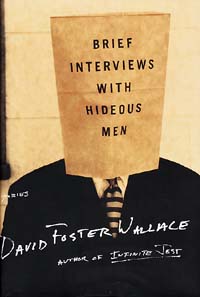
Critical Response Archive: Brief Interviews with Hideous Men
And now finally, just in time for graduation, the final critical response from my postmodernism independent study, featuring one of my all-time fave writers, David Foster Wallace!
***
The subject matter of David Foster Wallace’s short story collection Brief Interviews With Hideous Men is nothing new (relationships between straight men and straight women), nor is the dominating perspective (ostensibly white middle-class men). However, the experimental style of Wallace’s prose breathes new life into tired themes and perspectives, taking postmodernist literature to the next stage in its evolution. As a successor to the likes of Robert Coover, Vladimir Nabokov, and John Barth, David Foster Wallace is a natural heir, building upon such techniques as the non-linear linear tale (several stories are annotated tangentially a la Pale Fire), authorial presence and involvement, meta-fiction, and a dry and detached sense of humor. In some cases Wallace literally extends these postmodernist ideas, with long multi-clause sentences and footnotes, keeping the reader from getting too lost in the story and paying attention to his rather exhausting structure of lengthy-but-spare paragraphs and complete sentences. By synthesizing and building upon the style of the canonical postmodernist writers, Wallace continues their legacy and brings postmodernism to contemporary times.
The most striking thing about Brief Interviews is the non-linearity of the arrangement of the stories, and the interviews of the title story. None of the interviews printed in the book are arranged in a particularly numerical or chronological order, nor are the numbers consecutive. It’s clear that these interviews are the only ones “selected” for publication, since not all of these interviews are featured. These interviews are scattered throughout the text, divided into four parts, fragmenting them. This was definitely intentional, perhaps only for the superficial reason that the particular style of “Brief Interviews” may get tiresome for the reader or because they went on too long. A variant example of this fragmentation is “Octet,” which in fact has only five sections, and the fifth discusses how the eight sections became four among the other facets of the formulation of the story. “Octet” most obviously contains the classic characteristics of postmodernism, referring to itself, explaining itself, describing how its existence as a story came about, disregarding the conventional notions of character and plot altogether. “Adult World (II)” in fact disregards all formal pretense in its structure, reduced to a mere outline of the plot and character developments. Since it’s such a radical change from the preceding story, one might think that Wallace deliberately changed the tone to avoid and flout convention.
Wallace exhibits the detachment from his characters peculiar to postmodernist writers in a new way, writing of them as an unattached observer, with so much focus on detail that people and plot are all but forgotten. He utilizes this technique in “The Depressed Person” (who is referred to as that throughout the story), “Death Is Not the End,” and “Suicide as a Sort of Present.” The observational (though not usually objective) and often scientific language of these and many of the other stories cultivates the humor that pervades within them. In spite of the tragedies many of these characters endure, the reader can laugh due to the absurdly detailed and matter-of-fact voice of the narrator. Of course, the reader feels sorry for these characters, who often come off as victims of their own circumstances or pawns of plot, but in an abstract and distant way. Even the narrators who are an obvious part of the story (as in “Brief Interviews” and “On His Deathbed, Holding Your Hand”) reveal this sort of detachment from the characters they’re interacting with, due in part to their roles as listeners rather than speakers.
Wallace’s satirical and long-winded prose has evolved obviously from the postmodernist writers of the 60s, and his observational narrative style a more modern adaptation of their detachment from their subjects. He took postmodernist literature to new lengths, showing that even a movement that had become old hat could be revitalized and made anew in the face of a new century. After all, literature, like all art forms, always has room to evolve.
***
The most striking thing about Brief Interviews is the non-linearity of the arrangement of the stories, and the interviews of the title story. None of the interviews printed in the book are arranged in a particularly numerical or chronological order, nor are the numbers consecutive. It’s clear that these interviews are the only ones “selected” for publication, since not all of these interviews are featured. These interviews are scattered throughout the text, divided into four parts, fragmenting them. This was definitely intentional, perhaps only for the superficial reason that the particular style of “Brief Interviews” may get tiresome for the reader or because they went on too long. A variant example of this fragmentation is “Octet,” which in fact has only five sections, and the fifth discusses how the eight sections became four among the other facets of the formulation of the story. “Octet” most obviously contains the classic characteristics of postmodernism, referring to itself, explaining itself, describing how its existence as a story came about, disregarding the conventional notions of character and plot altogether. “Adult World (II)” in fact disregards all formal pretense in its structure, reduced to a mere outline of the plot and character developments. Since it’s such a radical change from the preceding story, one might think that Wallace deliberately changed the tone to avoid and flout convention.
Wallace exhibits the detachment from his characters peculiar to postmodernist writers in a new way, writing of them as an unattached observer, with so much focus on detail that people and plot are all but forgotten. He utilizes this technique in “The Depressed Person” (who is referred to as that throughout the story), “Death Is Not the End,” and “Suicide as a Sort of Present.” The observational (though not usually objective) and often scientific language of these and many of the other stories cultivates the humor that pervades within them. In spite of the tragedies many of these characters endure, the reader can laugh due to the absurdly detailed and matter-of-fact voice of the narrator. Of course, the reader feels sorry for these characters, who often come off as victims of their own circumstances or pawns of plot, but in an abstract and distant way. Even the narrators who are an obvious part of the story (as in “Brief Interviews” and “On His Deathbed, Holding Your Hand”) reveal this sort of detachment from the characters they’re interacting with, due in part to their roles as listeners rather than speakers.
Wallace’s satirical and long-winded prose has evolved obviously from the postmodernist writers of the 60s, and his observational narrative style a more modern adaptation of their detachment from their subjects. He took postmodernist literature to new lengths, showing that even a movement that had become old hat could be revitalized and made anew in the face of a new century. After all, literature, like all art forms, always has room to evolve.
Labels:
criticism,
David Foster Wallace,
fiction,
literature,
postmodernism
Subscribe to:
Posts (Atom)