Showing posts with label postmodernism. Show all posts

Thursday, September 25, 2014

We're back, for now; Calvino's Cosmicomics

I'm back! For the time being. Another site is in the works, as I plan on moving to a place with much more aesthetically pleasing free themes. News of that will soon follow...

I first heard about Italo Calvino's Cosmicomics in a New Yorker podcast. Some author read one of his stories and I was intrigued. When I saw an English language copy of the collection in a bookstore in Copenhagen (read it before NPR, bitchez!) a year later, I decided to buy it and check it out. It is quite an imaginative collection, with setting in all stages of the universe expertly composed and translated, many of which were delightfully meta and fantastic.

However timeless they may feel, or the subject matter is, it was very difficult to forget the time in which these stories were written, and the perspective of learned Italian men such as Calvino. Calvino famously believed that there was nothing more to do with traditional realism, thus he turned to other sources of inspiration. He may have been right, in terms of the Western white male perspective, that is. Women and other minorities have plenty to add to the traditional realism canon. This just goes to show Calvino's limited point of view, even as he writes stories with seemingly unlimited possibilities.

This most often took shape with a heteronormative male/female dichotomy, even when the characters aren't human!  I suppose this makes sense given that the characters are also anthropomorphized, and as this was originally written in the highly gendered language of Italian, such a dichotomy
is inevitable, but it became so lazy and tiresome after a while. Calvino could have been even more imaginative in this regard by refraining from using anthropomorphized or even gendered language at all. After all, not all species on Earth, let alone all the possible species that exist in the universe, have two sexes. 

I realize these stories tend to have a mythical feel, where the same shit often went on, but it was too often the story of a presumed male character in pursuit of a female character. Though the settings and ideas put forth were drastically different, the plot would be the same. It got on my nerves at times, that the female was always the pursued and preferred things the way they were before (which somehow imparted some wisdom on the male character) and hardly ever the one to take action herself. In some instances, one could argue that Qwfwq is an unreliable narrator, or that it's not been the same incarnation of Qwfwq, per se (this would explain why no other names recur). At the very least, we can't take his opinions of other characters' motivations at face value.

One that particularly stood out to me in a bad way was "The Soft Moon," an otherwise excellent story providing an alternative history of how the earth and moon came to be. There is another female character who is calm and expectant even as the world around them crumbles, and we flash forward to what the world looks like circa the 1970s, and right up until the last line of the story I'm there. But that last line... Qwfwq better be an unreliable narrator, bitter from a bad breakup, because the last line creates a caricature that completely flies in the face of Sylvia's character up until then. It made me so mad I stopped reading for a few days, because I would like to hear someone justify the reason for that line.

Most of the other stories I wasn't jazzed about didn't have such offensive lines of prose as that one did, but it started to become the same story over and over. At least in "Night Driver," the weak love pursuit premise dissolves into a pure thought experiment, devoid of any traditional trappings of story at all. The last few additions to the collections, like "Nothing and Not Much" and "Implosion," exist in the grander universe and bring up some though-provoking concepts while giving us settings and character forms I had never come across before. The stories really do improve, in my view, over time, when they're not so fixated on one-sided amorousness.

But there are instances where I find it difficult to excuse such blatantly male-centered storytelling in stories that don't even necessitate gender. It just ain't my thing. Hence I'm not a big fan of the first collection or the first part of "Time and the Hunter." Once I got into "Priscilla", the stories became more varied and interesting, relying less on the pursuit of woman plot. I much preferred "Spirals" to "The Spiral" - they were pretty much the same story but the former was more conceptually developed and experimental while the latter relied on the desire trope that I just got tired of.

This is not to say that I didn't enjoy the collection; I enjoyed the "Priscilla" trilogy and the new stories from "World Memory," among others. Many were the kind of heady, out-of-this-world stories that I like from that era. But whenever a so-called love story became apparent, I just thought, "Here we go again." As always, the presumed male character was the actor, the driving force in these stories, whereas the female characters did not so much at all, except settle down with another male character. 

So overall, not a bad collection of stories. I more highly recommend the latter parts of "Time and the Hunter" and the later stories, as opposed to the original "Cosmicomics." They're all very imaginative and full of wonder but if you're a feminist you might get annoyed, so don't read them all at once. It remains that these otherwise visionary tales fall short due to Calvino's patriarchal and heteronormative views, which certainly took away from my ability to fully enjoy this collection. I give it just three stars for not being imaginative enough.

Thursday, May 31, 2012

"Community" and Absurdity

This week, let's talk TV. Specifically, one of my current favorite shows--and one of the few that I still watch on network television--COMMUNITY!

Community wrapped up its third season this month, with much fanfare.  From the mid-season hiatus to the feud between Chevy Chase and the creator Dan Harmon, to the essential firing of Harmon by Sony from his own brainchild, the show's seen a whirlwind year so far. While the fate of the show remains up in the air, with a shortened fourth season and new showrunners, we'll focus on the Community that exists right now--which in spite of all its flaws, I love. (I'll reserve judgement on the upcoming season when it airs; Community is much more than just one person now.)

Community, for those of you who don't know, centers around a ragtag group of misfits that somehow became a study group during their first week at the fictional and outrageous Greendale Community College. While the story initially revolves around Jeff Winger, the charming but egoistic former lawyer back in school only to earn a "legitimate" degree, the show eventually branches out to explore narratives around the other characters: Britta, a left-leaning high school dropout; Annie, a neurotic overachiever; Troy, a former high school football star; Abed, a probably-autistic pop-culture encyclopedia; Shirley, born-again Christian, mother, and aspiring businesswoman; and Pierce, the crotchety old coot and scapegoat of the group. This past season was the first season I've followed since the premiere (I didn't get into it until about halfway through the second season), and as much as some fans have complained about it being too out-there this season, this season has contained some of the best, most memorable episodes of the series.

For example, "Remedial Chaos Theory," in which we explore the different scenarios that would result from a roll of the dice, and "Digital Estate Planning," which is almost entirely presented in 8-bit animation as the gang plays a video game Pierce's late father designed to determine the distribution of his estate, accomplish feats of wackiness and character development rarely seen on your average sitcom (looking at you, Two and a Half Men). Not to mention the multiple paintball wars, a pillow-vs-blanket-fort battle, and an entire episode surrounding Dungeons and Dragons. But you know what these episodes have in common?

They're, quite simply, absurd.

Absurd in a good way. In the best way. Not like the absurd inconsistencies that run rampant in long-running sitcoms, such as leafy green trees in Pennsylvania (or Wisconsin, or New York, etc) in January, or the situations that are just plain silly (i.e. "jumping the shark"), or the central characters dating exclusively within their group of friends. Not to mention the ridiculously canned laughter in multi-camera sitcoms that gets a little annoying (especially in this age of single-camera comedy and snappier dialogue).

Deliberately absurd, stretching reality in myriad ways. Presenting it, in fact, in multiple dimensions, showing, through exaggeration, how the different characters are viewing a situation--or, possibly, what can happen if the characters take an already outrageous premise to extreme heights. For example, in the episode, "Virtual Systems Analysis", Annie almost literally (or at least that's how we see it) steps into Abed's mind through the Dreamatorium--Abed and Troy's Danger Room of imaginative play. We learn a little bit more about Annie and Abed's sensibilities, they learn from each other, and it still doesn't stray too far from the hyper-realism of the sitcoms from which the show draws inspiration.

There's a nostalgic aspect to this absurdity, as well: a lot of the situations are reminiscent of older children's TV shows--that is, ones geared towards a tween/teen audience--which often present frustrating but obvious villains, outrageous adventures, and a focus on friendship. (that last point is the most salient) Ones that come to mind are Drake and Josh, Ned's Declassified, Even Stevens... even Saved By the Bell. I don't mean this as an insult at all. Perhaps it's just because it takes place at a school, unlike most adult-oriented comedies.

In fact, as a fan of a lot of (not recent) children-centric TV, I love the ridiculousness that often goes on. These shows are naturally absurd, as reality is presented in a more kid-friendly point of view: and to kids, even older ones, just about anything is possible. Of course, they often suffer from the just-world fallacy and more often than not promote positive values whilst featuring good-natured (if buffoonish) kids.  But it's like these shows, except inverting the just world and goody-two-shoes principles (making it more Seinfeldian and Arrested Development-esque), appealing to adult misfit sensibilities, and much more self-aware. So I think much of the absurdity, as well as the diversity, in Community uncovers not just good comedy, but also the idea that there is no one single perception (or reception) of reality.

Consider, for one, that more than half of the students in the group are non-traditional (at over 21), so they already have had "non-traditional" life experience. And unlike most shows, only four of the seven core characters are white, and only two characters are Christian. As a result, the core characters of Community are shown to be complex, flawed human beings with their own troperiffic quirks. I can't help but like them and want to see more of their adventures, because Community really is just like life in that way--which is, as Forrest Gump puts it, like a box of chocolates--you never know what you're gonna get.

And most of the time, it is delicious.

*If you want to get into one new comedy this summer, make it Community! Also watch it this fall!* (end fan plug)

Monday, April 16, 2012

Lydia Davis is Awesome

As a writer, anyway. I haven't met her in person, so maybe she's not super-awesome. After reading that lug 1Q84 I definitely wanted to follow up with some lighter reading, but with my copies of the Hunger Games trilogy back at my parents' house, and a collection of Lydia Davis short stories on my shelf, I decided to read me some short stories. And a lot of them were short: like, really short. Like, one sentence. So I couldn't really quote them in case I get chased down for reprinting without permission. At least in this  particular collection, Varieties of Disturbance.

Aw, fuck it. Here's one of her miniscule gems in its entirety:"Collaboration With a Fly"

"I put that word on the page,
but he added the apostrophe."

The collection contains 57 stories, most of them really, really short. The topics range from the ritual of TV watching, explaining sex to children, caterpillars, babies, and the relationships between friends. Sure, sounds banal, but the stories aren't your typical stories: most of the characters are not named, their focus is somewhat single-minded (on the topic at hand), and there is hardly any scene or dialogue (if any, just one).  Some, like the one above, even have line breaks, like poems. Davis certainly blends the two in cool ways: and not just as punchlines.

Some of them go on for several pages, though, resembling more typical stories, though not quite. "We Miss You" is a lengthy "analysis" of letters written in a fourth-grade class sometime in the fifties or sixties, written to a classmate who was in the hospital. The narrator picks apart these grammar-school exercises in formal writing quite thoroughly, noting the specific phrases and instances of complex sentence structure in each of the letters. Another story, which is much longer, "Helen and Vi," is a report of three women who have lived to be quite old--and the third, Hope, who defies the conventional notions of what it takes to stay healthy and live long, is mentioned peripherally.

Some of the stories are so abstract, terse, and just plain short, I question whether Davis even edited some of these stories, and just submitted them after jotting them down thanks to some inspired train of thought. It certainly puts the idea that writers are supposed to slave and suffer over their drafts into question: sure, you can agonize over perfecting a single sentence, but how much agonizing can you do when that's all the story is? Of course, I don't really know if Davis slaved over her writing or not.

The shortness of many of her short stories/prose-poems also enable re-readability: something that busy poeple such as myself do not really have time to waste with. This increased my enjoyment of the stories as I could easily read them again. And on some occasions, I dwelled on a story for much longer than the time it took for me to read it. Whether the short ones are hit-or-miss, they certainly require thinking about the relationship of the title to the sentence, which is not always apparent.

Lydia Davis's style is reminiscent of David Foster Wallace, with clever and absurd turns of phrase accompanying the ennui and hopelessness of everyday life, in addition to reality-bending realism. However, Davis is much more abstract and much less concerned about details than Wallace was; in fact, a lot of her stories are quite anti-Wallace, the prose vague and bare and conceptual (rather than meticulously detailed and concrete); thus her stories average only a few pages, while Wallace's go into the double digits. Her stories address storytelling and other meta-narratives in much a similar manner, in much less space; so it made me think why I had never heard of her before? Is it because she writes fiction/prose-poetry and not essays too? Because she wasn't in journalism? Because she's a woman? Of course, Wallace is still one of my favorite authors, but I think Lydia deserves some love too.

The short, terse style of Lydia Davis's stories are the real future of American short fiction, which is currently oversaturated with tedious depictions of everyday life for a specific (often based on a real person) character as they go through a change (usually aging or death). Writers: you've learned what the rules are; if you want to know how to shatter them completely, Lydia Davis is a must-read writer for you.*

A rare 5 out of 5 stars for this one. (Not perfect, but I'm grading on a curve here)

*I am basing this after reading just one collection, so I could be incorrect in saying that Lydia Davis eats nails instead of bran for breakfast, if you know what I mean.

Sunday, May 15, 2011

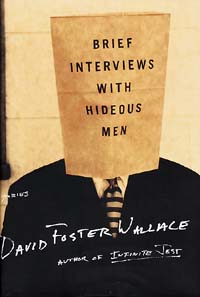
Critical Response Archive: Brief Interviews with Hideous Men

And now finally, just in time for graduation, the final critical response from my postmodernism independent study, featuring one of my all-time fave writers, David Foster Wallace!

***

The subject matter of David Foster Wallace’s short story collection Brief Interviews With Hideous Men is nothing new (relationships between straight men and straight women), nor is the dominating perspective (ostensibly white middle-class men). However, the experimental style of Wallace’s prose breathes new life into tired themes and perspectives, taking postmodernist literature to the next stage in its evolution. As a successor to the likes of Robert Coover, Vladimir Nabokov, and John Barth, David Foster Wallace is a natural heir, building upon such techniques as the non-linear linear tale (several stories are annotated tangentially a la Pale Fire), authorial presence and involvement, meta-fiction, and a dry and detached sense of humor. In some cases Wallace literally extends these postmodernist ideas, with long multi-clause sentences and footnotes, keeping the reader from getting too lost in the story and paying attention to his rather exhausting structure of lengthy-but-spare paragraphs and complete sentences. By synthesizing and building upon the style of the canonical postmodernist writers, Wallace continues their legacy and brings postmodernism to contemporary times.

The most striking thing about Brief Interviews is the non-linearity of the arrangement of the stories, and the interviews of the title story. None of the interviews printed in the book are arranged in a particularly numerical or chronological order, nor are the numbers consecutive. It’s clear that these interviews are the only ones “selected” for publication, since not all of these interviews are featured. These interviews are scattered throughout the text, divided into four parts, fragmenting them. This was definitely intentional, perhaps only for the superficial reason that the particular style of “Brief Interviews” may get tiresome for the reader or because they went on too long. A variant example of this fragmentation is “Octet,” which in fact has only five sections, and the fifth discusses how the eight sections became four among the other facets of the formulation of the story. “Octet” most obviously contains the classic characteristics of postmodernism, referring to itself, explaining itself, describing how its existence as a story came about, disregarding the conventional notions of character and plot altogether. “Adult World (II)” in fact disregards all formal pretense in its structure, reduced to a mere outline of the plot and character developments. Since it’s such a radical change from the preceding story, one might think that Wallace deliberately changed the tone to avoid and flout convention.

Wallace exhibits the detachment from his characters peculiar to postmodernist writers in a new way, writing of them as an unattached observer, with so much focus on detail that people and plot are all but forgotten. He utilizes this technique in “The Depressed Person” (who is referred to as that throughout the story), “Death Is Not the End,” and “Suicide as a Sort of Present.” The observational (though not usually objective) and often scientific language of these and many of the other stories cultivates the humor that pervades within them. In spite of the tragedies many of these characters endure, the reader can laugh due to the absurdly detailed and matter-of-fact voice of the narrator. Of course, the reader feels sorry for these characters, who often come off as victims of their own circumstances or pawns of plot, but in an abstract and distant way. Even the narrators who are an obvious part of the story (as in “Brief Interviews” and “On His Deathbed, Holding Your Hand”) reveal this sort of detachment from the characters they’re interacting with, due in part to their roles as listeners rather than speakers.

Wallace’s satirical and long-winded prose has evolved obviously from the postmodernist writers of the 60s, and his observational narrative style a more modern adaptation of their detachment from their subjects. He took postmodernist literature to new lengths, showing that even a movement that had become old hat could be revitalized and made anew in the face of a new century. After all, literature, like all art forms, always has room to evolve.

Tuesday, May 10, 2011

Critical Response Archive: Oranges Are Not the Only Fruit

As more experimental literature entered the literary world, the question of what could be classified as “postmodern” had to be asked when examining these texts. While a novel could be experimental, it did not necessarily make it postmodernist. Jeanette Winterson’s novel Oranges Are Not the Only Fruit is one of those novels that some would consider to not belong in the post-modern canon, for though she does some rule-breaking and experimenting that include stories-within-stories and unreal moments in the novel, it’s not so radically deviant from convention like the works of John Barth, William Burroughs, and Donald Barthelme. Yet one could argue that Oranges is postmodern, just in a different way from those canonical authors—after all, postmodernism is a flexible movement.

The most obvious element of experimentation, and the nature of its post-modernism, is the fact that much of the novel could very well be directly lifted from events that happened in her real life, and are nakedly so. Like Winterson, the narrator’s first name is Jeanette, she was adopted by Pentecostal evangelists, trained to become a minister, and she is a lesbian, among other autobiographical similarities. One begins to wonder how much truth lies behind the story—it could all be true, or it could be false; the reader doesn’t know enough about Winterson to draw any conclusions. Since it was published as a novel, one must accept it as fiction, with some facts and a grain of truth behind it. This is quite a contrast to the traditional memoir, which one reads expecting all the events that take place to have actually happened, when they might be exaggerated or even untrue.

And though the novel is basically a straightforward bildungsroman about her coming out and her relationship with her mother (framed within her coming out), there are some peculiarities about the prose—not just her unique writing style—that set it apart from typical autobiographical novels. For one, there are abrupt transitions from one scene to the next, big moments are interrupted tangentially, and in between we have lengthy metaphorical or direct real-world commentaries—an entire chapter, “Deuteronomy”, follows this vein. Images of such things as oranges and demons that would only appear in a carefully constructed reality constantly pop up, instead of being camouflaged in realism, glaringly symbolic of Jeanette’s conflicted identity. One character that pops up only in times of distress is her orange demon, and though this pebble that he gives her exists in the real world, the reader wonders if the demon is real or a hallucination—after all, nobody else could see him. It calls into question the realism of visions: as Jeanette was raised to believe in such visions, she believed the demon was real, even if it was never there at all. Winterson makes no argument that these visions are inconsequential: after all, the fictional Jeanette is compelled by her demon to leave home and stay true to herself.

Winterson also plays with perspective: though the story is obviously told from an adult Jeanette, descriptions of observations and beliefs she held in childhood reflect the point of view of a precocious child, or else a childlike adult—otherwise a person who does not understand the conventions and traditions of the world she grew up in. The reader witnesses her perception of the world develop and change, just as she does from childhood to adulthood. Her particular point of view as a lesbian could be a part of its uniqueness, as that perspective is hardly given a spotlight in serious literature.

In Oranges, Winterson blurs the line between fiction and memoir, fantasy and reality. One could classify her novel as a “fictitious memoir,” since Jeanette’s personal history parallels her namesake’s, though the various details may be exaggerated or fabricated. While Winterson does not deviate from convention to critique fiction, she does critique the memoir, showing that every person’s life story is just that—a story, shaped by his or her perception of the world—though this does not take away from the significance or uniqueness of that story. So in a way, her first novel could be classified as postmodern.

Wednesday, April 27, 2011

Critical Response Archive: Family Ties

Clarice Lispector stretches the idea of what is “realistic” in her short story collection Family Ties. The stories in Family Ties are intimately realistic, even if they do not adhere to strict realism. The reader really gets inside the heads of the main characters, while not learning of her every thought, hope, or fear. Her prose is detailed to the minutest degree; we get the feelings of some characters as they stand or throw a fit, as in “Preciousness.” Even in “The Chicken,” we are with the chicken, viewing the world at her level, though cognitively processing it above her level of thinking. It allows one to observe them while actually being with them as the action unfolds. Which isn’t much.

Most of the stories are defined by a single event: for Laura, it is when she receives a bouquet if roses in “The Imitation of the Rose,” for the chicken, it is when she makes a break to escape her fate; for the woman in “The Buffalo,” it is when she meets the buffalo while wandering aimlessly at the zoo. Not much happens outside of the characters’ heads, but so much happens inside of them that we still get to know the characters one way or another. Lispector’s stories must be carefully read, and separately, so that one can process the psychological and existential crises occurring in the everyday lives of her characters, and consider their motives. In this way she is creating distinctly feminist prose.

Most of her characters are women who feel alone or oppressed in one way or another, and in painting their sadly ordinary lives, Lispector creates characters and situations that are not only uniquely female, but also human. The humanity of women was and still is often negated from artistic expression in the Western world, women’s roles being relegated to the background or as archetypal representations or love interests. Literary critics outside the feminist circle have not even labeled Family Ties as feminist, even while such stories as “The Chicken,” “The Interpretation of the Rose,” and “Preciousness” make some pretty obvious critiques of perceptions of female beauty and maturity, the confines of the home, and the general oppression of women by the patriarchy. This could in fact a good thing, however, as it shows that she is worthy of being shelved next to the likes of Borges, instead of being slapped with a specialized label that would detach her work from canonical texts. Her stories, after all, rival the artistic innovation of many of her male contemporaries.

Thursday, April 21, 2011

Critical Response Archive: The Aleph

Before postmodern literature gained momentum in the sixties, there were several writers here and there who flouted even the conventions of modernism, the forerunners of the stylistic and conventional trends to come. Jorge Luis Borges’ story collection The Aleph is an example of the prototypical postmodern literature, combining intellectual and philosophical mind-games with artistic skill and innovation. His short stories question the nature of reality and truth, and reveal the nuances of human consciousness.

One of the most notable aspects that ties all these stories together is authorial presence: Borges himself is often called by name, and the main narrator often remains outside of the action, while another character tells the main story, as it occurs in “Ibn Hakkan al-Bokhari, Dead in his Labyrinth” and “Rosendo’s Tale.” Even in the stories where the narrator is present, even among the main action, he can be identified as Borges, which the author gives away in the commentary at the end of the book, revealing the names of characters based on people he had really known. In “The Aleph,” the narrator does go by the name of Borges. This blurs the line between reality and fiction even in the real world, though most presume that no such things as Alephs exist.

By presenting fantastic events such as universe-viewing, time travel, and legendary weapons in a frank manner, often told from the person who had witnessed the event, Borges takes on three things at once: the denial and revelation of science-defying phenomena by human beings, the flaws in human perception, and the gullibility of memory. In many of his stories, all three are at work: in “The Aleph,” Borges first accepts that he had indeed witnessed it, but later came to question whether it was an aleph, or if he had seen one at all; in “The Other Death,” the men whom the narrator speaks to remember a cowardly Damian, then can’t remember him at all, then remember him as a war hero who died in battle—all due to a possible fluctuation of the time-space continuum as the past was somehow changed, possibly. Above all, Borges tells his fiction like nonfiction, eyewitness accounts of newsworthy events (even if the news media would not have heard of it); and this creates the feel of a true story, or a legend…it may be true, but it probably isn’t. This creates a certain illusory realism within the tone and content of his work.

Friday, March 4, 2011

Critical Response Archive: Wide Sargasso Sea


Some postmodernist literature make a new spin on an old story, telling it from a new perspective, one that was likely ignored or marginalized in the original tale. In Wide Sargasso Sea, Jean Rhys shows the perspective of the character that was most marginalized in Charlotte Bronte’s Jane Eyre: Bertha Mason, the mad wife of Mr. Rochester. In Jane Eyre, Bertha was presented as a monster: dark, unkempt, and insidiously jealous of Jane. Jean Rhys humanizes the woman who was described as a beast, looking through her eyes, showing her hopes and her fears, and revealing her inner torment that led her to despairing madness. Through this portrayal, Rhys even questions the perception of “madness” and how it had come about. The fragmented structure of the story, in which bare snippets of various moments in her life are described, reflects the consciousness of the narrator, who for the most part is Bertha—though in Rhys’ story her real name is her middle name, Antoinette. However, Wide Sargasso Sea is not a retelling of Jane Eyre—hardly any of the characters or events in the novel are present, excepting Mr. Rochester and Antoinette—but a new story altogether, showing the progression of Antoinette’s mental breakdown.

Wide Sargasso Sea is hardly a conventional tale: two perspectives are shown, neither of which tell the complete story, and the timing of the events that take place are vague, blurring the separation between past and present. As a more modern novel than the story that inspired it, Wide Sargasso Sea stands more as a critique of colonial mores and a challenge to the reverence of old but certainly not unprejudiced works. Rhys clearly means no disrespect towards the original material: after all, Jane Eyre was the inspiration behind the whole novel; but she does bring to light the racism present in the story’s characters, as Mr. Rochester (who is unnamed in the novel) views the blackness of his wife as ugliness. But even Bertha holds some racist beliefs towards her black fellows, and she is impulsive to a fault, so Rhys does not paint her as a perfect innocent in light of the events that brought tragedy to her life. Rhys also sheds light on the aspects of Mr. Rochester’s personality that must have made some readers of Jane Eyre (such as myself) pause and wonder, “What does Jane see in him?” such as his temper and destructive selfishness. Though once again, even more inexplicably, we see Bertha falling dangerously in love with him. The reader knows the story won’t end well for Antoinette, but one can’t help but hope with Christophine, Antoinette’s caretaker since childhood, that she’ll wake up and escape her fate.

Jean Rhys does not tell the whole story leaving some interpretation up to the reader, such as whether Antoinette was really mad, or whether the madness was induced by the distress she experienced while she was with Mr. Rochester. With this fragmented narrative, Rhys suggests that the reader may take both Antoinette and Mr. Rochester’s stories, both full of regret and despair, with a grain of salt. She has presented two sides to the story to tell a more complete tale, while reminding us who has the power and privilege, and who is at a disadvantage.

Friday, February 25, 2011

Critical Response Archive: Lost in the Funhouse

Most of the stories in John Barth’s Lost in the Funhouse add an entirely new dimension to storytelling, removing both reader and author from the action while simultaneously placing them right in the midst of the storytelling process. For instance, the first story, “Frame Tale,” a Möbius strip of sorts, presents a recurring theme in the series (as Barth calls the book in the Author’s Note), that there is in fact no end. Another theme that links the stories together is the exposure of the actual construction of the story, with few trappings of illusion.


In the Author’s Note given at the opening of the book, he lists the different ways in which the various stories can be enjoyed, not just in print, but also in live and recorded voice. Several of the stories recommended for audio recordings, such as “Glossolalia” and “Echo” have a strong narrative voice that recalls the oral traditions of myths and folk tales: an element that is also present in Robert Coover’s work. But while the stories of Lost in the Funhouse contain a lot of the marks of postmodern work that I’ve come to identify as such, all address the process of telling of the story. Barth removes himself from it by inserting a version of himself (the “author”) into the story, using the same characters for several stories, and revisits the same story—recollecting the Iliad—twice, with two different perspectives: one from one of the epic’s major players, and the other on a lowly minstrel attempting to tell a version of the tale. Even the more “traditional” stories in the series, like “Ambrose His Mark” and “Water-Message,” have some unconventional traits that can classify them as postmodern: in addition to a possible connection between the stories, as the same names for the same characters and a similar setting are set up, both blur the distinction between true and untrue (either exaggerated or fantasized) events taking place in the story.

Each story also begins and ends by addressing itself, or whatever the narrator is speaking of, echoing the initial Mobius strip story in the beginning. Even in third person, the narrator, i.e. the “author”—or perhaps Barth himself—is a strong presence in the story, never invisible, as in traditional fiction. “Lost in the Funhouse” most prominently features these qualities, as Barth steps out of the narrative to examine narrative structure, wax philosophic, and create a fantasy within the narrative. Like a funhouse, the stories weave in and out from existing purely within the reality constructed in that story, to acknowledging and analyzing its construction, or else the construction of a reality within that reality. “Menelaiad” presents this concept visually, with quotations within quotations, as the narrator tells a story about telling a story about telling a story recalling possibly exaggerated actions of his past adventures. Similarly, “Life-Story” is a multi-layered narrative in which a writer is trying to tell the story of a writer who feels like he is but a character in a story and writing a story about a writer who feels like he is but a character in a story, etc., though one can get lost within the multiple dimensions of the narrative. The title Lost in the Funhouse applies not just to the short story that bears the name, but also the entire series, with their labyrinthine and multilayered structure.

Friday, February 18, 2011

Critical Response Archive: Breakfast Of Champions


Breakfast of Champions, Vonnegut’s first novel after a lengthy slump following one of his more famous novels, Slaughterhouse Five, definitely comes off as somewhat scatterbrained, yet it is more cohesive than some other novels I have read, like Naked Lunch. Breakfast of Champions blends all of the elements of postmodernism together, combining the critique of highbrow literary criticism and tangential self-indulgence of Pale Fire’s narrative and narrator with the obscene absurdity of Naked Lunch, meanwhile adding social commentary, philosophical musings, and self-self-referencing to the postmodern mix. The result is a marriage of highbrow and lowbrow culture, a trademark of many of the postmodern novels that followed. And once again the depressing prose is spiced with satire, easing the pain of swallowing the determinist analysis on our doomed reality. Upon further research behind the writing of Breakfast of Champions, I found that Kilgore Trout and other characters in the novel also appear in Vonnegut’s other novels. I wish now to read some of Vonnegut’s other work in my own spare time so that I can see how Breakfast of Champions fits into his multiverse.

Vonnegut has also blurred the concept of reality within the story, though with references to himself and the real world, he seems to be questioning the reality of our own world, in which he and the reader exist, as well. Vonnegut doesn’t just critique the nature of a story and its construction, but also the construction of the reality in which we live. Reality in Breakfast of Champions is distorted twofold, since Vonnegut wrote the story as an author of his own creation. His “author” presents and makes observations of the world around him (which rather closely resembles our own) in ways that the intended audience had probably never thought of before, like viewing the European explorers as “sea pirates.” Every now and then there are points at which the “author,” Philboyd Stodge, admits to taking some elements of his own life and putting them into the novel, and it’s clear from the preface (and knowing of Vonnegut’s creative process in writing this novel) that parts of Vonnegut’s own life and self are a part of the novel, as well.

Breakfast of Champions, while befuddling and thought-provoking in its own right, is more accessible than the lofty prose of Pale Fire, the disconnectedness of Naked Lunch, and the experimentalism of Pricksongs and Descants. Though this is the only Vonnegut that I’ve read, I think I can gather that he was one of the first mass-postmodern writers, who—while he did include themes that were relevant to avid readers and writers—he also spoke to the “common” reader. He questions both the nature of literature and reality itself.

Friday, January 14, 2011

Critical Response Archive: Pricksongs and Descants

Reading Robert Coover’s Pricksongs and Descants was like going through a primer in postmodernism, as each of the stories showcased an aspect of what had become associated with postmodern literature. There were stories that gave old ones a spin, stories that called attention to their existence as stories, boundaries between what is real and imagined blurred, pop cultural phenomena twisted into grotesque acts of human malice, and the notion of unilateral space-time cast into the wind. Each story in Pricksongs and Descants challenged the notion of what constitutes a short story and the conventional structure of such. Some broke conventions with much success, while others fell far short, or else distracted me with the problematic representation of the female characters.

I most enjoyed the style of the stories “Morris In Chains,” “Seven Exemplary Fictions,” and “The Gingerbread House,” which broke the rules in interesting and delightfully bizarre ways. In “Gingerbread House” and “J’s Marriage”, old stories are told from another character’s perspective (though “Gingerbread House” stays rather true to old-fashioned storytelling form), making them new and original. In “Panel Game,” a game show becomes a grotesque act showcasing humiliation and the basest and selfish instincts of human nature, eerily predicting the inception of “reality” television thirty years early. In fact, many of Coover’s stories present a distorted and/or monstrous version of reality, revealing the darkness of humanity. “A Pedestrian Accident,” “The Wayfarer,” and “The Leper’s Helix” are others that have this theme up front-and-center.

Other stories, I did not enjoy so much. “The Magic Poker” jumped from one reality to another much too quickly and abruptly to my taste, and the stories in “The Sentient Lens,” static and disconnected, though the language was quite intricate and beautiful. “Quenby and Ola, Swede and Carl” was the least innovative and interesting, the only story that actually bored me halfway through. The women in these stories (and a few others) were reduced mainly to their bodies, described very sensually by the onlooking narrator (whether they were a part of the action or not), but their own thoughts and motivations were withheld from the reader. Many of the female characters also experience either sex, death, or both, real or imagined, further reducing them to objects and literary devices. This did not hold entirely true to the male characters. And that is what is most bothersome about it. So, while much of Coover’s fiction was progressive for the time, his portrayal of women definitely was not.

One thing that I had not come across in any other fiction thus far was the helpless victimhood of many of the characters. In stories like “A Pedestrian Accident,” “Morris In Chains,” “Panel Game,” and “The Marker,” we learn very little about the main characters themselves, but are compelled to sympathize with them. They were mere pawns of theme and plot, somehow knowing they were trapped and could do nothing, but uncertain why. The storyteller thus becomes a cruel and sadistic god, putting his creations through humiliation and torture for the benefit of the narrative. This device brings the motivations and purpose of fiction to the foreground, placing all literary traditions in the background. It’s a cool concept that works in the aforementioned “Panel Game” and “A Pedestrian Accident,” not so much in “The Marker.” While his work is not perfectly progressive, Coover certainly proved himself to be one of the great spearheaders of the postmodern movement early in his career with these stories.

Friday, January 7, 2011

Critical Response Archive: Naked Lunch

Naked Lunch is one of those novels that may or may not withstand the test of time. Though it is one of the most acclaimed and influential novels of the last century, it did not have a very great impact on me personally. It’s described as “satire,” but I found it less humorous and more absurd. The vulgarity for me was also too much, and I found many of the depictions of homosexuals and foreigners to be problematic. It could be a matter of personal taste, but I did not find much that was so groundbreaking at the time. Certainly there was plenty of obscenity, but Kerouac and Ginsberg got there first. Such obscenity is so prominent in today’s culture that one can doubt if Naked Lunch has as much of an impact now as it did then.

What I did find interesting were the strange worlds that the narrator found himself in. However, I found it frustrating that I couldn’t really ground myself in any specific type of world. I chalk this up to the structure of the novel, which doesn’t really tell an overarching story, but several little stories loosely strung together with a character whose identity is multifaceted and unknown. One couldn’t know who was the narrator in sections that utilized the third person, and the nature of the narrator’s reality is constantly called into question, as he is always fucked up on some drug and hardly a reliable source about the reality of the world surrounding him. Cool images were conjured up by the artful language, but they were fleeting, lost in the murky waters of confusion. The proliferation of slang and made-up words also made the narratives difficult to follow, and one can definitely make an accurate guess about its age even without knowing about the Beat generation. However, Naked Lunch succeeded in constructing the consciousness of a drug junkie: a consciousness most of us are unfamiliar and uncomfortable with. For this, I commend Burroughs and his prose.

Thursday, December 23, 2010

Critical Response Archive: Pale Fire

Structurally, Pale Fire is a rather unique novel, masquerading as a non-fictional text surrounding an original poem. Posing as another kind of written work isn’t so unusual in the postmodern canon, but Vladimir Nabokov was one of the first, making Pale Fire an original and unique masterpiece. And because the novel is written as if it were nonfiction, the truthfulness of the narrator, who we know is merely a character, is already called into question. It draws attention to the fact that it is fiction, with made up place-names like Zembla and famous poets like John Shade. Whether the places and characters are modeled after anything or anyone in real life is anyone’s guess, and theories abound.

But what is most striking about Pale Fire is the unreliability and unlikeability of the narrator, who is so deluded as to think he could get a poet he admired to write a poem about him. And as one reads on, she questions the motivations and identity of the narrator, whose façade as a humble Zemblan professor quickly erodes in the last hundred pages. He seems almost eager to divulge his true identity towards the end. The ultimate doubts come towards the very end, when the narrator, Charles Kinbote, adds an anecdote about how he might make a play about two men with delusions of being a prince and his assassin, when that was the underlying plot of Kinbote’s tangent. The setup of the poet’s death itself is rather fishy, and given the evidence towards his creepy stalker-ish tendencies and eccentricities, I can’t help but wonder if perhaps Kinbote had been plotting his hero’s death the entire time, since the assassin’s incompetence was too painfully obvious. But just so he could get his hands on a poem? Pale Fire leaves us with many more questions than answers.

Pale Fire tells us a very important message: that you can’t always trust the word of the narrator, whether it’s non-fictional or not, especially if you’re given reasons to doubt him. I paid more attention to the text in order to detect inconsistencies or linguistic slips of the tongue in the narrative that could hint at the “truth” behind the “author” ’s words. And since Nabokov is twice removed from the text instead of once, his own motives and identity are even more disguised. Yet it can also be a very enjoyable read: Kinbote’s voice was very droll and entertaining, even if his tangents proved frustrating for me at first. I found myself laughing both at him and with him, reading more to find out what exactly his game was, as opposed to uncovering any plot twists (though they are certainly there). As one of the quintessential postmodern novels, Pale Fire is a good example of the boundaries that are pushed and questions raised when conventions are not just thwarted, but either cast into the wind or put to satire.