Showing posts with label meta. Show all posts

Thursday, September 25, 2014

We're back, for now; Calvino's Cosmicomics

I'm back! For the time being. Another site is in the works, as I plan on moving to a place with much more aesthetically pleasing free themes. News of that will soon follow...

I first heard about Italo Calvino's Cosmicomics in a New Yorker podcast. Some author read one of his stories and I was intrigued. When I saw an English language copy of the collection in a bookstore in Copenhagen (read it before NPR, bitchez!) a year later, I decided to buy it and check it out. It is quite an imaginative collection, with setting in all stages of the universe expertly composed and translated, many of which were delightfully meta and fantastic.

However timeless they may feel, or the subject matter is, it was very difficult to forget the time in which these stories were written, and the perspective of learned Italian men such as Calvino. Calvino famously believed that there was nothing more to do with traditional realism, thus he turned to other sources of inspiration. He may have been right, in terms of the Western white male perspective, that is. Women and other minorities have plenty to add to the traditional realism canon. This just goes to show Calvino's limited point of view, even as he writes stories with seemingly unlimited possibilities.

This most often took shape with a heteronormative male/female dichotomy, even when the characters aren't human!  I suppose this makes sense given that the characters are also anthropomorphized, and as this was originally written in the highly gendered language of Italian, such a dichotomy
is inevitable, but it became so lazy and tiresome after a while. Calvino could have been even more imaginative in this regard by refraining from using anthropomorphized or even gendered language at all. After all, not all species on Earth, let alone all the possible species that exist in the universe, have two sexes. 

I realize these stories tend to have a mythical feel, where the same shit often went on, but it was too often the story of a presumed male character in pursuit of a female character. Though the settings and ideas put forth were drastically different, the plot would be the same. It got on my nerves at times, that the female was always the pursued and preferred things the way they were before (which somehow imparted some wisdom on the male character) and hardly ever the one to take action herself. In some instances, one could argue that Qwfwq is an unreliable narrator, or that it's not been the same incarnation of Qwfwq, per se (this would explain why no other names recur). At the very least, we can't take his opinions of other characters' motivations at face value.

One that particularly stood out to me in a bad way was "The Soft Moon," an otherwise excellent story providing an alternative history of how the earth and moon came to be. There is another female character who is calm and expectant even as the world around them crumbles, and we flash forward to what the world looks like circa the 1970s, and right up until the last line of the story I'm there. But that last line... Qwfwq better be an unreliable narrator, bitter from a bad breakup, because the last line creates a caricature that completely flies in the face of Sylvia's character up until then. It made me so mad I stopped reading for a few days, because I would like to hear someone justify the reason for that line.

Most of the other stories I wasn't jazzed about didn't have such offensive lines of prose as that one did, but it started to become the same story over and over. At least in "Night Driver," the weak love pursuit premise dissolves into a pure thought experiment, devoid of any traditional trappings of story at all. The last few additions to the collections, like "Nothing and Not Much" and "Implosion," exist in the grander universe and bring up some though-provoking concepts while giving us settings and character forms I had never come across before. The stories really do improve, in my view, over time, when they're not so fixated on one-sided amorousness.

But there are instances where I find it difficult to excuse such blatantly male-centered storytelling in stories that don't even necessitate gender. It just ain't my thing. Hence I'm not a big fan of the first collection or the first part of "Time and the Hunter." Once I got into "Priscilla", the stories became more varied and interesting, relying less on the pursuit of woman plot. I much preferred "Spirals" to "The Spiral" - they were pretty much the same story but the former was more conceptually developed and experimental while the latter relied on the desire trope that I just got tired of.

This is not to say that I didn't enjoy the collection; I enjoyed the "Priscilla" trilogy and the new stories from "World Memory," among others. Many were the kind of heady, out-of-this-world stories that I like from that era. But whenever a so-called love story became apparent, I just thought, "Here we go again." As always, the presumed male character was the actor, the driving force in these stories, whereas the female characters did not so much at all, except settle down with another male character. 

So overall, not a bad collection of stories. I more highly recommend the latter parts of "Time and the Hunter" and the later stories, as opposed to the original "Cosmicomics." They're all very imaginative and full of wonder but if you're a feminist you might get annoyed, so don't read them all at once. It remains that these otherwise visionary tales fall short due to Calvino's patriarchal and heteronormative views, which certainly took away from my ability to fully enjoy this collection. I give it just three stars for not being imaginative enough.

Monday, June 3, 2013

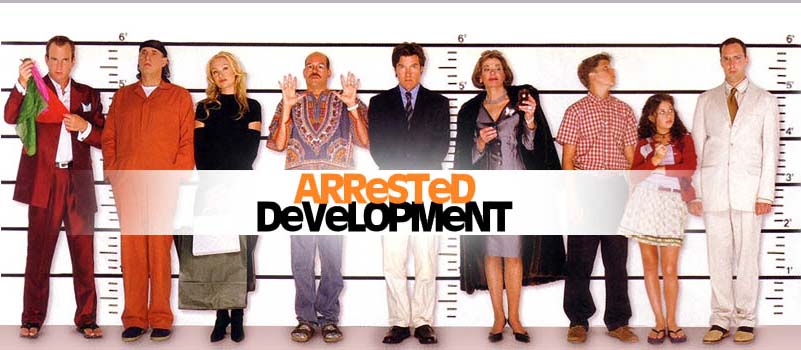
Thoughts on the new season of "Arrested Development"

At long last, I've powered through the debut season of the new Arrested Development. I've been a fan of the show since a year after it went off the air and discovered its wonders from my peers (did somebody say "wonder"?). Now I'm as big a fan as they come, and AD remains one of the greatest comedies of the 2000s. I expected it to be a little different this time around, what with the different format and the longer episodes. I think it's well-suited to the style of AD, with the interwoven narratives that close the knot (and leave some open for another season...which we may in fact have!). It unfolds much like a novel, with unanswered questions that will get you to read the next volume. On a related note, if this format catches on, we could replace the word "season x" with "volume x" like graphic novels.

Old promo image...
Warning, spoilers....

In this season, each episode focuses on a different character, and at this point the Bluths have gone their separate ways, more or less. Not all of the Bluths are in every episode, so you may miss a character from time to time (I did), but then you'll also realize which characters you missed the most. (Mine: George Sr. and Lucille, GOB,  Maeby, George Michael) The episodes are also longer than 22 minutes, which sometimes bogs down the funny in service of the story. So it's a little slower-paced, with some overextended gags and yet a great deal of information packed in...with some intriguing incomplete moments acting as missing pieces of the puzzle, as it unfolds. The season definitely starts to pick up as it goes on, though, and it's most fun the moments those pieces fall into place.

There are some moments that are a little silly, like Lindsay's beau the Ostrich Man (and his farm), Maeby staying in high school a few years longer than when she should have realized it was a fruitless endeavor, and Michael's downward spiral (as of right now) feels a little far-fetched. But there are some classic Bluth moments, and the new format, in which we follow the story of a single character (and where their paths cross) works quite well considering the fact that all the characters are inter-linked and will interact with one another from time to time. But don't worry, you'll laugh: I laughed out loud quite a few times every episode, and will probably laugh more the next time I get around to watching this season.

New promo image

A lot of critics have mentioned how dark it is, and how unlikeable Michael has become in this season. And I wonder, have they not been paying attention? This family is as unlikeable as they come, and haven't been able to mask it well over the course of the original series. It would only be a matter of time before each of them "got theirs". On the one hand, we feel bad for them, because thanks to the brilliant writing and acting, we actually kind of like these characters, even if they're selfish and racist and generally horrible people. They redeem themselves every once in a while. But on the other hand, the Bluths as a whole are horrible, and do horrible things to others for their own gain, each Bluth varying on levels of pitiability and horriblility. And in this season, the more things change, the more the Bluths stay the same--to a degree. I do feel bad for Maeby and George Michael, though, since they didn't ask to be a part of this dysfunctional family.

The idea that Michael would turn out to be a failure when he struck out on his own and then get into the movie business in a meta-arc is a stretch, but not entirely implausible--like a lot of the situations presented in this season. Michael has made many Bluth-worthy mistakes in the past. I found George Michael and Maeby to be the more relatable characters, anyway, though maybe that's because I'm a young'un. But the dark, cringe-worthy comedy is hardly alien to intelligent American viewers, and sure, it's not everyone's cup of tea, but you would think the critics would get that.

Thursday, May 31, 2012

"Community" and Absurdity

This week, let's talk TV. Specifically, one of my current favorite shows--and one of the few that I still watch on network television--COMMUNITY!

Community wrapped up its third season this month, with much fanfare.  From the mid-season hiatus to the feud between Chevy Chase and the creator Dan Harmon, to the essential firing of Harmon by Sony from his own brainchild, the show's seen a whirlwind year so far. While the fate of the show remains up in the air, with a shortened fourth season and new showrunners, we'll focus on the Community that exists right now--which in spite of all its flaws, I love. (I'll reserve judgement on the upcoming season when it airs; Community is much more than just one person now.)

Community, for those of you who don't know, centers around a ragtag group of misfits that somehow became a study group during their first week at the fictional and outrageous Greendale Community College. While the story initially revolves around Jeff Winger, the charming but egoistic former lawyer back in school only to earn a "legitimate" degree, the show eventually branches out to explore narratives around the other characters: Britta, a left-leaning high school dropout; Annie, a neurotic overachiever; Troy, a former high school football star; Abed, a probably-autistic pop-culture encyclopedia; Shirley, born-again Christian, mother, and aspiring businesswoman; and Pierce, the crotchety old coot and scapegoat of the group. This past season was the first season I've followed since the premiere (I didn't get into it until about halfway through the second season), and as much as some fans have complained about it being too out-there this season, this season has contained some of the best, most memorable episodes of the series.

For example, "Remedial Chaos Theory," in which we explore the different scenarios that would result from a roll of the dice, and "Digital Estate Planning," which is almost entirely presented in 8-bit animation as the gang plays a video game Pierce's late father designed to determine the distribution of his estate, accomplish feats of wackiness and character development rarely seen on your average sitcom (looking at you, Two and a Half Men). Not to mention the multiple paintball wars, a pillow-vs-blanket-fort battle, and an entire episode surrounding Dungeons and Dragons. But you know what these episodes have in common?

They're, quite simply, absurd.

Absurd in a good way. In the best way. Not like the absurd inconsistencies that run rampant in long-running sitcoms, such as leafy green trees in Pennsylvania (or Wisconsin, or New York, etc) in January, or the situations that are just plain silly (i.e. "jumping the shark"), or the central characters dating exclusively within their group of friends. Not to mention the ridiculously canned laughter in multi-camera sitcoms that gets a little annoying (especially in this age of single-camera comedy and snappier dialogue).

Deliberately absurd, stretching reality in myriad ways. Presenting it, in fact, in multiple dimensions, showing, through exaggeration, how the different characters are viewing a situation--or, possibly, what can happen if the characters take an already outrageous premise to extreme heights. For example, in the episode, "Virtual Systems Analysis", Annie almost literally (or at least that's how we see it) steps into Abed's mind through the Dreamatorium--Abed and Troy's Danger Room of imaginative play. We learn a little bit more about Annie and Abed's sensibilities, they learn from each other, and it still doesn't stray too far from the hyper-realism of the sitcoms from which the show draws inspiration.

There's a nostalgic aspect to this absurdity, as well: a lot of the situations are reminiscent of older children's TV shows--that is, ones geared towards a tween/teen audience--which often present frustrating but obvious villains, outrageous adventures, and a focus on friendship. (that last point is the most salient) Ones that come to mind are Drake and Josh, Ned's Declassified, Even Stevens... even Saved By the Bell. I don't mean this as an insult at all. Perhaps it's just because it takes place at a school, unlike most adult-oriented comedies.

In fact, as a fan of a lot of (not recent) children-centric TV, I love the ridiculousness that often goes on. These shows are naturally absurd, as reality is presented in a more kid-friendly point of view: and to kids, even older ones, just about anything is possible. Of course, they often suffer from the just-world fallacy and more often than not promote positive values whilst featuring good-natured (if buffoonish) kids.  But it's like these shows, except inverting the just world and goody-two-shoes principles (making it more Seinfeldian and Arrested Development-esque), appealing to adult misfit sensibilities, and much more self-aware. So I think much of the absurdity, as well as the diversity, in Community uncovers not just good comedy, but also the idea that there is no one single perception (or reception) of reality.

Consider, for one, that more than half of the students in the group are non-traditional (at over 21), so they already have had "non-traditional" life experience. And unlike most shows, only four of the seven core characters are white, and only two characters are Christian. As a result, the core characters of Community are shown to be complex, flawed human beings with their own troperiffic quirks. I can't help but like them and want to see more of their adventures, because Community really is just like life in that way--which is, as Forrest Gump puts it, like a box of chocolates--you never know what you're gonna get.

And most of the time, it is delicious.

*If you want to get into one new comedy this summer, make it Community! Also watch it this fall!* (end fan plug)

Monday, April 16, 2012

Lydia Davis is Awesome

As a writer, anyway. I haven't met her in person, so maybe she's not super-awesome. After reading that lug 1Q84 I definitely wanted to follow up with some lighter reading, but with my copies of the Hunger Games trilogy back at my parents' house, and a collection of Lydia Davis short stories on my shelf, I decided to read me some short stories. And a lot of them were short: like, really short. Like, one sentence. So I couldn't really quote them in case I get chased down for reprinting without permission. At least in this  particular collection, Varieties of Disturbance.

Aw, fuck it. Here's one of her miniscule gems in its entirety:"Collaboration With a Fly"

"I put that word on the page,
but he added the apostrophe."

The collection contains 57 stories, most of them really, really short. The topics range from the ritual of TV watching, explaining sex to children, caterpillars, babies, and the relationships between friends. Sure, sounds banal, but the stories aren't your typical stories: most of the characters are not named, their focus is somewhat single-minded (on the topic at hand), and there is hardly any scene or dialogue (if any, just one).  Some, like the one above, even have line breaks, like poems. Davis certainly blends the two in cool ways: and not just as punchlines.

Some of them go on for several pages, though, resembling more typical stories, though not quite. "We Miss You" is a lengthy "analysis" of letters written in a fourth-grade class sometime in the fifties or sixties, written to a classmate who was in the hospital. The narrator picks apart these grammar-school exercises in formal writing quite thoroughly, noting the specific phrases and instances of complex sentence structure in each of the letters. Another story, which is much longer, "Helen and Vi," is a report of three women who have lived to be quite old--and the third, Hope, who defies the conventional notions of what it takes to stay healthy and live long, is mentioned peripherally.

Some of the stories are so abstract, terse, and just plain short, I question whether Davis even edited some of these stories, and just submitted them after jotting them down thanks to some inspired train of thought. It certainly puts the idea that writers are supposed to slave and suffer over their drafts into question: sure, you can agonize over perfecting a single sentence, but how much agonizing can you do when that's all the story is? Of course, I don't really know if Davis slaved over her writing or not.

The shortness of many of her short stories/prose-poems also enable re-readability: something that busy poeple such as myself do not really have time to waste with. This increased my enjoyment of the stories as I could easily read them again. And on some occasions, I dwelled on a story for much longer than the time it took for me to read it. Whether the short ones are hit-or-miss, they certainly require thinking about the relationship of the title to the sentence, which is not always apparent.

Lydia Davis's style is reminiscent of David Foster Wallace, with clever and absurd turns of phrase accompanying the ennui and hopelessness of everyday life, in addition to reality-bending realism. However, Davis is much more abstract and much less concerned about details than Wallace was; in fact, a lot of her stories are quite anti-Wallace, the prose vague and bare and conceptual (rather than meticulously detailed and concrete); thus her stories average only a few pages, while Wallace's go into the double digits. Her stories address storytelling and other meta-narratives in much a similar manner, in much less space; so it made me think why I had never heard of her before? Is it because she writes fiction/prose-poetry and not essays too? Because she wasn't in journalism? Because she's a woman? Of course, Wallace is still one of my favorite authors, but I think Lydia deserves some love too.

The short, terse style of Lydia Davis's stories are the real future of American short fiction, which is currently oversaturated with tedious depictions of everyday life for a specific (often based on a real person) character as they go through a change (usually aging or death). Writers: you've learned what the rules are; if you want to know how to shatter them completely, Lydia Davis is a must-read writer for you.*

A rare 5 out of 5 stars for this one. (Not perfect, but I'm grading on a curve here)

*I am basing this after reading just one collection, so I could be incorrect in saying that Lydia Davis eats nails instead of bran for breakfast, if you know what I mean.

Saturday, March 31, 2012

1Q84

Slowly but surely, after a month of steady reading, I finished Haruki Murakami's  giant turtle of a novel. It's actually an amazing read--something that I've often found in a lot of long novels, oddly enough. Though the plot swells slowly with every progressive chapter, each page is rich with sensory details and intrigue that pulls me in further to the world with Tengo and Aomame, our two protagonists.

The basic plot of the novel follows the experiences of our protagonists as they enter this alternate version of 1984, and how their journey through this world (dubbed the title by Aomame) brings these two together. Both are drawn into the world unwittingly, and learn of the apparent secrets that few ever come to know: magical "Little People" that are neither good nor evil, two moons hang in the sky, and people who aren't real. It's difficult to explain the intricacies without giving too much away (admittedly, learning as you go along is a part of the fun--and let's face it, a 900+ page novel does not have much re-readability to begin with) but gradually we're drawn from the real world and into this strange magical one--but it's hardly a happy place. Tones of authoritarianism permeate the religion of the Little People, and Tengo and Aomame's most deeply held secrets are found out by complete strangers. People die horribly.

The greatest thing about 1Q84 is how the prose pulls you in so deep you end each chapter gasping for breath. Murakami presents a story so rich in detail, the long slog is more of a scenic route, as with every page we uncover an enticing bit of information about a character or how 1Q84 works as its own world. Each character conceals a fascinating history, full of "aha!" moments where the reader can make connections between the two storylines. The primary challenge of a long novel is keeping the reader interested, and Murakami has no problem with that.

But we don't learn all the answers to all the questions that arise as a result of our visit to this world. This doesn't bother me too much, however. It's fitting that we pretty much know only what Tengo and Aomame know. In fact, the novel ends with the possibility of a sequel, leaving enough unexplored material for another installment. While the point of conclusion may have been somewhat arbitrary (it wouldn't be 1Q84 forever) the novel's long enough that Murakami could have simply decided to stop there. And the ending, while it was great that Aomame and Tengo could finally be together, felt underwhelming. Fo so long we were teased that something major was going to happen--and while Tengo and Aomame finally meeting and escaping from 1Q84 was pretty major, I was expecting something a little more... bombastic? Like the ending of Janacek's "Sinfonietta," which is referenced frequently throughout the novel. Kind of like how in Revolutionary Girl Utena they keep on talking about an impending revolution, but it never happens (though the climax is quite exciting, if confusing because that anime is just one big allegory).  So it really just led to the couple meeting? That's what disappointed me the most.

A few other little things bothered me throughout the novel, though they were quite minor. Well ok, the mystical pregnancy thing put me off at first (and this is why we need a sequel--does the kid have any special powers or what?); that's pretty major. Mainly Murakami's fixation with boobs (and the female body in general) definitely annoyed me; and it was always the women who were objectified--even Aomame, a straight lady, would comment on how nice another lady's boobs were. But it didn't surprise me. There was also a lot of repetition in the beginning--not just to how small or nice a lady characer's boobs were: Tengo's "older girlfriend",  the fact that Tamaru is gay, and Ushikawa is ugly, among other details repeated ad nauseum. This stops mostly in the third part, and I suppose it's helpful to remind readers of important facts in a long story when there's a lot to keep track of, but it was a bit too much. Oh, and the phrase "from the bottom of my heart" popped up in the last three chapters at least twice as many times, appearing nowhere before then (and I HATE HATE HATE that saying! Like, it doesn't even make any sense! If you care so much why do you keep it at the bottom???) though I'll chalk it up to translation goofs, since there's no way the original text literally translates to that super-cliche saying.

But overall, it's an enthralling story. The characters are infinitely interesting, the alternate world intriguing, the love story cute and squee-worthy, the details that tie these together fascinating to find. I would suggest lovers of literature that is immersive, suspenseful, and a little bit weird to take the time to read it--and go slowly. 1Q84 is a lovely place to wander. 4 stars out of 5.