For once, I am being culturally relevant, and discussing the hit novel by Veronica Roth, which is also a movie coming out this weekend, Divergent. I have friends who have enjoyed this book, but for a long time I've been apprehensive. The premise sounded a lot like Hunger Games lite, and I'm loath to waste my time with posers and pretenders. But the good reviews and intriguing movie trailer compelled me to pick up the book and give it a read. And I put the book down, having read the whole thing, confused. I'm not sure if I liked it or if I didn't. And I sure came up with a lot of questions--the bad kind of questions, the ones that poke holes in razor-thin plots and deflate the story like a bloated balloon.
A quick run-down of the plot: the time comes the main character, Beatrice, a.k.a. Tris, to take the faction aptitude test to see if she should stay in her own faction or switch to another. Her results reveal that she is Divergent: uncategorizable, and somehow dangerous. After giving it some thought, she decides to switch to the Dauntless faction and goes through a grueling initiation process, all the while uncovering a plot to overthrow society as she knows it.
The story of Divergent has a lot in common with the Hunger Games: the setting is a self-contained society formed likely after environmental and sociopolitcal disaster on the brink of collapse; the main character is a young woman who calculates every move she makes, whose friends she views as competitors more often than not; and there's plenty of deadly violence involved in the bulk of the story. The differences lie in the premise and the love story: this dystopian society has more obvious social stratification, with individuals divided in five factions, each modeled after a virtue that the faction most values (honesty, kindness, knowledge, selflessness, and courage), and the leftovers are called factionless (basically pariahs who do most of society's dirty work); the love story is your run-of-the mill YA genre love story, both parties uncertain and shy from the start but quickly fall for each other.
The story had a lot of potential; the premise could have taken us to some interesting places, and raise questions about the nature of humanity and society that even teens could pick up on. I was interested enough in what would happen. I kept reading, even as I kept stumbling on bothersome questions of logic and inconsistency, but I didn't care that much about the characters. Everything seemed to happen too fast, in a way that feels kind of arbitrary.
So, first, with the questions: How long ago did they decide that it was a good idea that each faction should just take control of certain sectors of career tracks? And for Abnegation (selfless) to be the only faction in charge of the government? I mean, each faction deserves representation, and Candor represents honesty, so wouldn't that also be valued in government and politics? And Dauntless seems to be a parody of itself when Tris (the heroine) goes through the initation trials: it's all violence and ridiculous derring-do for basically no reason. Why did they have to fight each other so brutally? How quickly did their wounds heal? Why the fuck did they have to cut their palms at the initiation ceremony and there was no mention of a nurse on hand? I mean, it's not like it's a cut like that heals instantly!
More questions arose as I read the story. When Tris's mom comes on Visiting Day, she tells her to stay in the middle of the pack. But then when it comes to the simulation stage of initiation, she goes on to be easily the best, and that doesn't raise red flags? (other than being the target of the comically predictable bullies, yawn) Then love interest Tobias goes and gives her a preview of what's to come in the final stage, giving her a huge leg up in the competition. Playing favorites much? Why does it matter if she's first, if all that matters is that she makes the cut? At least in The Hunger Games, Katniss had to be first, or else she would be killed. And the whole Erudite scheme to use the Dauntless to kill and capture Abnegation felt tacked on, after we've spent all this time on initation and only hints of such an attack here and there. The whole story was a disjointed mess, reeking of first novelism. Especially in the beginning, the boring sentence pattern of "I do this. I do this. Then I do this," reared its ugly head, causing me to skim over to the more interesting parts.
I mentioned earlier that I did not care about the characters. There were some interesting moments, like Tris looking at herself in the mirror in the beginning, the zipline scene, a few of the more tense, intimate moments with Tobias. Roth can paint vibrant scenes and action sequences. But the only remotely fleshed out characters were Tobias and Tris, maybe her mom. The rest, especially the villains, were two-dimensional at most.
Plenty of characters die, but I was neither shocked nor saddened by their deaths. Both her parents die, and she witnesses it, which I felt was a little convenient; she kills her so-called friend Will, I guess so there's some personal conflict to start the next book with; and Al kills himself just when he starts being a jerk, to be swiftly forgotten for most of the rest of the book. (not to mention there's some posthumous shaming involved) Her parents seemed to be emotionally distant from her until towards the end of the book, yet there is no sense of tragedy that she never really knew them. Even her so-called friend Christina, she didn't seem to have a deep connection with. I didn't really get that connection with anyone except Tobias, and yet she claims to love all of these other people? It seems that Roth spent too much time focusing on action and plot rather than developing her characters or forging meaningful connections between them.
Finally, the character of Tris. Why is she so special? Why is being Divergent not a thing? It seems highly improbable, especially among those initiates who decided to change factions, that only about a handful of people in each faction are Divergent. Why is everyone else in Dauntless apparently so dumb? Why does she not think she's pretty, when she's thin and blonde? Does Abnegation have low self-esteem on purpose? (I really hope Shailene Woodley doesn't claim to be not pretty in the movie; what an eye-roller that would be) Why did the people who formed this society think that giving people the choice to leave their faction was a good idea in the first place, if they insist on such rigid conformity to faction norms, and divergence is such a bad thing, anyway?
All right, I'll stop with the questions. There were plenty more, though.
This book wasn't all bad. There were some cool moments and interesting writing, and some allowances can be made for the two-dimensional hero/villian set-up, but I guess I shouldn't be surprised that Amateur Hour YA is up to snuff for bestseller status. Will I read the second one? Maybe, maybe not. Though I think I'm going back to grown-up novels for a while. Two stars out of five.
Reviews and Analyses of literature, film, and pop culture. Because critical readers will never be obsolete.
Showing posts with label YA. Show all posts
Friday, March 21, 2014
Friday, August 30, 2013
The Wonder of Childhood and the Wisdom of Experience
Welcome to the weekend, and the end of summer, in which I might get more time to devote to this blog (maybe; I have to admit that lately, other things have taken higher priority). So today, a short post about a short novel: Neil Gaiman's The Ocean At the End of the Lane.
The story follows a boyhood encounter with a mysterious magic world that is full of peril for the mere mortal, leading him to experience a thrilling, strange, and terrifying adventure. It's framed by a middle aged man remembering this period of his life, and the entire story is tinged with a nostalgic atmosphere. It's technically a novel, but flows as smoothly and slowly as a short story.
Neil Gaiman is an experienced writer, and it shows. His language is air-tight, and he paints the secret, forbidden world with vivid detail. I won't give away much here, because I think it should be experienced first-hand, this introduction to this world. Gaiman also captures the psyche of an imaginative little boy wonderfully, full of the curiosity, wonder, and fear of an imaginative seven-year-old. While the story takes place when the unnamed narrator is seven, there is a sense of experience, of darkness, perhaps imposed by the presence of ancient beings, that may appeal more to older audiences--or precocious children. That said, anyone with adequate life experience to understand that things were different "back then" will take some enjoyment from the story.
In some ways, the tale subverts the genre of boyhood adventure, as he becomes scared an powerless the being and forces too great for him to overcome alone. His troubles begin and end with the Hempstocks, a family of women whose origins and existence remain a mystery. Another interesting point is that all the named characters are female, suggesting that it is these characters who are the real actors in the story--the boy is just along for the ride.
That's not to say that the boy's problems were purely fantastical. There's a not-so-subtle implication that his father has abusive tendencies, which is not explored further when the traumatic incident is snipped out of his father's memory. We get a sense of disconnect of the boy from his family, right in the beginning when he's moved out of his own small bedroom into his sister's. While he cares for his mother, he doesn't seem to be close with her at all. In all, the bland family situation, aside from the time when they rent out the boy's room to lodgers, is pretty run of the mill family drama type stuff. It's almost unfair how the boy's adventure seems that much more fantastic, as his family and his own life are so mundane.
Gaiman leaves us with incredible, beautiful, shocking, frightening images from this boy's encounter with the magical realm. I found myself verbally reacting to the turns of events of each chapter as the story revealed that the world of what could be called "magic" can be dangerous and scary, possibly resulting in existential threats. The language is perfectly immersive, the work of a master of his craft, creating a lasting impression on the reader. I finished reading the book about a week ago, and the story still holds fast in my memory. I will definitely read it again at some point.
In The Ocean at the End of the Lane, Gaiman presented a world that is vivid, wonderful, and terrifying that I had never seen before, a world within a world that follows its own logic. and this was the story of one little boy's encounter with it, and his death (or near-death) because of it. Because it is so perfectly constructed, I have to give it 4.5 stars.
The story follows a boyhood encounter with a mysterious magic world that is full of peril for the mere mortal, leading him to experience a thrilling, strange, and terrifying adventure. It's framed by a middle aged man remembering this period of his life, and the entire story is tinged with a nostalgic atmosphere. It's technically a novel, but flows as smoothly and slowly as a short story.
Neil Gaiman is an experienced writer, and it shows. His language is air-tight, and he paints the secret, forbidden world with vivid detail. I won't give away much here, because I think it should be experienced first-hand, this introduction to this world. Gaiman also captures the psyche of an imaginative little boy wonderfully, full of the curiosity, wonder, and fear of an imaginative seven-year-old. While the story takes place when the unnamed narrator is seven, there is a sense of experience, of darkness, perhaps imposed by the presence of ancient beings, that may appeal more to older audiences--or precocious children. That said, anyone with adequate life experience to understand that things were different "back then" will take some enjoyment from the story.
That's not to say that the boy's problems were purely fantastical. There's a not-so-subtle implication that his father has abusive tendencies, which is not explored further when the traumatic incident is snipped out of his father's memory. We get a sense of disconnect of the boy from his family, right in the beginning when he's moved out of his own small bedroom into his sister's. While he cares for his mother, he doesn't seem to be close with her at all. In all, the bland family situation, aside from the time when they rent out the boy's room to lodgers, is pretty run of the mill family drama type stuff. It's almost unfair how the boy's adventure seems that much more fantastic, as his family and his own life are so mundane.
Gaiman leaves us with incredible, beautiful, shocking, frightening images from this boy's encounter with the magical realm. I found myself verbally reacting to the turns of events of each chapter as the story revealed that the world of what could be called "magic" can be dangerous and scary, possibly resulting in existential threats. The language is perfectly immersive, the work of a master of his craft, creating a lasting impression on the reader. I finished reading the book about a week ago, and the story still holds fast in my memory. I will definitely read it again at some point.
In The Ocean at the End of the Lane, Gaiman presented a world that is vivid, wonderful, and terrifying that I had never seen before, a world within a world that follows its own logic. and this was the story of one little boy's encounter with it, and his death (or near-death) because of it. Because it is so perfectly constructed, I have to give it 4.5 stars.
Thursday, July 18, 2013
A Summer Reading Series: There's Always a "Light" at the End of the Tunnel
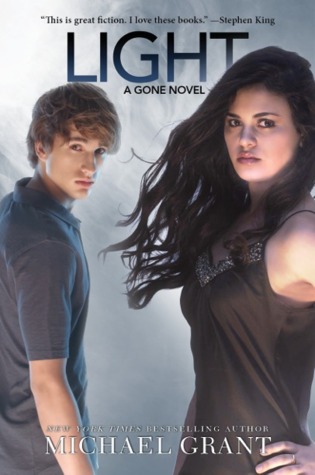
In three days, I read the final installment of the fast-paced and immensely disturbing Gone series. Light was decidedly faster paced than the rest of the books in the series (except perhaps for the first), so fast that I really did get swept up in the action, unaware of time's passing. It was a brisk, violent, emotional end to the series, but I responded more viscerally to the former than the latter. It seems that even though Light is full of action, death, and thematic resonance, it fell short emotionally, as if the author himself had turned off his emotional capacity to better cope with all the suffering he has caused these characters, just as many of them have done with theirs.
**SPOILERS AHEAD**
Obviously, Gaia lives, and grows, as Sam had not managed to kill her completely. And now that the FAYZ wall is transparent, the whole world can see the suffering and trauma that the kids have endured. But as sound cannot travel through the wall, misunderstandings about the goings-on in the FAYZ abound, and our core characters each consider what lies in wait for them at the end. It's not long, however, before Gaia is strong enough to unleash some bloodshed, and several characters, some named and most not, meet a swift and terrible end.
Light retains all the good stuff from the last five volumes, keeping the tone consistent: a fast-moving plot, complex characterization, and intense action. Additionally, all the loose ends get tied up real nicely, with a quick hint that maybe not everything is back to normal. But even as the story moved quickly, it is the same plot that drags on: the battle with Gaia. A couple kids get to throw some punches at her, she massacres a few more, then there is a rest. So there wasn't a whole lot of variety this time around. The plot with Petey was also grossly underutilized, as we only get precious few glimpses into his disembodied psyche before he possesses Caine, and his final battle with Gaia is laughably brief and almost comical to boot.
Interestingly enough, the last 30 or so pages, which go over the aftermath with all the main characters, was the most intriguing aspect of the emotional psychodrama that took place in this volume. The effect of their experience in the FAYZ would definitely be long-lasting, and adjusting to life in the real world would be difficult. I would almost rather have had another volume that went into a bit more detail about these kids' futures; sure, it would be epilogual, tangential to the overarching story of the FAYZ, but it is just another missed opportunity for a YA series to go in depth with the psychological effects of the trauma that the characters experienced and the cruelty of the real world when it comes to sympathizing with such trauma (see also: Hunger Games). But I applaud that Grant devoted more than 10 pages to it and treated the aftermath with deft realism.
One major weak point in the overall emotional arc came from Edilio's end. Edilio quickly became one of my favorite characters over the course of the series, and he has steadfastedly remained a "better person" than even Sam and Astrid (who basically give in to fear of death towards the middle-end), and there were some nail-biting moments when I thought he wouldn't make it to the end. But his grief for Roger, his supposed lover...I couldn't sense it the way I had with Sam and Astrid, or even Dekka's love for Brianna. Maybe Edilio is just good at holding back his emotions, but I did not get that intense fear and sadness that the other aforementioned characters in love had felt. If Grant really wanted to run with this, we should have gotten more set-up, seen Edilio and Roger interact a few more times than the few scenes we got back in Fear. In the end, I was happy for him, but still didn't buy that it was "true love" in the sense of Sam and Astrid or Dekka's love for Brianna.
Which brings me back to emotionality. This book made me gasp, tense, sigh with relief, and even feel happy for the characters towards the end. But I didn't cry. I was shocked that Brianna was killed so quickly, but I didn't feel sad. I felt sorry for everyone who was there to witness it, and the characters who cared about her, but I wasn't sad. I wasn't sad when any of them were killed. I even got angry with Sam and Caine for acting like such selfish cowards while helpless kids were being slaughtered with their powers. (Yeah, sorry Sam fans, but for a minute there I actually wanted him to die. When will a YA author have the guts to kill off the hero?) It wasn't like I didn't care about any of the characters who died. Perhaps there was just so much death, more then in any of the other volumes, I expected just about everyone to die, and not only wasn't surprised, but was desensistized to it. It stopped being shocking and more like, "Welp, now it's time for more kids to die." The killing was getting out of control.
But even through all of this, Sam gets through it all, coming out of the experience amazingly well-adjusted (if more stubborn and headstrong than before) while many others hadn't. As he's been in the thick of the action, you would think that he would leave the FAYZ just a teeny bit more scarred than he had. Ironically, in the end, the big hero of the FAYZ wasn't much of a hero, his life preserved thanks to others and his own selfish instincts, and yet retains that title for his past actions and doesn't seem to suffer a major guilt complex. (Though one would hope that Astrid would give credit where it was due regarding the end of the FAYZ) It was pretty obvious that the author was making it so that he and his closest friends would live...surprise, surprise.
So ends this thrilling ride of a series. Worth checking out, but, like the vast majority of critics say, it could've been better. 3 stars out of 5.
**SPOILERS AHEAD**
Obviously, Gaia lives, and grows, as Sam had not managed to kill her completely. And now that the FAYZ wall is transparent, the whole world can see the suffering and trauma that the kids have endured. But as sound cannot travel through the wall, misunderstandings about the goings-on in the FAYZ abound, and our core characters each consider what lies in wait for them at the end. It's not long, however, before Gaia is strong enough to unleash some bloodshed, and several characters, some named and most not, meet a swift and terrible end.
Interestingly enough, the last 30 or so pages, which go over the aftermath with all the main characters, was the most intriguing aspect of the emotional psychodrama that took place in this volume. The effect of their experience in the FAYZ would definitely be long-lasting, and adjusting to life in the real world would be difficult. I would almost rather have had another volume that went into a bit more detail about these kids' futures; sure, it would be epilogual, tangential to the overarching story of the FAYZ, but it is just another missed opportunity for a YA series to go in depth with the psychological effects of the trauma that the characters experienced and the cruelty of the real world when it comes to sympathizing with such trauma (see also: Hunger Games). But I applaud that Grant devoted more than 10 pages to it and treated the aftermath with deft realism.
One major weak point in the overall emotional arc came from Edilio's end. Edilio quickly became one of my favorite characters over the course of the series, and he has steadfastedly remained a "better person" than even Sam and Astrid (who basically give in to fear of death towards the middle-end), and there were some nail-biting moments when I thought he wouldn't make it to the end. But his grief for Roger, his supposed lover...I couldn't sense it the way I had with Sam and Astrid, or even Dekka's love for Brianna. Maybe Edilio is just good at holding back his emotions, but I did not get that intense fear and sadness that the other aforementioned characters in love had felt. If Grant really wanted to run with this, we should have gotten more set-up, seen Edilio and Roger interact a few more times than the few scenes we got back in Fear. In the end, I was happy for him, but still didn't buy that it was "true love" in the sense of Sam and Astrid or Dekka's love for Brianna.
Which brings me back to emotionality. This book made me gasp, tense, sigh with relief, and even feel happy for the characters towards the end. But I didn't cry. I was shocked that Brianna was killed so quickly, but I didn't feel sad. I felt sorry for everyone who was there to witness it, and the characters who cared about her, but I wasn't sad. I wasn't sad when any of them were killed. I even got angry with Sam and Caine for acting like such selfish cowards while helpless kids were being slaughtered with their powers. (Yeah, sorry Sam fans, but for a minute there I actually wanted him to die. When will a YA author have the guts to kill off the hero?) It wasn't like I didn't care about any of the characters who died. Perhaps there was just so much death, more then in any of the other volumes, I expected just about everyone to die, and not only wasn't surprised, but was desensistized to it. It stopped being shocking and more like, "Welp, now it's time for more kids to die." The killing was getting out of control.
But even through all of this, Sam gets through it all, coming out of the experience amazingly well-adjusted (if more stubborn and headstrong than before) while many others hadn't. As he's been in the thick of the action, you would think that he would leave the FAYZ just a teeny bit more scarred than he had. Ironically, in the end, the big hero of the FAYZ wasn't much of a hero, his life preserved thanks to others and his own selfish instincts, and yet retains that title for his past actions and doesn't seem to suffer a major guilt complex. (Though one would hope that Astrid would give credit where it was due regarding the end of the FAYZ) It was pretty obvious that the author was making it so that he and his closest friends would live...surprise, surprise.
So ends this thrilling ride of a series. Worth checking out, but, like the vast majority of critics say, it could've been better. 3 stars out of 5.
Monday, May 20, 2013
"Fear" Keeps the Suspense Going
Five books in, Fear retains all the great qualities of the previous four books, even as the red shirt, climatic battle with Drake and death of some other baddie starts feeling repetitive. Clocking in at over 500 pages, this is one of the longest books in the series by far, and Grant maintains the mounting suspense, surprising (and shocking) twists, and realistic character development that has made the series so compelling. However, beneath all the action, horror, and suspense, one can sense that the author was running out of steam, making this book a little more uneven than the first few.
The looming crisis in this volume is the impending darkness of the sphere, stemming from the gaiaphage and blackening the barrier, eventually obliterating all sky light in the FAYZ. Astrid has exiled herself from the new communities as a form of punishment for her desperate act of the previous book--and she is easily one of the best-written characters in this volume. Sam and his crew have set up a new community at the lake they had found, and enjoyed four months of relative prosperity. Things in Perdido Beach are not as peaceful, however, as one of Quinn's fishermen is sentenced to being tortured by the visions of Penny, who herself begins to plot a coup against "King Caine" when he is pressured by Quinn to get rid of her. Meanwhile, Drake is on a mission for his master: to bring Diana, and her baby, to its lair, and Petey has become a disembodied spirit with the ability to manipulate living things--often with horrific results.
Things go south fast in this book, but not before a good deal of time is taken to catch up the reader on the past four months and spend some time with each set of characters, which slows down the momentum of the book. It's a lot more quiet and pensive in the beginning, which ain't a bad thing. We also get a glimpse of what has happened in the outside world after all this time--and a plot to destroy the sphere forever. The greatest strength remains to be the complex character development, strongly evidenced in this volumes by Astrid, Dekka, Sam, and Brianna--with Quinn and Caine revealing new sides of themselves, as well. Astrid's was by far the most profound, as she had lost her faith and accepts her desire for Sam, rather than try to push it away. We see Dekka and Brianna be hopelessly vulnerable--and Orc, too, come to think of it.
The ending--which was quite cool and surprising--opens up the door for further interesting character conflict, as the world of FAYZ is now open for the adults to see--without the benefit of warm embraces and lengthy explanations. (And imagine the pressure of being seen while going about your business running a run-down world!) For that reason, and not the final demise of the gaiaphage, I am excited to see what happens in the final volume.
In spite of its enduring strengths, Fear had many weaknesses, mainly figuring around the mutant baby of Diana's that the gaiaphage possesses. It was one thing to have the "bad girl" endure a pregnancy, but once it accelerates and the baby is born, I couldn't help but giggle a little bit because it's so convenient that the gaiaphage can accelerate growth, I find the precocious monster baby trope a little silly (as well as precocious babies in general), and I am immature. Even with Penny's quick descent into madness and evil and Cigar's beady new eyes, I found the baby gaiaphage to be the silliest turn that the Gone series has taken thus far.
I found other aspects problematic, as well. While the depiction of violence and madness has usually been handled tactfully in the series, the introduction of Penny as a "pure evil" character as bad as Drake, and Cigar's descent into madness as a result of her own, paints a problematic picture of both. While in a world where survival is prime, the mad and the violent are most often shunned or condemned to death, a sad state of affairs, I still find it terrible that nobody has tried to help them. Mad people need help, not to be euthanized or brutally killed. Another small issue I had was the abrupt reveal of Edilio's relationship with Artful Roger. Though Sam calls him "gay," I doubt that Edilio should have accepted the label so blatantly. Didn't he have a little crush on Lana at first? I would say he's at least bisexual. He just happens to like this guy.
All told, however, Fear remains a quality installment to the series, with a cliffhanging finish that leaves you beyond excited for the next volume. I give it 3 stars out of 5.
| I can never figure out who the kids on the cover are supposed to be... |
Things go south fast in this book, but not before a good deal of time is taken to catch up the reader on the past four months and spend some time with each set of characters, which slows down the momentum of the book. It's a lot more quiet and pensive in the beginning, which ain't a bad thing. We also get a glimpse of what has happened in the outside world after all this time--and a plot to destroy the sphere forever. The greatest strength remains to be the complex character development, strongly evidenced in this volumes by Astrid, Dekka, Sam, and Brianna--with Quinn and Caine revealing new sides of themselves, as well. Astrid's was by far the most profound, as she had lost her faith and accepts her desire for Sam, rather than try to push it away. We see Dekka and Brianna be hopelessly vulnerable--and Orc, too, come to think of it.
The ending--which was quite cool and surprising--opens up the door for further interesting character conflict, as the world of FAYZ is now open for the adults to see--without the benefit of warm embraces and lengthy explanations. (And imagine the pressure of being seen while going about your business running a run-down world!) For that reason, and not the final demise of the gaiaphage, I am excited to see what happens in the final volume.
In spite of its enduring strengths, Fear had many weaknesses, mainly figuring around the mutant baby of Diana's that the gaiaphage possesses. It was one thing to have the "bad girl" endure a pregnancy, but once it accelerates and the baby is born, I couldn't help but giggle a little bit because it's so convenient that the gaiaphage can accelerate growth, I find the precocious monster baby trope a little silly (as well as precocious babies in general), and I am immature. Even with Penny's quick descent into madness and evil and Cigar's beady new eyes, I found the baby gaiaphage to be the silliest turn that the Gone series has taken thus far.
I found other aspects problematic, as well. While the depiction of violence and madness has usually been handled tactfully in the series, the introduction of Penny as a "pure evil" character as bad as Drake, and Cigar's descent into madness as a result of her own, paints a problematic picture of both. While in a world where survival is prime, the mad and the violent are most often shunned or condemned to death, a sad state of affairs, I still find it terrible that nobody has tried to help them. Mad people need help, not to be euthanized or brutally killed. Another small issue I had was the abrupt reveal of Edilio's relationship with Artful Roger. Though Sam calls him "gay," I doubt that Edilio should have accepted the label so blatantly. Didn't he have a little crush on Lana at first? I would say he's at least bisexual. He just happens to like this guy.
All told, however, Fear remains a quality installment to the series, with a cliffhanging finish that leaves you beyond excited for the next volume. I give it 3 stars out of 5.
Labels:
apocalypse,
books,
fiction,
reviews,
science fiction,
YA
Friday, May 3, 2013
"Plague: A Gone Novel": the FAYZ continues
To call the Gone series a dystopia is a misnomer, at the very least. A dystpoian tale conjures up the likes of Brave New World and 1984: stories that take place in the future, predicting a forseeable technological and societal upheaval that bears the mask of a utopia, but is actually quite a terrible place, devoid of such Enlightenment values as freedom and reasonable debate. Yet this is what it is called on the dust jackets of the first edition, probably to capitalize on the dystopian trend at the time. And it does appear a utopia (from a kid's point of view) for a fleeting moment in the first book: no more adults. And...that's it. Plague, perhaps more so than the other volumes, shows that this series is not "dystopian," but a supernatural horror story, with some aliens thrown in for good measure.
Among the growing atrocities in Plague, a parasite that eats kids from the inside out--and can transfer itself to another host via green goo--that eventually grow into six foot long mutant insects terrorize Perdido Beach; two individuals who cannot die and share the same body (Brittany and Drake from the previous book) are sliced into pieces and put themselves back together multiple times; and a freak flu strikes in which the infected can literally cough out their insides. If you thought the craziness of Lies was bad, things get much, much worse in this installment.
*mild spoilers may follow*
Even with all the shocking and stomach-churning events that transpire over the course of the novel, Grant remains true to the characters, who keep growing and changing throughout the novels. Astrid finds herself in a dark place, and commits the previously unthinkable, riddled with guilt afterwards. Sam, tired of being a leader, begins to regret his choice as things just keep getting worse. Edilio, now mayor of Perdido Beach, sees what made Sam shrink away from leadership and is in a bind with terrible choices to make. Lana opens up slowly to one of the kids from the island, Sanjit, and on the island, Diana works at keeping Caine with her, but when he returns to Perdido Beach at another chance for glory, she leaves him in the end. Each of the characters we follow in Gone's diverse cast is distinct and complex, continuing the trend of the previous books.
My main criticism? People seemed to get from place to place suspiciously quickly. While it's tough to keep track of the time frame when so many things are happening at once and the perspective changes every other time, the bulk of the story takes place over a mere three days. Would Drake have reached the bottom of the cave so quickly? Would Quinn really have reached the island and come back in time? Would Sam and his water posse have made it back so soon? It's hard to say.
As with the swiftly moving, action-packed plot, the interesting characters keep the reader engaged and leave you hungry for more. Oh, I am definitely seeing this series through 'til the end. 4 stars out of five.
| These kids still look too good to be from the FAYZ |
*mild spoilers may follow*
Even with all the shocking and stomach-churning events that transpire over the course of the novel, Grant remains true to the characters, who keep growing and changing throughout the novels. Astrid finds herself in a dark place, and commits the previously unthinkable, riddled with guilt afterwards. Sam, tired of being a leader, begins to regret his choice as things just keep getting worse. Edilio, now mayor of Perdido Beach, sees what made Sam shrink away from leadership and is in a bind with terrible choices to make. Lana opens up slowly to one of the kids from the island, Sanjit, and on the island, Diana works at keeping Caine with her, but when he returns to Perdido Beach at another chance for glory, she leaves him in the end. Each of the characters we follow in Gone's diverse cast is distinct and complex, continuing the trend of the previous books.
My main criticism? People seemed to get from place to place suspiciously quickly. While it's tough to keep track of the time frame when so many things are happening at once and the perspective changes every other time, the bulk of the story takes place over a mere three days. Would Drake have reached the bottom of the cave so quickly? Would Quinn really have reached the island and come back in time? Would Sam and his water posse have made it back so soon? It's hard to say.
As with the swiftly moving, action-packed plot, the interesting characters keep the reader engaged and leave you hungry for more. Oh, I am definitely seeing this series through 'til the end. 4 stars out of five.
Sunday, September 30, 2012
"Exodus": How to Write a Decent Feminist Apocalyptic YA
Finishing off my YA kick (going back to adult novels for a while), the critically acclaimed Exodus by Scottish writer Julie Bertagna. It doesn't have the breezy pacing of the Gone books--I would call it more "rushed"--but the story is as captivating and exciting.
Exodus has a very different feel, reading more like a mythical fantasy, with mentions of legends and destiny recurring throughout the story. But this is not a fantasy: the novel takes place in 2100, and great scientific advancements had been made well before the protagonist's time; even the elders' world was very different from ours in their youth. Instead, culture and technological progress has regressed in the wake of the encroaching seas--at least on the islands.
The apocalyptic scenario that Exodus explores is the rising seas as a result of global warming, taken to its extreme conclusion: by 2100, the seas have risen to such a height that most of the earth's land mass has been swallowed up, leaving small islands in the mountains and highlands. The people of Earth dealt with this problem by constructing sky-cities, but once they were built the rest of world was shut out.
The novel opens on Wing, the island home of our protagonist, Mara, where these cities are a mere rumor. But her explorations on her cyber wizz (a high-tech instrument that allows access to the weave, a highly advanced version of the Web) leads her to find evidence of these places, aided by a mysterious fox character. As the seas surge inland, Mara convinces her people to leave the island and try to get to the New World cities. But it's not all smooth sailing: the boats are separated right from the cast-off, and a great wall separates them from the city. They're forced to weigh anchor at a refugee camp, where conditions are squalid, and one of her friends dies from a sicknesss she contracted from eating a diseased fish (the water, of course, is filthy). That is the last straw for Mara--she decides to get through the wall and somehow enter the city. With the help of a wild child (called urchins, ratkins, or ratbashers) she makes it to the Netherworld, the islands beneath the City, and lives with the Treenester tribe for a time. While she is figuring out a way to break into the City, her friends are captured by the police, and she finally breaks in to rescue them and save her people.
There's a lot more to the story than can be explained in a brief synopsis, containing mounting tension and conflict, superb setting descriptions, and a cast of interesting characters. Exodus explores apocalyptic themes with deftness, depth, and honesty: the frailty of life, death, self-preservation instinct, and the relentless drive to do what's right. Mara is a likable but flawed character, determined to save others but unsure of herself every step of the way. She makes mistakes, and even kills a man in a fit of panic, regretting them immediately. Few other characters, however, get as much development or depth as she does, as many of them are only around for a few chapters or so, before getting separated from Mara in some way--except perhaps for Candleriggs and the Fox.
The different worlds of the refugee camp, the Netherworld, and the city of New Mungo are greatly distinguished, resembling the realms of our current world. Those residing in prosperous bubbles are often oblivious to the suffering of lesser people, no matter how close they are. The story also does a good job of bringing up such relevant themes without being too obvious or preachy about it: especially when one's story is inspired by the absurdly politically charged environmental issues.
Exodus has a very different feel, reading more like a mythical fantasy, with mentions of legends and destiny recurring throughout the story. But this is not a fantasy: the novel takes place in 2100, and great scientific advancements had been made well before the protagonist's time; even the elders' world was very different from ours in their youth. Instead, culture and technological progress has regressed in the wake of the encroaching seas--at least on the islands.
The apocalyptic scenario that Exodus explores is the rising seas as a result of global warming, taken to its extreme conclusion: by 2100, the seas have risen to such a height that most of the earth's land mass has been swallowed up, leaving small islands in the mountains and highlands. The people of Earth dealt with this problem by constructing sky-cities, but once they were built the rest of world was shut out.
The novel opens on Wing, the island home of our protagonist, Mara, where these cities are a mere rumor. But her explorations on her cyber wizz (a high-tech instrument that allows access to the weave, a highly advanced version of the Web) leads her to find evidence of these places, aided by a mysterious fox character. As the seas surge inland, Mara convinces her people to leave the island and try to get to the New World cities. But it's not all smooth sailing: the boats are separated right from the cast-off, and a great wall separates them from the city. They're forced to weigh anchor at a refugee camp, where conditions are squalid, and one of her friends dies from a sicknesss she contracted from eating a diseased fish (the water, of course, is filthy). That is the last straw for Mara--she decides to get through the wall and somehow enter the city. With the help of a wild child (called urchins, ratkins, or ratbashers) she makes it to the Netherworld, the islands beneath the City, and lives with the Treenester tribe for a time. While she is figuring out a way to break into the City, her friends are captured by the police, and she finally breaks in to rescue them and save her people.
There's a lot more to the story than can be explained in a brief synopsis, containing mounting tension and conflict, superb setting descriptions, and a cast of interesting characters. Exodus explores apocalyptic themes with deftness, depth, and honesty: the frailty of life, death, self-preservation instinct, and the relentless drive to do what's right. Mara is a likable but flawed character, determined to save others but unsure of herself every step of the way. She makes mistakes, and even kills a man in a fit of panic, regretting them immediately. Few other characters, however, get as much development or depth as she does, as many of them are only around for a few chapters or so, before getting separated from Mara in some way--except perhaps for Candleriggs and the Fox.
The different worlds of the refugee camp, the Netherworld, and the city of New Mungo are greatly distinguished, resembling the realms of our current world. Those residing in prosperous bubbles are often oblivious to the suffering of lesser people, no matter how close they are. The story also does a good job of bringing up such relevant themes without being too obvious or preachy about it: especially when one's story is inspired by the absurdly politically charged environmental issues.
Thursday, September 13, 2012
"Lies, A Gone Novel:" Just when you thought it couldn't get weirder...
I read the third book in Michael Grant's thrilling series in five days--just a little over the amount of time that lapses in the book. Boy, was it difficult to put down. The same attributes that made the first two books so addictive are present in the third installment, as well: mounting tension and violence, breezy chapters that leave you poised at the edge of a cliff, and engaging characters. Even though some events in the second book sort of repeat themselves in Lies, it's a story all its own.
Like in the previous books, the events unfold very quickly in a short time frame. Orsay is garnering several followers by speaking of her visions, which she usually gets by touching the FAYZ wall--or in her dreams. At the same time, dead girl Brittney has risen from the grave, the Human Crew plot to terrorize the town, Caine invades an island, and the Town Council falls apart. What's more, a mysterious girl, Nerezza, appears as Orsay's disciple, a flu is going around, and Drake is back from the dead. Sam and Astrid also demonstrate some seriously flawed thinking, with Astrid lying about Orsay's dreams, and Sam frustrated with not being able to do what he wants and having to deal with every little problem himself. New characters come into the fold, such as the inhabitants of the invaded island and illusionist Penny, while others leave us for good: Orsay through death, Mary through taking the jump on the "Big One-Five." The ending is tragic and messy (in an awesome way), with many issues far from resolved. However, many characters--Sam, Astrid, and Diana, most notably--have learned and grown from these additionally harrowing experiences. This novel has as much violence, gore, and pain as the previous installments--with the villains of Caine, Drake, and the Darkness (yes, it's baaaaaaack) more malicious and deranged than ever.
In spite of all the chaos and craziness that ensues, the characters come off as real and flawed human beings. Mary, who had stepped up to take care of the littles in the beginning, even though she suffers from eating disorders, has had enough of the burden, and even though she is basically giving up the kids for chance, we can understand why she decides to leave the FAYZ the only way anyone knows how--through the poof. Astrid and Sam make frustrating choices, but they realize their mistakes and we're assured that they're not infallible heroes. I even sympathized with Diana in this one, as she realized how monstrous Caine had become. Throughout this series I've enjoyed learning more about the Beta characters and watching them grow into their own.
Of course, the story has its flaws. First of all there was the very basic question of how long after the FAYZ this all takes place. I gleaned from the first book that it began in early November, as it starts about two weeks before Sam's birthday, which is the 22nd. Lies says it's been seven months--so, it we were to say it's been seven whole months, then that would mean late May/early June, right? But Lies takes place over the three days leading up to Mary's birthday, which falls on Mother's Day this un-numbered year. Usually, Mother's Day is early May, so technically only six whole months have passed. May is six months after November (think of it this way: November-born kids celebrate their half-birthdays in May, and vice versa). So, it's close, but not quite. People might disagree with me on this, but I stick by it. Nit, picked.
Then there are some events that I think are just forced and random, just to reveal information to the reader or move the story in a particular direction. An example of that is a completely random conversation between Lana and a drugged-out Mary. We get a little of what Lana thinks about Orsay, and Mary, but she could have talked to just about anyone. I also have a hard time believing that they took so long to make some rules, and all of a sudden in one night they have rules?
Like in the previous books, the events unfold very quickly in a short time frame. Orsay is garnering several followers by speaking of her visions, which she usually gets by touching the FAYZ wall--or in her dreams. At the same time, dead girl Brittney has risen from the grave, the Human Crew plot to terrorize the town, Caine invades an island, and the Town Council falls apart. What's more, a mysterious girl, Nerezza, appears as Orsay's disciple, a flu is going around, and Drake is back from the dead. Sam and Astrid also demonstrate some seriously flawed thinking, with Astrid lying about Orsay's dreams, and Sam frustrated with not being able to do what he wants and having to deal with every little problem himself. New characters come into the fold, such as the inhabitants of the invaded island and illusionist Penny, while others leave us for good: Orsay through death, Mary through taking the jump on the "Big One-Five." The ending is tragic and messy (in an awesome way), with many issues far from resolved. However, many characters--Sam, Astrid, and Diana, most notably--have learned and grown from these additionally harrowing experiences. This novel has as much violence, gore, and pain as the previous installments--with the villains of Caine, Drake, and the Darkness (yes, it's baaaaaaack) more malicious and deranged than ever.
Of course, the story has its flaws. First of all there was the very basic question of how long after the FAYZ this all takes place. I gleaned from the first book that it began in early November, as it starts about two weeks before Sam's birthday, which is the 22nd. Lies says it's been seven months--so, it we were to say it's been seven whole months, then that would mean late May/early June, right? But Lies takes place over the three days leading up to Mary's birthday, which falls on Mother's Day this un-numbered year. Usually, Mother's Day is early May, so technically only six whole months have passed. May is six months after November (think of it this way: November-born kids celebrate their half-birthdays in May, and vice versa). So, it's close, but not quite. People might disagree with me on this, but I stick by it. Nit, picked.
Then there are some events that I think are just forced and random, just to reveal information to the reader or move the story in a particular direction. An example of that is a completely random conversation between Lana and a drugged-out Mary. We get a little of what Lana thinks about Orsay, and Mary, but she could have talked to just about anyone. I also have a hard time believing that they took so long to make some rules, and all of a sudden in one night they have rules?
Friday, September 7, 2012
Wait, Wait, It Gets Better: "Hunger, A Gone Novel" Reviewed
After reading Gone, I was riveted enough to check out the sequel, the second of the six books in the series, Hunger. And as far as the writing quality goes, it's the same as the first: the pacing is swift, the characters are engaging (if still conforming to their perspective types), and of course still very much full of tropes. And even though things turn out even weirder than in the first book, it's not so outlandish this time around.
But first, a quick plot overview: three months after the events in the first book, hunger is a real issue, and it turns out man-eating worms have infested parts of the fields. Given this, plus laziness, most kids don't want to go out and pick food, even though they're on the brink of starvation. Caine comes out of a 90-day delirium that had resulted from contact with the "Darkness" (actually called a "gaiaphage," an alien creature that feeds on radioactive waste) and plans to take over the power plant. Little Pete, it turns out, is also connected to this creature. In addition to that, a group of kids without powers foster resentment against the kids with powers, intensifying conflict within Perdido Beach. Sam starts getting tired of dealing with it all, and shows the signs of an inept leader. The story leads up to Sam and Caine ultimately collaborating to destroy the gaiaphage, with the stakes raised and the incidences of violence and near-deaths much higher among the main characters--every major character experiences severe physical trauma or death in this book.
We meet some new characters who join the crew from the first book: Duck, teased by a group of normals, and who develops the ability to increase or decrease his density; Orsay, a girl who had been hiding out in the nearby state park and who has the ability to see into other people's dreams; Zil and the 'human crew,' a band of rabidly anti-mutant normals; and Hunter, a friend of Zil's who becomes an enemy when he accidentally kills another friend with his microwave hands. We also get to know several secondary characters a lot better--Dekka, Brianna, Albert, and Computer Jack--giving them more nuance and depth.
In addition to more nuanced characterization, there's also a greater diversity of characters; there's even a gay character now. Considering the large cast of characters, it's a more representative sample of the diversity in California today--though there's a surprisingly small number of Hispanics. And in this book, the true evil is not any of the wrongheaded, violent kids (except maybe Drake), it's the gaiaphage--which I'm sure will come back from the dead in good time.
As far as the plot goes, I wonder why they didn't try and take care of the hunger issue sooner--I suppose it can be chalked up to poor leadership, as Sam and co. should have prioritized tasks via immediacy and Maslow's hierarchy of needs to prevent this from happening in the first place. They also should have set up some sort of governing body by now, with different people in charge of different things, so that Sam didn't have to make all the decisions by himself. Though I guess this installment sort of resolved that issue. And absolutely nothing was said of the water: still no rain is mentioned, or even a cloud in the sky, yet water is not a problem? There is a municipal water system, but where does the water come from? I'm thinking the author took the presence of drinkable water for granted, and didn't think that would be a problem for Perdido Beach. Just like other residents of California towns that siphon their water from wetter places.
This book felt more like a long TV episode more than anything else, from the switching perspectives to the swift action scenes and snappy dialogue. However, the ending to Hunger didn't leave much in the way of cliffhangers. There is still an issue with the humans vs. mutants, we don't know if Drake is really dead (it's unsurprisingly difficult to kill off major characters), and several of the characters are shaken from the recent events, but there's no sense of imminent danger. I'm still going to read the next book, just because of the whole FAYZ mystery--which apart from the gaiaphage revelations wasn't really addressed. But it's important to note that.
In all, this book was just as enjoyable as the first--so if you liked the first one, you'll like this one. General rating: 3.5 out of 5 stars. Oppression rating? I had no major qualms with this installment, so I give it a 2. Next time, I'll be looking at Book 3, Lies.
But first, a quick plot overview: three months after the events in the first book, hunger is a real issue, and it turns out man-eating worms have infested parts of the fields. Given this, plus laziness, most kids don't want to go out and pick food, even though they're on the brink of starvation. Caine comes out of a 90-day delirium that had resulted from contact with the "Darkness" (actually called a "gaiaphage," an alien creature that feeds on radioactive waste) and plans to take over the power plant. Little Pete, it turns out, is also connected to this creature. In addition to that, a group of kids without powers foster resentment against the kids with powers, intensifying conflict within Perdido Beach. Sam starts getting tired of dealing with it all, and shows the signs of an inept leader. The story leads up to Sam and Caine ultimately collaborating to destroy the gaiaphage, with the stakes raised and the incidences of violence and near-deaths much higher among the main characters--every major character experiences severe physical trauma or death in this book.
We meet some new characters who join the crew from the first book: Duck, teased by a group of normals, and who develops the ability to increase or decrease his density; Orsay, a girl who had been hiding out in the nearby state park and who has the ability to see into other people's dreams; Zil and the 'human crew,' a band of rabidly anti-mutant normals; and Hunter, a friend of Zil's who becomes an enemy when he accidentally kills another friend with his microwave hands. We also get to know several secondary characters a lot better--Dekka, Brianna, Albert, and Computer Jack--giving them more nuance and depth.
In addition to more nuanced characterization, there's also a greater diversity of characters; there's even a gay character now. Considering the large cast of characters, it's a more representative sample of the diversity in California today--though there's a surprisingly small number of Hispanics. And in this book, the true evil is not any of the wrongheaded, violent kids (except maybe Drake), it's the gaiaphage--which I'm sure will come back from the dead in good time.
As far as the plot goes, I wonder why they didn't try and take care of the hunger issue sooner--I suppose it can be chalked up to poor leadership, as Sam and co. should have prioritized tasks via immediacy and Maslow's hierarchy of needs to prevent this from happening in the first place. They also should have set up some sort of governing body by now, with different people in charge of different things, so that Sam didn't have to make all the decisions by himself. Though I guess this installment sort of resolved that issue. And absolutely nothing was said of the water: still no rain is mentioned, or even a cloud in the sky, yet water is not a problem? There is a municipal water system, but where does the water come from? I'm thinking the author took the presence of drinkable water for granted, and didn't think that would be a problem for Perdido Beach. Just like other residents of California towns that siphon their water from wetter places.
This book felt more like a long TV episode more than anything else, from the switching perspectives to the swift action scenes and snappy dialogue. However, the ending to Hunger didn't leave much in the way of cliffhangers. There is still an issue with the humans vs. mutants, we don't know if Drake is really dead (it's unsurprisingly difficult to kill off major characters), and several of the characters are shaken from the recent events, but there's no sense of imminent danger. I'm still going to read the next book, just because of the whole FAYZ mystery--which apart from the gaiaphage revelations wasn't really addressed. But it's important to note that.
In all, this book was just as enjoyable as the first--so if you liked the first one, you'll like this one. General rating: 3.5 out of 5 stars. Oppression rating? I had no major qualms with this installment, so I give it a 2. Next time, I'll be looking at Book 3, Lies.
Thursday, August 30, 2012
Gone is Just the Beginning
The first non-blockbuster YA book I've read in quite some time (since sophomore year of college, I think--wow), and Gone is everything you'd expect it to be: original, suspenseful, and trope-r-iffic!
The basics: Gone begins with everyone over 14 in the small town of Perdido Beach disppearing: one second they're there, the next, they're gone. Our main protagonist, Sam, shunts taking responsibility and instead looks for his crush Astrid's autistic little brother, along with his wisecracking best friend Quinn. This leaves the town bully, Orc, in charge: at least until the boarding school kids show up. Oh, and on top of the survival problem, some kids have special powers: lightning bolts, teleporting, telekinesis, or other kinds of power that only require their hands to be free. And the local wildlife has also mutated: snakes can now fly and coyotes talk, for instance. All the while Sam and co. try to solve the mystery of the FAYZ (Fallout Alley Youth Zone).
Now, this is only the first book of a series (with the final installment due next year), so only a few of the mysteries are solved, with many more still to come, I'm sure. The story takes so many unexpected twists and turns, I can't tell you too much of the plot without spoiling this thrill. (Still, spoilers may follow)
The structure of the book is very cinematic: we jump around to different scenes and perspectives throughout the book, just like in any disaster movie or TV drama. We see what both the "good guys" and the "bad guys" are up to, which only builds the suspense and excitement even more, as we uncover new details and more secrets are revealed. The premise is also very imaginative, combining elements from classic stories and creating a whole new breed of sci-fi and the supernatural. However, there are moments that make you go, "Really?"--even with the unrealistic premise, some things are just too far-fetched. For example: would Lana and her dog really have survived a tumble down a steep ravine in a vehicle without their seatbelts on? The fact that Sam and Caine are twin brothers really came out of left field--no hints or anything. And--really? You name the bad brother "Caine"? Gee, I wonder what that references.
Bald biblical references aside, this story is full of familiar tropes. We have the reluctant hero (Sam); the goofy, hopelessly ordinary best friend (Quinn); the genius and love interest rolled into one (Astrid); the idiot savant (Pete); the token minority (Edilio); the big dumb bully and his loyal sidekick (Orc and Howard); the cunning villain, who doubly serves as the hero's foil (Caine); the sadistic psychopath (Drake); the sultry seductress (but PG-rated: Diana); the computer whiz (Jack); the den mother (Mary); among others. Whatever comes to your mind when you think of these tropes, that's probably what they are. They might step out of the box every now and then, but their characters are pretty predictable. There's also a real, sinister evil lurking behind it all--though there will be more on that in the next book, most likely. Funnily enough, basically all the bullies go by non-human nicknames--so it's easy to tell who those guys are. There's nothing wrong with characters fitting neatly into tropes(that's why they're tropes); however, it makes for unambitious characterization.
The basics: Gone begins with everyone over 14 in the small town of Perdido Beach disppearing: one second they're there, the next, they're gone. Our main protagonist, Sam, shunts taking responsibility and instead looks for his crush Astrid's autistic little brother, along with his wisecracking best friend Quinn. This leaves the town bully, Orc, in charge: at least until the boarding school kids show up. Oh, and on top of the survival problem, some kids have special powers: lightning bolts, teleporting, telekinesis, or other kinds of power that only require their hands to be free. And the local wildlife has also mutated: snakes can now fly and coyotes talk, for instance. All the while Sam and co. try to solve the mystery of the FAYZ (Fallout Alley Youth Zone).
Now, this is only the first book of a series (with the final installment due next year), so only a few of the mysteries are solved, with many more still to come, I'm sure. The story takes so many unexpected twists and turns, I can't tell you too much of the plot without spoiling this thrill. (Still, spoilers may follow)
| Guh, their makeup is so overdone |
Bald biblical references aside, this story is full of familiar tropes. We have the reluctant hero (Sam); the goofy, hopelessly ordinary best friend (Quinn); the genius and love interest rolled into one (Astrid); the idiot savant (Pete); the token minority (Edilio); the big dumb bully and his loyal sidekick (Orc and Howard); the cunning villain, who doubly serves as the hero's foil (Caine); the sadistic psychopath (Drake); the sultry seductress (but PG-rated: Diana); the computer whiz (Jack); the den mother (Mary); among others. Whatever comes to your mind when you think of these tropes, that's probably what they are. They might step out of the box every now and then, but their characters are pretty predictable. There's also a real, sinister evil lurking behind it all--though there will be more on that in the next book, most likely. Funnily enough, basically all the bullies go by non-human nicknames--so it's easy to tell who those guys are. There's nothing wrong with characters fitting neatly into tropes(that's why they're tropes); however, it makes for unambitious characterization.
Sunday, June 17, 2012
The Girl Who Owned a City is Pro-Capitalist Propaganda
Recently I read the post-apocalyptic children's novel The Girl Who Owned a City (which is apparently the only book the author, O.T. Nelson, ever wrote). Even though it was an obscure book by a non-author, it's made enough of a splash to have a graphic novel adaptation. And boy howdy, is this book a doozy.
The premise of the situation is that a plague wipes out all people over the age of 12 for some reason, with the children left behind having to fend for themselves. The main character, Lisa, ends up taking charge not just of the household (she has a younger brother to take care of), but also of the entire neighborhood, establishing a "city" in their old school. But not everybody wants to do things her way, much less the violent gangs of kids who prowl the ruined town. One gang forces her out and takes over, so she has to plot how to take back her city.
Some post-apocalyptic scenarios, such as this one, require some suspension of disbelief; so I just set aside the traumatic implications of such an event and marvelled at Lisa's ingenuity and persistence. (of course, there was the other disbelief I had to suspend, which was--if this highly unlikely scenario were to occur, would children really act like this? I know they are more independent than people give them credit for, but still) It's written well enough, and the character of Lisa is a strong and intelligent female character--more of a rarity when it was first published in 1977--though the writing isn't spectacular, even overly simplistic at times.
But something funny started happening halfway through the novel, and hit me right in the face in the second part. At this point, the decision to build a city in the school had been made. The words "hard work" and "earned" were repeated ad nauseum, Lisa dismissed the concept of sharing, and called the city her property. But it all clicked in a scene when she is arguing with one of her close friends and the doctor-in-training about claiming the city as hers: "Freedom is more important than sharing." That's when I realized what the story was really about.
It's pro-capitalist propaganda.
Perhaps propaganda is a strong word, but that's the only way I can describe it when the minds of the target demographic are so malleable. In any case, it endorses the values espoused by extreme libertarians, which is that selfishness is a virtue and that people should get only what they deserve. That is, rich people deserve to be rich, for they have earned their riches (to say nothing of those who were merely born into wealth), poor people deserve to be poor, and if we give them what they need they won't work to better themselves. These ideas are present in Lisa's reasoning that the city was hers, and that she has to earn her city back (although it is laughably easy), and that Jill has coddled the younger children too much. In this particular context, where of course there is no monetary system and everyone is equalized in every respect but for their ability to "use their heads" as Lisa puts it, some of these values are actually ok: using logical reasoning to sort out problems, material possessions aren't everything, and yes, the value of hard work, though Lisa comes off as inflexible and self-centered when she tells other people about these virtues. But the idea that working hard will reap its own rewards rings false in a highly unequal society. Not to mention that they didn't elect her as their leader, per se. She may be a benevolent leader, but she's still a dictator.
Of course, the dogmatic nature of the story isn't its only problem: the uneven pacing, the gaping holes in believability of both the children's behavior and the scenario, the anti-climatic ending, Lisa's annoyance with Craig for wanting to farm instead of command an army (there's also a pro-military message in this story, as well--she's hell-bent on forming an army before she can return to her city). I can't help but think that her victory was short-lived. Soon enough, the food would run out, and they would have to go to the farms. Then she better hope Craig will want to share his crops! (see, Lisa? Sharing is caring!) What is wrong with all of this is fit for another post.
Of course, the author is free to write a children's book on Objectivist philosophy, just as others are free to promote communist, democratic, and anarchic ideals in their stories (and they certainly have in children's literature). We don't have a problem unless there is only one type of philosophy allowed. But if you're going to write this kind of propaganda, at least tone down the preachiness--and make your stories more compelling. I give this book two out of five stars.
The premise of the situation is that a plague wipes out all people over the age of 12 for some reason, with the children left behind having to fend for themselves. The main character, Lisa, ends up taking charge not just of the household (she has a younger brother to take care of), but also of the entire neighborhood, establishing a "city" in their old school. But not everybody wants to do things her way, much less the violent gangs of kids who prowl the ruined town. One gang forces her out and takes over, so she has to plot how to take back her city.
Some post-apocalyptic scenarios, such as this one, require some suspension of disbelief; so I just set aside the traumatic implications of such an event and marvelled at Lisa's ingenuity and persistence. (of course, there was the other disbelief I had to suspend, which was--if this highly unlikely scenario were to occur, would children really act like this? I know they are more independent than people give them credit for, but still) It's written well enough, and the character of Lisa is a strong and intelligent female character--more of a rarity when it was first published in 1977--though the writing isn't spectacular, even overly simplistic at times.
It's pro-capitalist propaganda.
Perhaps propaganda is a strong word, but that's the only way I can describe it when the minds of the target demographic are so malleable. In any case, it endorses the values espoused by extreme libertarians, which is that selfishness is a virtue and that people should get only what they deserve. That is, rich people deserve to be rich, for they have earned their riches (to say nothing of those who were merely born into wealth), poor people deserve to be poor, and if we give them what they need they won't work to better themselves. These ideas are present in Lisa's reasoning that the city was hers, and that she has to earn her city back (although it is laughably easy), and that Jill has coddled the younger children too much. In this particular context, where of course there is no monetary system and everyone is equalized in every respect but for their ability to "use their heads" as Lisa puts it, some of these values are actually ok: using logical reasoning to sort out problems, material possessions aren't everything, and yes, the value of hard work, though Lisa comes off as inflexible and self-centered when she tells other people about these virtues. But the idea that working hard will reap its own rewards rings false in a highly unequal society. Not to mention that they didn't elect her as their leader, per se. She may be a benevolent leader, but she's still a dictator.
Of course, the dogmatic nature of the story isn't its only problem: the uneven pacing, the gaping holes in believability of both the children's behavior and the scenario, the anti-climatic ending, Lisa's annoyance with Craig for wanting to farm instead of command an army (there's also a pro-military message in this story, as well--she's hell-bent on forming an army before she can return to her city). I can't help but think that her victory was short-lived. Soon enough, the food would run out, and they would have to go to the farms. Then she better hope Craig will want to share his crops! (see, Lisa? Sharing is caring!) What is wrong with all of this is fit for another post.
Of course, the author is free to write a children's book on Objectivist philosophy, just as others are free to promote communist, democratic, and anarchic ideals in their stories (and they certainly have in children's literature). We don't have a problem unless there is only one type of philosophy allowed. But if you're going to write this kind of propaganda, at least tone down the preachiness--and make your stories more compelling. I give this book two out of five stars.
Monday, April 9, 2012
The Hunger Games Movie Review; Or, How the Movie is Never, Ever Better than the Book
So it looks like The Hunger Games is going to be a real blockbuster trilogy, along with the books, following Harry Potter and Twilight before it. There was some slight nervous anticipation before it came out in theaters a couple weeks ago, nail-biting over the fact that the protagonist was female and if the movie was going to be any good. There was criticism early on about the fact that the casting call for Katniss called for a specifically white woman, and the fact that the person who ultimately played her was a blonde in real life. I myself was a little miffed about the imperfect appearances (in stark contrast to the first Harry Potter movie, where each person looked the part)--Peeta needed blue eyes, Gale's hair needed to be longer and his skin darker, Haymitch was definitely not blond (and he needed to be more messed up!), and Snow needed to have had some work done. Katniss's criticism goes without saying. I also imagined Rue to be darker-skinned (after all, she's described in the book as having dark brown skin), but the actor who played her fit the part anyway. I'm not going to touch on all those racist Hunger Games fans who thought that Rue wasn't supposed to be black: you people need to pay more attention in both English and History class.

In spite of that negative impression, I was excited to see this movie, not nervous about it like with The Golden Compass (LOVE the books, do not ever want to see the movie!). I went to see it on opening day in a packed theater--we probably bought some of the few tickets left available for that showing. And I liked it a lot; I wanted to just go and read the books again immediately afterward. Though the movie was over two hours, and a bit slow to start, it breezed through the story, much like an abridged version of the book (which isn't really necessary). The shaky-camera thing was odd in the beginning, when there wasn't that much going on, and I wanted more scenes pre-Hunger Games--preferably more with Cinna. People say Lenny Kravitz did a good job, but there wasn't that much for him to do... And the scene when the tributes from District 12 are set on fire is supposed to be incredible, but I was underwhelmed. So, they just wear fire for capes?
Once the Hunger Games begins, though, the film finds its legs, and it captures all the important plot points with seamless faithfulness to the source material. Rue's death was as tragic as it was in the books. However, they did sort of mangle the end: we don't see much of what happens to Katniss and Peeta after the Games end--they don't even look as fucked up as they are in the book--and the rift that forms between them on their way home. Even earlier, as the Games are about to end, they changed Cato's death to make him even more pitiful than he needed to be, and I imagined the moment with the berries to be more dramatic, because they were going to send a big fuck-you to the capitol.
There were plenty of other deviations (such as when Katniss receives the Mockingjay pin) and omissions from the book, predictable in any movie adaptation of a story longer than 60 pages. This is how books are superior to time-constrained media like films: the audience has a chance to get to know the characters, and in the case of speculative fiction, the world, better. We learn a lot of juicy details that wouldn't even make it into a screenplay, let alone a rough cut.
The movie was predictably clean: everybody looked quite clean and healthy for starving civilians and beat-up games contestants. While they could have done something with makeup to produce the haggard effect, I'm not really surprised that everybody looks pretty damn good in the movie. More realistic portrayals of what humans look like has long been relegated to the indie film circuit.
So, while I wasn't one hundred percent thrilled with the look of the film, it was really well done as a movie, with moments that will leave you tense with anticipation even if you've read the books, and enough excitment to have you wanting more. (and there should have been more!) I look forward to the sequel, and hope that it's even better than the first. If you've been thinking about seeing this movie, go ahead and see it: you could do a LOT worse. 3 out of 5 stars.
In spite of that negative impression, I was excited to see this movie, not nervous about it like with The Golden Compass (LOVE the books, do not ever want to see the movie!). I went to see it on opening day in a packed theater--we probably bought some of the few tickets left available for that showing. And I liked it a lot; I wanted to just go and read the books again immediately afterward. Though the movie was over two hours, and a bit slow to start, it breezed through the story, much like an abridged version of the book (which isn't really necessary). The shaky-camera thing was odd in the beginning, when there wasn't that much going on, and I wanted more scenes pre-Hunger Games--preferably more with Cinna. People say Lenny Kravitz did a good job, but there wasn't that much for him to do... And the scene when the tributes from District 12 are set on fire is supposed to be incredible, but I was underwhelmed. So, they just wear fire for capes?
Once the Hunger Games begins, though, the film finds its legs, and it captures all the important plot points with seamless faithfulness to the source material. Rue's death was as tragic as it was in the books. However, they did sort of mangle the end: we don't see much of what happens to Katniss and Peeta after the Games end--they don't even look as fucked up as they are in the book--and the rift that forms between them on their way home. Even earlier, as the Games are about to end, they changed Cato's death to make him even more pitiful than he needed to be, and I imagined the moment with the berries to be more dramatic, because they were going to send a big fuck-you to the capitol.
There were plenty of other deviations (such as when Katniss receives the Mockingjay pin) and omissions from the book, predictable in any movie adaptation of a story longer than 60 pages. This is how books are superior to time-constrained media like films: the audience has a chance to get to know the characters, and in the case of speculative fiction, the world, better. We learn a lot of juicy details that wouldn't even make it into a screenplay, let alone a rough cut.
The movie was predictably clean: everybody looked quite clean and healthy for starving civilians and beat-up games contestants. While they could have done something with makeup to produce the haggard effect, I'm not really surprised that everybody looks pretty damn good in the movie. More realistic portrayals of what humans look like has long been relegated to the indie film circuit.
So, while I wasn't one hundred percent thrilled with the look of the film, it was really well done as a movie, with moments that will leave you tense with anticipation even if you've read the books, and enough excitment to have you wanting more. (and there should have been more!) I look forward to the sequel, and hope that it's even better than the first. If you've been thinking about seeing this movie, go ahead and see it: you could do a LOT worse. 3 out of 5 stars.
Tuesday, December 20, 2011
Movie Review: Young Adult
Now, I don't usually go to the movies very often, but for some reason I went a lot this year. I've seen a total of five movies in theatres this year--NEW movies, too. I haven't seen that many new movies in theatres since I was a kid. Maybe not even then: come to think of it, this is probably a new record for me. Anyway, a lot of the movies I saw garnered a lot of hype--Black Swan, Harry Potter, 50/50, and Melancholia were all much-talked-about. I liked them all--with Melancholia being the unequivocally best one of the bunch--but none had surprised me quite like Young Adult did.
Young Adult is the second collaboration between screenwriter Diablo Cody and Jason Reitman, their first being Juno. Juno was cute and quirky, occupying a hyperrealistic world of ultra-hip jargon and unconventional romance. Young Adult, on the other hand, ventures into much more sobering (pun intended) territory. The protagonist of Young Adult, Mavis Gary is a recently divorced (and apparently depressed) thirtysomething woman struggling to write the final novel in the young-adult series that she took over as author. While procrastinating, she comes across an invitation to her high school boyfriend's baby's naming ceremony, and after thinking about it all day, she decides to head back to her hometown to win him back.
It's pretty plain that Mavis is destined for failure early on: in her early encounters with Buddy, he's cheerful and kinda hokey, and while she keeps on discussing the past as if things haven't changed, he clearly has changed, accepting responsibility as a husband and father in what seems to be a pretty solid, egalitarian relationship. As much as the laughingstock nerd-turned-confidante in Patton Oswalt's character warns that she is making a big mistake, Mavis continues down into this marriage-destroying mission until it ends in tears--that being her own.
Mavis' reputation as a Queen Bee is evident through her blindly selfish pursuit of her high school sweetheart, and she's pretty mean to just about everyone but Buddy Slade--unless she's pretending to be nice. Yet she's become a pitiful character, slaving over a YA series that she can't even call her own, drinking heavily almost every night and spending her days watching TV (or else getting done up to see Buddy). It's obvious that she is suffering from depression, alcoholism, or (most likely) both. However, no one but Patton Oswalt's character, even her parents (in a telling scene, Mavis admits outright that she's an alcoholic, with her mother only responding "No you're not"--and not in a nice way), recognizes this. As much of a trainwreck her life becomes, it's hard not to hope that she does learn and grow from the experience. In the end it appears that she gets back on her feet--the novel, at least, is finished--but it's otherwise ambiguous.
Young Adult contrasts sharply with Juno, not only in the darker tone and heightened drama, but also in its realism. Music played a minimal role in creating atmosphere, though one song did serve as a crucial forewarning to Mavis sometime during the film. The dialogue is more natural than clever. Images, which are a large part of the film medium, are repeated and emphasized (such as Mavis lying in bed the morning after with a sleeping shirtless guy, unimpressed). The dialogue was very spot-on for real life, and of course the acting was great--especially by Charlize Theron and Patton Oswalt. Buddy and Beth Slade seemed a little too content and cheerful (at least until towards the end), though perhaps they were exaggerating their contentedness on purpose, as some are wont to do in the presence of exes. The scenes leading up to the final one are painful to watch, especially for those sensitive to secondhand embarrassment. Nor does the ending tie itself up nicely. This is not a typical comedy--in fact, it's more of a comedy-drama (or, as I prefer it, a "tragicomedy"). Which was not what I at all expected.
Cody said in an interview with NPR that she had sought to turn several rom-com tropes on their head--and she accomplished just that. For one, it's just a comedy--I did not think of it as a rom-com in the slightest. The romantic arc is more of the subplot to the real story going on, which is Mavis' desperation to return to the time when she was happiest. The possibilities aren't tied up in a neat little knot at the end--instead, they spread out into the imagination of the audience. Naturally, as someone who has filled in the blanks in many a movie in my head countless times, I like ambiguity when it's done right. While I'm generally lukewarm towards Diablo Cody, I think she's outdone herself with Young Adult. Good on all involved, in fact. I give it a 4 out of 5 stars.
Young Adult is the second collaboration between screenwriter Diablo Cody and Jason Reitman, their first being Juno. Juno was cute and quirky, occupying a hyperrealistic world of ultra-hip jargon and unconventional romance. Young Adult, on the other hand, ventures into much more sobering (pun intended) territory. The protagonist of Young Adult, Mavis Gary is a recently divorced (and apparently depressed) thirtysomething woman struggling to write the final novel in the young-adult series that she took over as author. While procrastinating, she comes across an invitation to her high school boyfriend's baby's naming ceremony, and after thinking about it all day, she decides to head back to her hometown to win him back.
Mavis' reputation as a Queen Bee is evident through her blindly selfish pursuit of her high school sweetheart, and she's pretty mean to just about everyone but Buddy Slade--unless she's pretending to be nice. Yet she's become a pitiful character, slaving over a YA series that she can't even call her own, drinking heavily almost every night and spending her days watching TV (or else getting done up to see Buddy). It's obvious that she is suffering from depression, alcoholism, or (most likely) both. However, no one but Patton Oswalt's character, even her parents (in a telling scene, Mavis admits outright that she's an alcoholic, with her mother only responding "No you're not"--and not in a nice way), recognizes this. As much of a trainwreck her life becomes, it's hard not to hope that she does learn and grow from the experience. In the end it appears that she gets back on her feet--the novel, at least, is finished--but it's otherwise ambiguous.
Young Adult contrasts sharply with Juno, not only in the darker tone and heightened drama, but also in its realism. Music played a minimal role in creating atmosphere, though one song did serve as a crucial forewarning to Mavis sometime during the film. The dialogue is more natural than clever. Images, which are a large part of the film medium, are repeated and emphasized (such as Mavis lying in bed the morning after with a sleeping shirtless guy, unimpressed). The dialogue was very spot-on for real life, and of course the acting was great--especially by Charlize Theron and Patton Oswalt. Buddy and Beth Slade seemed a little too content and cheerful (at least until towards the end), though perhaps they were exaggerating their contentedness on purpose, as some are wont to do in the presence of exes. The scenes leading up to the final one are painful to watch, especially for those sensitive to secondhand embarrassment. Nor does the ending tie itself up nicely. This is not a typical comedy--in fact, it's more of a comedy-drama (or, as I prefer it, a "tragicomedy"). Which was not what I at all expected.
Cody said in an interview with NPR that she had sought to turn several rom-com tropes on their head--and she accomplished just that. For one, it's just a comedy--I did not think of it as a rom-com in the slightest. The romantic arc is more of the subplot to the real story going on, which is Mavis' desperation to return to the time when she was happiest. The possibilities aren't tied up in a neat little knot at the end--instead, they spread out into the imagination of the audience. Naturally, as someone who has filled in the blanks in many a movie in my head countless times, I like ambiguity when it's done right. While I'm generally lukewarm towards Diablo Cody, I think she's outdone herself with Young Adult. Good on all involved, in fact. I give it a 4 out of 5 stars.
Tuesday, August 16, 2011
Beauty Queens is not as it Seems
Every once in a while, an avid reader's got to have some fun. Sometimes (say, during the summer) that means picking out a YA book and spend the weekend lounging in the park or on the beach to read it. This makes YA--and other "easy" genre novels--my summer reads of choice. A couple weekends ago (I've been busy OK) I read Beauty Queens, which hit bookstores this past June. The first thing that's obvious in the first few pages: the title and cover are very misleading.
The basic premise is this: a bunch of girls on their way to the ultimate beauty pageant are stranded on a deserted island after their plane crashes. Needless to say, most of them died. Though since this is a comic novel, the dead pageant girls are killed off in the beginning. That may seem like a Lord of the Flies with shallow, narcissistic girls, but it doesn't quite turn out like that. In fact, the surviving girls all band together and create a small, thriving community on the island. But, it turns out that the Corporation (apparently all real-world corporations combined) is operating a secret lair, of sorts, on the island, and is planning to deal the dictator of a small country weapons in exchange for greater market share.
Part of what makes this novel great is its over-the-top portrayal of advertising, celeb-politicians, and what I call "brand-masking" (the practice of making up a sillier version of a real-world product, place, or person, to avoid lawsuits or just for fun). But these are often staples of comic YA entertainment, camp and all. What really stands out about this novel was its fairly diverse range of characters and the thoughtful, progressive ways in which their issues were addressed. All the surviving girls confronted the limitations society imposed on them because of their gender, and they learned to be more tolerant and comfortable with who they are. There was also very little girl-girl rivalry, even when hot TV pirates were introduced.
Plus, each of the nine main characters (in addition to the five supporting girls) experience significant change/growth as people as a result of this experience, each going beyond what they all learned collectively and according to whatever issues/prejudices they came to the island with. Also, they don't all get boyfriends, and are happy with that. This sort of honest and thoughtful inclusion of feminist issues is not very common in YA lit, and it's great to see a novel that goes beyond the mainstream. The climax/ending are Teen-TV silly, but this is a comedy for teens we're talking about here.
That said, this is a perfect novel for a feminist reader in need of beach reads--or even for someone who could use some entertaining enlightenment (perhaps an aspiring beauty queen?). If YA that pokes fun at the very things that target this demographic are your thing, then you'll also enjoy it. I give it a (fairly generous) 4/5.
Part of what makes this novel great is its over-the-top portrayal of advertising, celeb-politicians, and what I call "brand-masking" (the practice of making up a sillier version of a real-world product, place, or person, to avoid lawsuits or just for fun). But these are often staples of comic YA entertainment, camp and all. What really stands out about this novel was its fairly diverse range of characters and the thoughtful, progressive ways in which their issues were addressed. All the surviving girls confronted the limitations society imposed on them because of their gender, and they learned to be more tolerant and comfortable with who they are. There was also very little girl-girl rivalry, even when hot TV pirates were introduced.
Plus, each of the nine main characters (in addition to the five supporting girls) experience significant change/growth as people as a result of this experience, each going beyond what they all learned collectively and according to whatever issues/prejudices they came to the island with. Also, they don't all get boyfriends, and are happy with that. This sort of honest and thoughtful inclusion of feminist issues is not very common in YA lit, and it's great to see a novel that goes beyond the mainstream. The climax/ending are Teen-TV silly, but this is a comedy for teens we're talking about here.
That said, this is a perfect novel for a feminist reader in need of beach reads--or even for someone who could use some entertaining enlightenment (perhaps an aspiring beauty queen?). If YA that pokes fun at the very things that target this demographic are your thing, then you'll also enjoy it. I give it a (fairly generous) 4/5.
Sunday, June 5, 2011
Mockingjay, and the Disappointment of Hurried Good-byes
OK, I finished the Hunger Games trilogy about a month ago (I read Catching Fire and Mockingjay in quick succession). I won't say much about Catching Fire, but like many second-installments, it was better than the first. I loved all the new characters, the new revelations about Haymitch (one of my fave characters), it was just as fast-paced and exciting as the first, and the ending blew me away.
***WARNING: SPOILERS AHEAD***
My main gripes came with Mockingjay. Unlike the first two installments, the pacing really slowed down. The entire first part was Katniss hanging out in the underground metropolis of District 13. When it was time to go to the Capitol, I got really into it. The blurring of the lines between the "good" guys and "bad" was also really interesting, and not something you see very often in sci-fi/fantasy stories. Though that perspective brought about some depressing rumination towards the end of the novel... which is where my problems begin.
While I wasn't expecting everyone to live (though I figured Katniss, Gale, and Peeta would live, cuz if one of them died, the love triangle would be too easy to resolve), some deaths I found particularly upsetting in their abruptness: namely, Prim, the whole reason Katniss entered the Hunger Games--and set the entire trilogy in motion--in the first place. The suddenness of it all was like when Fred was killed off in Deathly Hallows, only times 1000. Prim was reduced to a mere plot device in her death, to ultimately challenge Katniss to find the strength to keep on living. I know killing in war is senseless, everyone's a potential casualty, blah-blah-blah, but I felt that was needlessly cruel of Collins to do that, when there wasn't much of a reason for Prim to even be on the front lines in the first place. After all they've been through...you hurt them (physically and emotionally) even more?
That was the main thing. This also happens with less than like 50 pages in the book left to go...and we're at the lowest point. The rest seems kind of rushed, especially once Katniss kills the next president-to-be, Coin. There's a pervasive sense of hopelessness that drags itself throughout the rest of the book, even when we fast-forward through the recovery and reconstruction period and find Katniss settled down with Peeta. Someone pointed out that these last few chapters could have been a whole other book in itself, noting that these very important events were hastily rushed through. Guess that's why JK Rowling killed off Dumbledore in the sixth book... And hey, I wouldn't have minded a fourth one, getting to spend a couple hundred more pages with these characters.
But my main disappointment I guess is with the--er--bittersweet ending. In series where the stakes are so high it's almost impossible to see how one can overcome them, there's often sadness and tragedy. But this ending...was such...a downer. There was all this existentialist musing about how whether humankind should even really be allowed to continue existing, given all the destruction they give each other and the environment. Yet they keep on living...why again? Because the instinct to live is more powerful than the compulsion to kill yourself off?
Also--and this was something I wondered throughout the entire series--is everyone just ignorant, or is Panem really the only country left? Did all the other humans on the planet really get killed off some point in the past? Five-six billion of them? Really? I'm just going to go with ignorance--it's not like Katniss and co. really learned anything in school other than the basics of reading, 'riting, and 'rithmetic in addition to the Capitol's propaganda. I sense a brief foray into fanfiction coming on...
But all in all, I enjoyed the series, and like to analyze it almost as much. The series definitely warrants a second read-through...however, I should read some other stuff for a while.
***WARNING: SPOILERS AHEAD***
While I wasn't expecting everyone to live (though I figured Katniss, Gale, and Peeta would live, cuz if one of them died, the love triangle would be too easy to resolve), some deaths I found particularly upsetting in their abruptness: namely, Prim, the whole reason Katniss entered the Hunger Games--and set the entire trilogy in motion--in the first place. The suddenness of it all was like when Fred was killed off in Deathly Hallows, only times 1000. Prim was reduced to a mere plot device in her death, to ultimately challenge Katniss to find the strength to keep on living. I know killing in war is senseless, everyone's a potential casualty, blah-blah-blah, but I felt that was needlessly cruel of Collins to do that, when there wasn't much of a reason for Prim to even be on the front lines in the first place. After all they've been through...you hurt them (physically and emotionally) even more?
That was the main thing. This also happens with less than like 50 pages in the book left to go...and we're at the lowest point. The rest seems kind of rushed, especially once Katniss kills the next president-to-be, Coin. There's a pervasive sense of hopelessness that drags itself throughout the rest of the book, even when we fast-forward through the recovery and reconstruction period and find Katniss settled down with Peeta. Someone pointed out that these last few chapters could have been a whole other book in itself, noting that these very important events were hastily rushed through. Guess that's why JK Rowling killed off Dumbledore in the sixth book... And hey, I wouldn't have minded a fourth one, getting to spend a couple hundred more pages with these characters.
But my main disappointment I guess is with the--er--bittersweet ending. In series where the stakes are so high it's almost impossible to see how one can overcome them, there's often sadness and tragedy. But this ending...was such...a downer. There was all this existentialist musing about how whether humankind should even really be allowed to continue existing, given all the destruction they give each other and the environment. Yet they keep on living...why again? Because the instinct to live is more powerful than the compulsion to kill yourself off?
Also--and this was something I wondered throughout the entire series--is everyone just ignorant, or is Panem really the only country left? Did all the other humans on the planet really get killed off some point in the past? Five-six billion of them? Really? I'm just going to go with ignorance--it's not like Katniss and co. really learned anything in school other than the basics of reading, 'riting, and 'rithmetic in addition to the Capitol's propaganda. I sense a brief foray into fanfiction coming on...
But all in all, I enjoyed the series, and like to analyze it almost as much. The series definitely warrants a second read-through...however, I should read some other stuff for a while.
Thursday, May 5, 2011
The Hunger Games, and the Art of the Hook
*WARNING: SPOILERS*
So last weekend I read The Hunger Games, uncertain as to whether I would love it or just like it. I got into it after a lot of hype: the folks at my internship raved about it, and I’ve come across a lot of Harry Potter and Twilight comparisons. So when I began reading I wondered: will it be more like Harry Potter (yay) or Twilight (boo)?
Believe the hype.
It has the same edge-of-your-seat story structure that engaged me in Harry Potter and other book series in my youth. For the first time since the Princess Diaries (whenever the last book came out), I read a book in four days of my own volition, and not because I had to read it for a class. The pace picked up really quickly, and before I knew it I was engrossed in the adventure.
Like Harry Potter, The Hunger Games was almost a completely positive reading experience. I got engrossed in the story almost immediately, and there was no shortage of violence, intrigue, and of course romance. It's almost indescribably good. The characters that we got to know were rich and complex, the protagonist Katniss a strong but flawed woman. I teared up when Rue was killed, and was nearly bawling when District 11 gave Katniss the bread as a token of appreciation. (something similar happened in Book 2, which I'm already almost done reading) I can't really remember the last time a new book got me so emotional and excited. Maybe Lolita, which I read back in January... and that was a different kind of reading experience.
However, unlike Harry Potter, I am glad that this world is not possible in reality--and hopefully never will be. In spite of all the violence and gore (which, as a formerly avid video game player of Grand Theft Auto, Super Smash Bros. and the like, I enjoyed in an abstractly sadistic way I guess), this was not glorified or celebrated by the sympathetic characters. In fact, because they are forced to kill to survive, one finds the violence abhorrent. It's the characters that matter most in this YA series.
I was actually surprised at how much romance was actually IN the book, and how quickly we learn of Peeta's love for Katniss. One could almost classify it as a YA romance...with a dystopian twist. It didn't put me off too much...I used to read fantasy/sci-fi stories with a pivotal romantic subplot all the time--though they were shojo manga, not YA prose. How did I get swept into it?
Authors like Suzanne Collins and JK Rowling have some sort of magic touch--a mixture of writing talent, cleverness, and ability to craft a story that has the audience asking for more--that captivates readers so much. I think it's an impossible talent to learn, as it's almost impossible to articulate why these books are so good. It's not the same way that David Foster Wallace or Vladimir Nabokov or Joyce Carol Oates are good writers. Or maybe it is...they're just working with different genres.
All in all, I've found a new obsession. I can't wait to read through the end of Book 2! (I'm already on Chapter 21...) I might even see the movie. The pacing of the book is so brisk it was practically made with a movie deal in mind.I give it a 4.5...and will probably like it even more on a second go-around. But I have plenty more to say about this book: expect more gushing in the coming weeks.
So last weekend I read The Hunger Games, uncertain as to whether I would love it or just like it. I got into it after a lot of hype: the folks at my internship raved about it, and I’ve come across a lot of Harry Potter and Twilight comparisons. So when I began reading I wondered: will it be more like Harry Potter (yay) or Twilight (boo)?
Believe the hype.
It has the same edge-of-your-seat story structure that engaged me in Harry Potter and other book series in my youth. For the first time since the Princess Diaries (whenever the last book came out), I read a book in four days of my own volition, and not because I had to read it for a class. The pace picked up really quickly, and before I knew it I was engrossed in the adventure.
Like Harry Potter, The Hunger Games was almost a completely positive reading experience. I got engrossed in the story almost immediately, and there was no shortage of violence, intrigue, and of course romance. It's almost indescribably good. The characters that we got to know were rich and complex, the protagonist Katniss a strong but flawed woman. I teared up when Rue was killed, and was nearly bawling when District 11 gave Katniss the bread as a token of appreciation. (something similar happened in Book 2, which I'm already almost done reading) I can't really remember the last time a new book got me so emotional and excited. Maybe Lolita, which I read back in January... and that was a different kind of reading experience.However, unlike Harry Potter, I am glad that this world is not possible in reality--and hopefully never will be. In spite of all the violence and gore (which, as a formerly avid video game player of Grand Theft Auto, Super Smash Bros. and the like, I enjoyed in an abstractly sadistic way I guess), this was not glorified or celebrated by the sympathetic characters. In fact, because they are forced to kill to survive, one finds the violence abhorrent. It's the characters that matter most in this YA series.
I was actually surprised at how much romance was actually IN the book, and how quickly we learn of Peeta's love for Katniss. One could almost classify it as a YA romance...with a dystopian twist. It didn't put me off too much...I used to read fantasy/sci-fi stories with a pivotal romantic subplot all the time--though they were shojo manga, not YA prose. How did I get swept into it?
Authors like Suzanne Collins and JK Rowling have some sort of magic touch--a mixture of writing talent, cleverness, and ability to craft a story that has the audience asking for more--that captivates readers so much. I think it's an impossible talent to learn, as it's almost impossible to articulate why these books are so good. It's not the same way that David Foster Wallace or Vladimir Nabokov or Joyce Carol Oates are good writers. Or maybe it is...they're just working with different genres.
All in all, I've found a new obsession. I can't wait to read through the end of Book 2! (I'm already on Chapter 21...) I might even see the movie. The pacing of the book is so brisk it was practically made with a movie deal in mind.I give it a 4.5...and will probably like it even more on a second go-around. But I have plenty more to say about this book: expect more gushing in the coming weeks.
Subscribe to:
Posts (Atom)