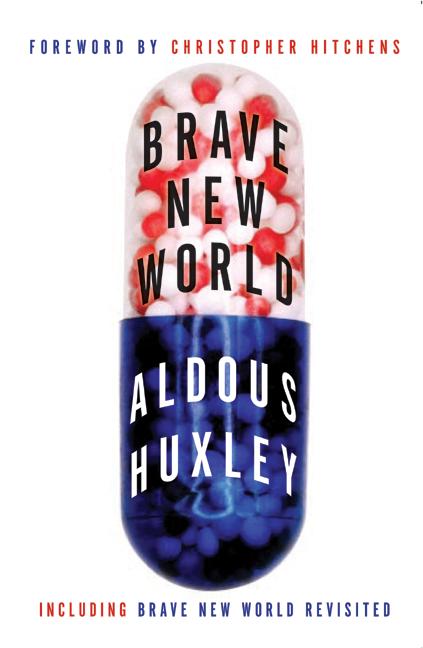
It's been a long time coming, and I have finally read Aldous Huxley's best-known novel, Brave New World. Seriously, can anyone else name another book of his they've heard of, let alone read? As a fan of dystopian and other socially relevant speculative fiction, I had to read this, a classic of the genre. While some of the glaring anachronisms (to the modern mind) are at once funny and frustrating, I did my best to set them aside and evaluate the book in-context. But even with that in mind, I found the book to be less of a novel and more of a weakly woven parody.
The novel opens with a tour of a "hatchery and conditioning center," where children are carefully manufactured and raised to fulfill their duties as defined by their assigned caste. Even though they have time to play (the type of play most often alluded to being "erotic play"), childhood in this world looks like a real drag. And immediately we know that this is going to be a very dry, detached novel. Usually these sorts of novels start out by presenting the protagonist at some point during his daily routine in this weird world. Instead, we get a boatload of exposition. Kudos to not following the formula I guess?
There are several main characters, as well. We meet Lenina first (bet you didn't get that reference right off the bat), a seemingly conventional hatchery worker. Then a bit later we see the world from Bernard Marx's perspective, an Alpha-Plus whose short stature makes him an outcast, and a very bitter one, at that. His only friend is Helmholtz, a lecturer at the university, and who apparently has too much of a good thing going on. All three of these characters become inextricably linked when Lenina, who apparently has a greater proclivity toward monogamy than her peers as well as an attraction to odd men, goes on a trip to a savage reservation with Bernard. While there, they meet a pair of white people living amongst the so-called "squalor": a woman named Linda, who looks way older than your typical 44-year-old would look even then, probably, and her son, John. That last guy is the third main character.
Linda apparently had become separated from the hatchery director while on holiday there, and she was pregnant with their son--an obscenity and an abomination in this civilization. Both of them are outcasts in the reservation, so when Bernard offers John the chance to go back to England with them, he eagerly accepts. However, things aren't so great when they return. Everyone is horrified by Linda's haggard appearance, so she spends the rest of her life on soma (the happiness drug with no side effects--unless you take too much for too long). And John, last name Savage, doesn't find the "Other Place" to be quite as nice as he'd imagined. The infinite sets of twins freaks him out, the promiscuity repulses him, and so does the indulging of "pleasant vices." The only people he can talk to are Bernard and Helmholtz--but since Bernard is petty, John connects more with Helmholtz, who is slightly more thoughtful and understanding. Lenina and John share a mutual attraction to one another, but as she abhors marriage and he, extramarital sex, John drives her away.
After the death of his mother, John incites a riot amongst the hospital workers when he discards their soma ration, and the three men are taken away and dealt with. Bernard and Helmholtz are sent away to an island somewhere, and John is encouraged to stay. However, John wants to be alone (something that civilians are conditioned against doing), and goes to hide in an abandoned lighthouse. However, because he decided to stay in Britain and not, like, go far far away like he should have, he is discovered, and people start flocking to the lighthouse to gawk at him. After a secret "feely" (movies that engage all the senses) is made about him, even more people come, and John is pushed over the edge when Lenina shows up. Enraged, he starts beating her, and the other people beat each other. In the end, he hangs himself.
To give Huxley credit, it's not like all the women are perfectly fine with this society: Lenina does fall in love with John, which other women seem mystified by. However, as it is shown with Lenina and Linda, apparently promiscuity is hard to shake, and perhaps John's undue repulsion at Lenina's advances are a result of his own social conditioning, having seen his mother sleep with a lot of men--and suffer for it. And so of course it is only the men who can defy society. This aspect of the book was a large portion of the outrage expressed when it was first published--and these people obviously missed the point. Sex was one of the distractions to make the people happy and keep them from thinking too much, and monogamy meant committing oneself to a single person--and that could bring all sorts of problems. After all, "everyone belongs to everyone else". And not more to a single person than another person.
I suppose that the blatant references to Soviet leaders, the confusion between Henry Ford and Sigmund Freud, the irony of an American Indian reservation being more civilized than civilization, and the obvious choice of Shakespeare were deliberately satirical--I certainly thought it was funny. (actually the Indian thing wasn't funny--that part's racist). But overall I didn't find the tone very satirical--ridiculous, yes, but not very funny at all. This was in part due to the fact that several chapters are devoted to a few characters merely spouting talking points at each other. In all of chapter 17, the Western Europe controller and John Savage are engaging in a debate about God and unhappiness. And since Bernard and Helmholtz just get sent to an island, the stakes were nonexistent here. Sure, John kills himself, but it was sort of his fault because he stayed in England instead of going to a place where he would be FAR FAR AWAY from people. Yes, this place is horrible because it takes away people's choices, stamps out any capacity for rational thought in the majority of the population, and demonizes nature and biology (making it way more difficult for outcasts to function in society), but, to paraphrase Mustapha Mond, what would there be to gain if they changed now? It's already too late. Everybody's happy, even the Alphas who step out of line. There is no danger.
Perhaps Huxley meant it as more of a cautionary tale, to show the world we could end up living in. Advances in genetic engineering have brought about speculation of "designer babies" becoming our future--though under the free market it would be the rich with perfected genetics and not the lower classes--and thanks to the Internet, we have more ways to distract ourselves than ever. People do have sex more often, and with more sexual partners--however, it's the ignorance of sexuality and slut-shaming that are more pressing problems regarding this topic, not promiscuity itself. More people are also less religious--but as long as they're not worshiping the almighty dollar or a political leader instead, I don't think this is a problem, either. Manipulation of the masses, however, is a problem, and I'll give Huxley credit for that one.
The novel is about as shallow as the world it depicts. Huxley has spent too much time imagining the world, and articulating what is wrong with it, rather than developing the characters struggling in this world. Thus breaking one of the golden rules of writing: show, don't tell. The book was interesting, but I couldn't be moved very much. I finished the book, but I wasn't invested in the characters or the story--though I guess shallow characters make a shallow story. The unhappiest person was John, and of course he would be unhappy, he didn't belong there!
Perhaps, though, that isn't the point. When people talk about this book they talk about the world that Huxley created, not the characters within it. And it has made me think about how happiness can never be guaranteed for everyone all the time, and a guaranteed happiness saps humanity of freedom and meaning (among other musings). A perfect world is impossible. Huxley gets points for thoughtfulness, even with a shallow story.
3 stars out of 5.
Reviews and Analyses of literature, film, and pop culture. Because critical readers will never be obsolete.
Thursday, August 16, 2012
Friday, August 3, 2012
How to Become an Urban Cyclist
Cross-posted from my other blog, and inspired by this blog.
1. Find friends who already do it. It’s always easier to get into something when you have a friend who’s already into it. Maybe you don’t know they use bicycles for transportation at first. Maybe you just think they’re cool, and secretly admire them for the way their coolness comes off effortlessly, emulating them when you can—sometimes conscious of it, sometimes not. Observe how they love it, ask them why they choose cycling over the T. Think, subconsciously, that this is a way you can be cool like them.
| Source: CBS local |
3. Get some wheels. Ask for advice from your friends, and research your perfect bike: it’s as important as finding the right car. If you want a light weight, go for the road bike; but if you prefer durability, a hybrid may be more your speed. Browse Craigslist and do some comparison shopping; bring your biker friend when you make your final choice, if you want another opinion. Your new ride may feel strange at first—much larger than the one back home—but like new shoes, it will suit you in no time.
4. Buy a bike lock—better yet, buy two. Bicycle thieves are everywhere, and no place is truly safe. It could happen to anyone, and it has already happened to some of your friends. Try not to worry too much—but write down the serial number, just in case.
5. Overcome your fear of fatal crashes by taking precautions. Wear a helmet, even if it looks dorky. Always be alert. If you ride at night, wear reflective clothing or accessories and lights. You can never have too many lights. Start out by taking detours through city parks and low-traffic streets at a slow pace. Don’t get annoyed by the fluorescent speedsters that pass you by. And certainly don’t be ashamed of your street clothes: if they’re comfortable, they are as good as any spandex.
The easiest way to get used to it is to just go out there and ride. Begin with shorter trips, and once you’ve gotten your bike legs (literal and figurative), go out farther. Ride up hills at your own pace, even if motorists honk as they pass. Don’t overexert yourself. In time, the two-mile ride to work will feel like nothing at all.
6. Always be courteous. If a passing motorist gets mad and says you don’t belong there, say calmly that you have a right to the road. The occasional rude encounter might leave you muttering expletives until you reach your destination, but road rage won’t end motorist hostility.
7. Follow the rules of the road, and there will be fewer motorist mishaps. However, if the light is red, and the streets are clearly deserted, it’s OK to go. We all do it sometimes.
8. Love your bicycle. Protect it from the rain with shade or plastic bags, remove any rust that accumulates, take it in for a tune-up every six months or so. If you wish, dress it up with a basket or reflective paint. If you plan on riding throughout the cold and snowy New England winter, prepare ahead. If you take care, you and your bike may be riding together for a long, long time.
And it always helps to have a sense of adventure when you ride. You never know what you’ll find at the end of a wrong turn.
Labels:
bicycles,
essay,
how-to,
nonfiction,
urban cycling
Tuesday, July 31, 2012
The Long, Winding Road of Unemployment
This blog has been sadly neglected over the past couple months because I am unemployed, and as I recently relocated I have doubled down on the job search. I say "unemployed" because although I am certainly working sporadically in my spare time on occasional freelance projects (and the major writing project I took up a few months ago), it's making a negligible amount of cash, and like I said, I have debts to pay off.
This is Part 2 of my personal problems confessional--though, like in my last post, these problems are certainly not unique to me. Today, I discuss the issues of unemployment.
I have never had a "regular" job: that is, one with not only full-time, regular hours (I've had those), but also a salary, benefits, and a guarantee that you'll be working there for more than a year. Not so surprising for a person my age these days. And at this point, I'm not so sure that I want one. Not with all the trouble the search for one has been causing me.
Many of my friends, at least, have a job--even if it's not in their chosen field. Others don't have all this debt to worry about, so they can live in a city for a couple months looking for work--provided they find something within those months, of course. And some people have it worse than I do. But at what point do I give up my pride and do something that I'd rather not do? After less than three months of my relocation, I am all but prepared to take drastic measures for my situation to change. I am sick of debt, sick of no fun, sick of putting up with my parents' maddening idiosyncrasies. There was a reason why I left in the first place, and I'm already being driven insane.
Oh, I've gotten the interview--twelve times so far this year. And that's not even counting the ones I had since last August. And that's good, I guess. But life has no meaningful buildup, so it tells me nothing, other than the fact that I look good on paper. I have some ideas for Plan B's in the event of a failure to find gainful employment--go abroad, follow through with that startup idea, work with my mom at her dreadful dead-end job--but this will require discarding my debt, either actually or just ignoring it. And that won't be so easy.
Coming across this old article in the New York Times the other day, then, obviously struck a blow close to home for me--and it rings quite false. I want to go places, but I would prefer to not own a car for at least two more years; did the author take into account the fact that many young people live in cities with good public transportation systems? How expensive everything is? And what is so bad about attributing luck as a major factor is success--because it is true! Not to mention that a lot of college grads are riddled with debt--it's quite understandable that we aren't so keen to accumulate more debt when we're so uncertain whether we can pay off what we already have.
Sure, I don't have typical career aspirations, so as long as I don't give up hope that I will make a name for myself. But I'm just so tired of spending so much energy on this, and I want it to end--my last interview was on Tuesday, and I was thoroughly exhausted for the next two days. I want this to be over. I want things to change, but I have hardly any power to do so. Some days I feel like I'm not doing enough, and other days I feel fine. Fridays are the worst. I'm angry at a lot of people, including myself. I wonder if I shouldn't have relocated, if I should've started looking for internships earlier, if I should've tried harder at networking. I'm tired of waiting. I'm tired. I'm so, so tired.
I can only console myself that it isn't my fault, and just try harder next time. Perhaps this will be over sooner than I think, but if I've learned anything throughout this agonizing search, it's that I can never, ever get my hopes up.
*now that all that's off my chest, we will return to your regularly scheduled programming*
This is Part 2 of my personal problems confessional--though, like in my last post, these problems are certainly not unique to me. Today, I discuss the issues of unemployment.
I have never had a "regular" job: that is, one with not only full-time, regular hours (I've had those), but also a salary, benefits, and a guarantee that you'll be working there for more than a year. Not so surprising for a person my age these days. And at this point, I'm not so sure that I want one. Not with all the trouble the search for one has been causing me.
| Source |
Oh, I've gotten the interview--twelve times so far this year. And that's not even counting the ones I had since last August. And that's good, I guess. But life has no meaningful buildup, so it tells me nothing, other than the fact that I look good on paper. I have some ideas for Plan B's in the event of a failure to find gainful employment--go abroad, follow through with that startup idea, work with my mom at her dreadful dead-end job--but this will require discarding my debt, either actually or just ignoring it. And that won't be so easy.
Coming across this old article in the New York Times the other day, then, obviously struck a blow close to home for me--and it rings quite false. I want to go places, but I would prefer to not own a car for at least two more years; did the author take into account the fact that many young people live in cities with good public transportation systems? How expensive everything is? And what is so bad about attributing luck as a major factor is success--because it is true! Not to mention that a lot of college grads are riddled with debt--it's quite understandable that we aren't so keen to accumulate more debt when we're so uncertain whether we can pay off what we already have.
Sure, I don't have typical career aspirations, so as long as I don't give up hope that I will make a name for myself. But I'm just so tired of spending so much energy on this, and I want it to end--my last interview was on Tuesday, and I was thoroughly exhausted for the next two days. I want this to be over. I want things to change, but I have hardly any power to do so. Some days I feel like I'm not doing enough, and other days I feel fine. Fridays are the worst. I'm angry at a lot of people, including myself. I wonder if I shouldn't have relocated, if I should've started looking for internships earlier, if I should've tried harder at networking. I'm tired of waiting. I'm tired. I'm so, so tired.
I can only console myself that it isn't my fault, and just try harder next time. Perhaps this will be over sooner than I think, but if I've learned anything throughout this agonizing search, it's that I can never, ever get my hopes up.
*now that all that's off my chest, we will return to your regularly scheduled programming*
Labels:
apocalypse,
business,
criticism,
culture,
random thoughts
Monday, July 30, 2012
Class and Making Art
Part 1 of some personal thoughts that have been running through my mind over the past year, and need to get off my chest--even if it means admitting weakness and anxieties. Today, some self-doubt about my "true" calling: do people like me aspire to things that are "above our station"?
In December 2010 I graduated college, and my parents took out loans for a few semesters at my alma mater (I was so relieved to find out that they didn't have to take out loans for all of them). But since I'm the beneficiary/recipient of the loans, I'm the one who has to pay the loans back.
I have been paying back the 30,000+ dollars that I now owe...which will be even more as time progresses and interest mounts. And as I have failed thus far to find steady employment, it will take longer than I expected... unless I win big. This is partly my fault, of course: I took no part in the financial aid process, allowing my mom to do it instead. And I probably should have started looking for jobs and internships sooner than I did. Like a fool without a trust fund, I focused instead on my studies, art, and social life instead of my financial future. Who did I think I was, cavorting around with a bourgeois lifestyle instead of living within my class?
The main thing I'm concerned about is how long will I have to be in debt. I'm going into writing, publishing, and possibly academia, after all. Two of these have the potential to pay well and pay off, but two also do not. I'm afraid that I won't be able to succeed, that I will become poor and be forced to live with my parents...who are already suffering from the side effects of aging and economic woes, and still have two more kids to put through school before they're out on their own. In this context, I guess my biggest fear is that my dreams will remain unfulfilled, and worse, that debt will further prevent me from seeing them become more than dreams.
Famous writers have been in debt, of course: but for their education? If I went back to when I was looking at colleges, I would again choose to go to a private, artsy-fartsy college like my alma mater. But I can't think of any writers who struggled through student loan debt...maybe it was because they didn't have to struggle.
See, to study writing is a professional and artistic endeavor traditionally relegated to the privileged few. It was something until relatively recently only those whose parents or spouses were wealthy enough to provide well for them. There were some educated among the poor and minorities, but they were few and far between. And not many of them made a living on their writing, or even lived to see it published. This goes for all the fields of work and art where formal schooling is often necessary, but the arts have a particular privilege that is more evasive than many other fields: the fact that most artists, musicians, and writers will not make much off their work, if at all. This compels them to find other work.
Now I'm not saying that all artists should be able to just do art full time--sometimes we may need the discipline of a workday to get our shit together--but it helps if you have benefactors to support you. It's related to the fact that unpaid internships are more viable for rich kids than not-so-rich ones, and how girls like Rebecca Black are able to make music videos in spite of a desperate need for voice lessons. Wealthy relatives are able to make connections, get their kid a leg up on the rest: this includes attending the best schools. Rich kids are the only ones who get to study whatever they want unscathed of financial burden, unless they're disowned or something.
I've occasionally wondered during my tenure at college if I was aspiring to be a member of a class that I am not a part of. What good is what is basically an English degree in today's world? People do still read and write, and ebook technology, coupled with the internet, is adapting the industry to this brave new world. But will I ever make any good money doing what I truly love to do: telling stories? Statistics point to "no". I've wondered if I should have studied astronomy, or psychology, or computer science, thus getting a degree that was actually "useful."
I do not regret it.
It should not be that people have disadvantages coming into this world, just because of the parents they were born to. I realize that though I have at least a decade of debt (unless I get lucky or desperate--or if the world ends, of course) ahead of me, I have plenty of advantages over others because of my parents, who support me no matter what I choose to do. And if us artists decided not to study our craft--or even do what we want to do and put it out there--art would remain the realm of only the rich and the white. Will student loan debt really be able to prevent me from putting myself out there in the age of the internet? Probably not.
I guess my fear is really the fear of all of us who have this insatiable drive to create, but teeter on the brink of poverty when our voices are just beginning to emerge. The fear of disappearing into a life we do not want to live. And all because of a lack of funds. It's more than unfair--it's criminal, robbing us young people, and society at large, of our contributions.
In December 2010 I graduated college, and my parents took out loans for a few semesters at my alma mater (I was so relieved to find out that they didn't have to take out loans for all of them). But since I'm the beneficiary/recipient of the loans, I'm the one who has to pay the loans back.
I have been paying back the 30,000+ dollars that I now owe...which will be even more as time progresses and interest mounts. And as I have failed thus far to find steady employment, it will take longer than I expected... unless I win big. This is partly my fault, of course: I took no part in the financial aid process, allowing my mom to do it instead. And I probably should have started looking for jobs and internships sooner than I did. Like a fool without a trust fund, I focused instead on my studies, art, and social life instead of my financial future. Who did I think I was, cavorting around with a bourgeois lifestyle instead of living within my class?
The main thing I'm concerned about is how long will I have to be in debt. I'm going into writing, publishing, and possibly academia, after all. Two of these have the potential to pay well and pay off, but two also do not. I'm afraid that I won't be able to succeed, that I will become poor and be forced to live with my parents...who are already suffering from the side effects of aging and economic woes, and still have two more kids to put through school before they're out on their own. In this context, I guess my biggest fear is that my dreams will remain unfulfilled, and worse, that debt will further prevent me from seeing them become more than dreams.
Famous writers have been in debt, of course: but for their education? If I went back to when I was looking at colleges, I would again choose to go to a private, artsy-fartsy college like my alma mater. But I can't think of any writers who struggled through student loan debt...maybe it was because they didn't have to struggle.
See, to study writing is a professional and artistic endeavor traditionally relegated to the privileged few. It was something until relatively recently only those whose parents or spouses were wealthy enough to provide well for them. There were some educated among the poor and minorities, but they were few and far between. And not many of them made a living on their writing, or even lived to see it published. This goes for all the fields of work and art where formal schooling is often necessary, but the arts have a particular privilege that is more evasive than many other fields: the fact that most artists, musicians, and writers will not make much off their work, if at all. This compels them to find other work.
Now I'm not saying that all artists should be able to just do art full time--sometimes we may need the discipline of a workday to get our shit together--but it helps if you have benefactors to support you. It's related to the fact that unpaid internships are more viable for rich kids than not-so-rich ones, and how girls like Rebecca Black are able to make music videos in spite of a desperate need for voice lessons. Wealthy relatives are able to make connections, get their kid a leg up on the rest: this includes attending the best schools. Rich kids are the only ones who get to study whatever they want unscathed of financial burden, unless they're disowned or something.
I've occasionally wondered during my tenure at college if I was aspiring to be a member of a class that I am not a part of. What good is what is basically an English degree in today's world? People do still read and write, and ebook technology, coupled with the internet, is adapting the industry to this brave new world. But will I ever make any good money doing what I truly love to do: telling stories? Statistics point to "no". I've wondered if I should have studied astronomy, or psychology, or computer science, thus getting a degree that was actually "useful."
I do not regret it.
It should not be that people have disadvantages coming into this world, just because of the parents they were born to. I realize that though I have at least a decade of debt (unless I get lucky or desperate--or if the world ends, of course) ahead of me, I have plenty of advantages over others because of my parents, who support me no matter what I choose to do. And if us artists decided not to study our craft--or even do what we want to do and put it out there--art would remain the realm of only the rich and the white. Will student loan debt really be able to prevent me from putting myself out there in the age of the internet? Probably not.
I guess my fear is really the fear of all of us who have this insatiable drive to create, but teeter on the brink of poverty when our voices are just beginning to emerge. The fear of disappearing into a life we do not want to live. And all because of a lack of funds. It's more than unfair--it's criminal, robbing us young people, and society at large, of our contributions.
Labels:
apocalypse,
Class War,
culture,
essays,
random thoughts
Sunday, June 17, 2012
The Girl Who Owned a City is Pro-Capitalist Propaganda
Recently I read the post-apocalyptic children's novel The Girl Who Owned a City (which is apparently the only book the author, O.T. Nelson, ever wrote). Even though it was an obscure book by a non-author, it's made enough of a splash to have a graphic novel adaptation. And boy howdy, is this book a doozy.
The premise of the situation is that a plague wipes out all people over the age of 12 for some reason, with the children left behind having to fend for themselves. The main character, Lisa, ends up taking charge not just of the household (she has a younger brother to take care of), but also of the entire neighborhood, establishing a "city" in their old school. But not everybody wants to do things her way, much less the violent gangs of kids who prowl the ruined town. One gang forces her out and takes over, so she has to plot how to take back her city.
Some post-apocalyptic scenarios, such as this one, require some suspension of disbelief; so I just set aside the traumatic implications of such an event and marvelled at Lisa's ingenuity and persistence. (of course, there was the other disbelief I had to suspend, which was--if this highly unlikely scenario were to occur, would children really act like this? I know they are more independent than people give them credit for, but still) It's written well enough, and the character of Lisa is a strong and intelligent female character--more of a rarity when it was first published in 1977--though the writing isn't spectacular, even overly simplistic at times.
But something funny started happening halfway through the novel, and hit me right in the face in the second part. At this point, the decision to build a city in the school had been made. The words "hard work" and "earned" were repeated ad nauseum, Lisa dismissed the concept of sharing, and called the city her property. But it all clicked in a scene when she is arguing with one of her close friends and the doctor-in-training about claiming the city as hers: "Freedom is more important than sharing." That's when I realized what the story was really about.
It's pro-capitalist propaganda.
Perhaps propaganda is a strong word, but that's the only way I can describe it when the minds of the target demographic are so malleable. In any case, it endorses the values espoused by extreme libertarians, which is that selfishness is a virtue and that people should get only what they deserve. That is, rich people deserve to be rich, for they have earned their riches (to say nothing of those who were merely born into wealth), poor people deserve to be poor, and if we give them what they need they won't work to better themselves. These ideas are present in Lisa's reasoning that the city was hers, and that she has to earn her city back (although it is laughably easy), and that Jill has coddled the younger children too much. In this particular context, where of course there is no monetary system and everyone is equalized in every respect but for their ability to "use their heads" as Lisa puts it, some of these values are actually ok: using logical reasoning to sort out problems, material possessions aren't everything, and yes, the value of hard work, though Lisa comes off as inflexible and self-centered when she tells other people about these virtues. But the idea that working hard will reap its own rewards rings false in a highly unequal society. Not to mention that they didn't elect her as their leader, per se. She may be a benevolent leader, but she's still a dictator.
Of course, the dogmatic nature of the story isn't its only problem: the uneven pacing, the gaping holes in believability of both the children's behavior and the scenario, the anti-climatic ending, Lisa's annoyance with Craig for wanting to farm instead of command an army (there's also a pro-military message in this story, as well--she's hell-bent on forming an army before she can return to her city). I can't help but think that her victory was short-lived. Soon enough, the food would run out, and they would have to go to the farms. Then she better hope Craig will want to share his crops! (see, Lisa? Sharing is caring!) What is wrong with all of this is fit for another post.
Of course, the author is free to write a children's book on Objectivist philosophy, just as others are free to promote communist, democratic, and anarchic ideals in their stories (and they certainly have in children's literature). We don't have a problem unless there is only one type of philosophy allowed. But if you're going to write this kind of propaganda, at least tone down the preachiness--and make your stories more compelling. I give this book two out of five stars.
The premise of the situation is that a plague wipes out all people over the age of 12 for some reason, with the children left behind having to fend for themselves. The main character, Lisa, ends up taking charge not just of the household (she has a younger brother to take care of), but also of the entire neighborhood, establishing a "city" in their old school. But not everybody wants to do things her way, much less the violent gangs of kids who prowl the ruined town. One gang forces her out and takes over, so she has to plot how to take back her city.
Some post-apocalyptic scenarios, such as this one, require some suspension of disbelief; so I just set aside the traumatic implications of such an event and marvelled at Lisa's ingenuity and persistence. (of course, there was the other disbelief I had to suspend, which was--if this highly unlikely scenario were to occur, would children really act like this? I know they are more independent than people give them credit for, but still) It's written well enough, and the character of Lisa is a strong and intelligent female character--more of a rarity when it was first published in 1977--though the writing isn't spectacular, even overly simplistic at times.
It's pro-capitalist propaganda.
Perhaps propaganda is a strong word, but that's the only way I can describe it when the minds of the target demographic are so malleable. In any case, it endorses the values espoused by extreme libertarians, which is that selfishness is a virtue and that people should get only what they deserve. That is, rich people deserve to be rich, for they have earned their riches (to say nothing of those who were merely born into wealth), poor people deserve to be poor, and if we give them what they need they won't work to better themselves. These ideas are present in Lisa's reasoning that the city was hers, and that she has to earn her city back (although it is laughably easy), and that Jill has coddled the younger children too much. In this particular context, where of course there is no monetary system and everyone is equalized in every respect but for their ability to "use their heads" as Lisa puts it, some of these values are actually ok: using logical reasoning to sort out problems, material possessions aren't everything, and yes, the value of hard work, though Lisa comes off as inflexible and self-centered when she tells other people about these virtues. But the idea that working hard will reap its own rewards rings false in a highly unequal society. Not to mention that they didn't elect her as their leader, per se. She may be a benevolent leader, but she's still a dictator.
Of course, the dogmatic nature of the story isn't its only problem: the uneven pacing, the gaping holes in believability of both the children's behavior and the scenario, the anti-climatic ending, Lisa's annoyance with Craig for wanting to farm instead of command an army (there's also a pro-military message in this story, as well--she's hell-bent on forming an army before she can return to her city). I can't help but think that her victory was short-lived. Soon enough, the food would run out, and they would have to go to the farms. Then she better hope Craig will want to share his crops! (see, Lisa? Sharing is caring!) What is wrong with all of this is fit for another post.
Of course, the author is free to write a children's book on Objectivist philosophy, just as others are free to promote communist, democratic, and anarchic ideals in their stories (and they certainly have in children's literature). We don't have a problem unless there is only one type of philosophy allowed. But if you're going to write this kind of propaganda, at least tone down the preachiness--and make your stories more compelling. I give this book two out of five stars.
Thursday, May 31, 2012
"Community" and Absurdity
This week, let's talk TV. Specifically, one of my current favorite shows--and one of the few that I still watch on network television--COMMUNITY!
Community wrapped up its third season this month, with much fanfare. From the mid-season hiatus to the feud between Chevy Chase and the creator Dan Harmon, to the essential firing of Harmon by Sony from his own brainchild, the show's seen a whirlwind year so far. While the fate of the show remains up in the air, with a shortened fourth season and new showrunners, we'll focus on the Community that exists right now--which in spite of all its flaws, I love. (I'll reserve judgement on the upcoming season when it airs; Community is much more than just one person now.)
Community, for those of you who don't know, centers around a ragtag group of misfits that somehow became a study group during their first week at the fictional and outrageous Greendale Community College. While the story initially revolves around Jeff Winger, the charming but egoistic former lawyer back in school only to earn a "legitimate" degree, the show eventually branches out to explore narratives around the other characters: Britta, a left-leaning high school dropout; Annie, a neurotic overachiever; Troy, a former high school football star; Abed, a probably-autistic pop-culture encyclopedia; Shirley, born-again Christian, mother, and aspiring businesswoman; and Pierce, the crotchety old coot and scapegoat of the group. This past season was the first season I've followed since the premiere (I didn't get into it until about halfway through the second season), and as much as some fans have complained about it being too out-there this season, this season has contained some of the best, most memorable episodes of the series.
For example, "Remedial Chaos Theory," in which we explore the different scenarios that would result from a roll of the dice, and "Digital Estate Planning," which is almost entirely presented in 8-bit animation as the gang plays a video game Pierce's late father designed to determine the distribution of his estate, accomplish feats of wackiness and character development rarely seen on your average sitcom (looking at you, Two and a Half Men). Not to mention the multiple paintball wars, a pillow-vs-blanket-fort battle, and an entire episode surrounding Dungeons and Dragons. But you know what these episodes have in common?
They're, quite simply, absurd.
Absurd in a good way. In the best way. Not like the absurd inconsistencies that run rampant in long-running sitcoms, such as leafy green trees in Pennsylvania (or Wisconsin, or New York, etc) in January, or the situations that are just plain silly (i.e. "jumping the shark"), or the central characters dating exclusively within their group of friends. Not to mention the ridiculously canned laughter in multi-camera sitcoms that gets a little annoying (especially in this age of single-camera comedy and snappier dialogue).
Deliberately absurd, stretching reality in myriad ways. Presenting it, in fact, in multiple dimensions, showing, through exaggeration, how the different characters are viewing a situation--or, possibly, what can happen if the characters take an already outrageous premise to extreme heights. For example, in the episode, "Virtual Systems Analysis", Annie almost literally (or at least that's how we see it) steps into Abed's mind through the Dreamatorium--Abed and Troy's Danger Room of imaginative play. We learn a little bit more about Annie and Abed's sensibilities, they learn from each other, and it still doesn't stray too far from the hyper-realism of the sitcoms from which the show draws inspiration.
There's a nostalgic aspect to this absurdity, as well: a lot of the situations are reminiscent of older children's TV shows--that is, ones geared towards a tween/teen audience--which often present frustrating but obvious villains, outrageous adventures, and a focus on friendship. (that last point is the most salient) Ones that come to mind are Drake and Josh, Ned's Declassified, Even Stevens... even Saved By the Bell. I don't mean this as an insult at all. Perhaps it's just because it takes place at a school, unlike most adult-oriented comedies.
In fact, as a fan of a lot of (not recent) children-centric TV, I love the ridiculousness that often goes on. These shows are naturally absurd, as reality is presented in a more kid-friendly point of view: and to kids, even older ones, just about anything is possible. Of course, they often suffer from the just-world fallacy and more often than not promote positive values whilst featuring good-natured (if buffoonish) kids. But it's like these shows, except inverting the just world and goody-two-shoes principles (making it more Seinfeldian and Arrested Development-esque), appealing to adult misfit sensibilities, and much more self-aware. So I think much of the absurdity, as well as the diversity, in Community uncovers not just good comedy, but also the idea that there is no one single perception (or reception) of reality.
Consider, for one, that more than half of the students in the group are non-traditional (at over 21), so they already have had "non-traditional" life experience. And unlike most shows, only four of the seven core characters are white, and only two characters are Christian. As a result, the core characters of Community are shown to be complex, flawed human beings with their own troperiffic quirks. I can't help but like them and want to see more of their adventures, because Community really is just like life in that way--which is, as Forrest Gump puts it, like a box of chocolates--you never know what you're gonna get.
And most of the time, it is delicious.
*If you want to get into one new comedy this summer, make it Community! Also watch it this fall!* (end fan plug)
Community wrapped up its third season this month, with much fanfare. From the mid-season hiatus to the feud between Chevy Chase and the creator Dan Harmon, to the essential firing of Harmon by Sony from his own brainchild, the show's seen a whirlwind year so far. While the fate of the show remains up in the air, with a shortened fourth season and new showrunners, we'll focus on the Community that exists right now--which in spite of all its flaws, I love. (I'll reserve judgement on the upcoming season when it airs; Community is much more than just one person now.)
Community, for those of you who don't know, centers around a ragtag group of misfits that somehow became a study group during their first week at the fictional and outrageous Greendale Community College. While the story initially revolves around Jeff Winger, the charming but egoistic former lawyer back in school only to earn a "legitimate" degree, the show eventually branches out to explore narratives around the other characters: Britta, a left-leaning high school dropout; Annie, a neurotic overachiever; Troy, a former high school football star; Abed, a probably-autistic pop-culture encyclopedia; Shirley, born-again Christian, mother, and aspiring businesswoman; and Pierce, the crotchety old coot and scapegoat of the group. This past season was the first season I've followed since the premiere (I didn't get into it until about halfway through the second season), and as much as some fans have complained about it being too out-there this season, this season has contained some of the best, most memorable episodes of the series.
For example, "Remedial Chaos Theory," in which we explore the different scenarios that would result from a roll of the dice, and "Digital Estate Planning," which is almost entirely presented in 8-bit animation as the gang plays a video game Pierce's late father designed to determine the distribution of his estate, accomplish feats of wackiness and character development rarely seen on your average sitcom (looking at you, Two and a Half Men). Not to mention the multiple paintball wars, a pillow-vs-blanket-fort battle, and an entire episode surrounding Dungeons and Dragons. But you know what these episodes have in common?
They're, quite simply, absurd.
Absurd in a good way. In the best way. Not like the absurd inconsistencies that run rampant in long-running sitcoms, such as leafy green trees in Pennsylvania (or Wisconsin, or New York, etc) in January, or the situations that are just plain silly (i.e. "jumping the shark"), or the central characters dating exclusively within their group of friends. Not to mention the ridiculously canned laughter in multi-camera sitcoms that gets a little annoying (especially in this age of single-camera comedy and snappier dialogue).
Deliberately absurd, stretching reality in myriad ways. Presenting it, in fact, in multiple dimensions, showing, through exaggeration, how the different characters are viewing a situation--or, possibly, what can happen if the characters take an already outrageous premise to extreme heights. For example, in the episode, "Virtual Systems Analysis", Annie almost literally (or at least that's how we see it) steps into Abed's mind through the Dreamatorium--Abed and Troy's Danger Room of imaginative play. We learn a little bit more about Annie and Abed's sensibilities, they learn from each other, and it still doesn't stray too far from the hyper-realism of the sitcoms from which the show draws inspiration.
There's a nostalgic aspect to this absurdity, as well: a lot of the situations are reminiscent of older children's TV shows--that is, ones geared towards a tween/teen audience--which often present frustrating but obvious villains, outrageous adventures, and a focus on friendship. (that last point is the most salient) Ones that come to mind are Drake and Josh, Ned's Declassified, Even Stevens... even Saved By the Bell. I don't mean this as an insult at all. Perhaps it's just because it takes place at a school, unlike most adult-oriented comedies.
In fact, as a fan of a lot of (not recent) children-centric TV, I love the ridiculousness that often goes on. These shows are naturally absurd, as reality is presented in a more kid-friendly point of view: and to kids, even older ones, just about anything is possible. Of course, they often suffer from the just-world fallacy and more often than not promote positive values whilst featuring good-natured (if buffoonish) kids. But it's like these shows, except inverting the just world and goody-two-shoes principles (making it more Seinfeldian and Arrested Development-esque), appealing to adult misfit sensibilities, and much more self-aware. So I think much of the absurdity, as well as the diversity, in Community uncovers not just good comedy, but also the idea that there is no one single perception (or reception) of reality.
Consider, for one, that more than half of the students in the group are non-traditional (at over 21), so they already have had "non-traditional" life experience. And unlike most shows, only four of the seven core characters are white, and only two characters are Christian. As a result, the core characters of Community are shown to be complex, flawed human beings with their own troperiffic quirks. I can't help but like them and want to see more of their adventures, because Community really is just like life in that way--which is, as Forrest Gump puts it, like a box of chocolates--you never know what you're gonna get.
And most of the time, it is delicious.
*If you want to get into one new comedy this summer, make it Community! Also watch it this fall!* (end fan plug)
Labels:
80s,
90s,
Community,
media,
meta,
postmodernism,
random thoughts,
surrealism,
TV
Friday, May 25, 2012
Ellen Foster is Pretty Good
A few weeks ago I read a short novel that I had never heard of before, Ellen Foster. It made Oprah's Book club, apparently. The book also won the Sue Kaufman Prize for First Fiction in 1987, among other selections so it's passed the literary worthiness test with flying colors. And after reading it, I can see why it did win.
The story takes place in the South during an unspecified time, though one can infer that it takes place probably in the 1970s, as the 1960s are briefly referred to as occurring in the past. The story is told by an eleven-year-old girl who has just recently found a new home after spending the year after her mother's death searching for a new one. She, and her mother, suffered abuse from an alcoholic father, and the spite of her mother's family. While she deals with her mother's death and her father's wrath, she becomes close to a black girl, Starletta, and lives in several different family homes before finally settling in with her "new mama."
The basic premise is one we have seen before: abusive white-trash family, white girl learns to like "colored" people, finds new home. However, Ellen's young yet wise voice gives new insight into this common southern story, and flows in a nonlinear, stream-of-consciousness fashion. No quotation marks separate the dialogue from the narration, and grammatical mistakes left in, making the story all the more Ellen's own. The story hooks you in with the first line, as many good stories do, and considering the idiosyncratic voice, it works better as a short novel. Of course, the initial racism and prejudice against "colored people" on Ellen's part peeved me off at first, but as she is a poor southern white girl it's understandable that she was socialized that way. What wasn't explained, though, was her father's association with rowdy black men when he was racist himself--gambling buddies?
The structure of the narrative was also confusing at times--there were some points where I had to go back and reread the section because there was an abrupt change of scene without even a line break to indicate the scene change. And the lack of quotation marks is unusual, so it can be a bit hard to follow in that sense, too. But people used to reading fiction as challenging as William Faulkner's should be able to read this book just fine.With its thematic exploration of racial identity, class, and abuse, Ellen Foster fits quite well in the Southern literary canon.
In spite of my initial reservations, I found Ellen Foster to be an endearing character and an enjoyable, quick read. I'll give it 4 out of 5 stars.
The basic premise is one we have seen before: abusive white-trash family, white girl learns to like "colored" people, finds new home. However, Ellen's young yet wise voice gives new insight into this common southern story, and flows in a nonlinear, stream-of-consciousness fashion. No quotation marks separate the dialogue from the narration, and grammatical mistakes left in, making the story all the more Ellen's own. The story hooks you in with the first line, as many good stories do, and considering the idiosyncratic voice, it works better as a short novel. Of course, the initial racism and prejudice against "colored people" on Ellen's part peeved me off at first, but as she is a poor southern white girl it's understandable that she was socialized that way. What wasn't explained, though, was her father's association with rowdy black men when he was racist himself--gambling buddies?
The structure of the narrative was also confusing at times--there were some points where I had to go back and reread the section because there was an abrupt change of scene without even a line break to indicate the scene change. And the lack of quotation marks is unusual, so it can be a bit hard to follow in that sense, too. But people used to reading fiction as challenging as William Faulkner's should be able to read this book just fine.With its thematic exploration of racial identity, class, and abuse, Ellen Foster fits quite well in the Southern literary canon.
In spite of my initial reservations, I found Ellen Foster to be an endearing character and an enjoyable, quick read. I'll give it 4 out of 5 stars.
Subscribe to:
Posts (Atom)