Monday, September 30, 2013

A Short Review on a Book Too Long

So, among the usual reasons for extended dry spells--busy, busy, busy--I also have not posted for a while because it took me so long to read Clash of Kings. While I enjoyed the blood and violence and horrible/awesome twists and interesting characters, the book was too damn long.

Are there abridged versions of the Game of Thrones books that I can read, which get to the meat and leave out all the pointless details about this lord or that lord who gets cut down like two pages later? (Essentially, cut out all the parts I should be skimming over?)

On a related note, I have been contemplating the TV series ever since it took me so agonizingly long to read this book. I usually don't spend a whole month on a book, unless it's something like IQ84. I'm starting to think that watching the show might take less time than reading the books at this point. Also, Sigur Ros, one of my favorite bands, will appear in the next season, so that definitely piques my interest a bit more.

To end this short review, a video from the band in question.  

(To read more detailed thoughts on Clash of Kings, read my review of the first book. My thoughts are basically the same. I am so tired of this book I do not even want to put any more thought into it than that.)


Friday, August 30, 2013

The Wonder of Childhood and the Wisdom of Experience

Welcome to the weekend, and the end of summer, in which I might get more time to devote to this blog (maybe; I have to admit that lately, other things have taken higher priority). So today, a short post about a short novel: Neil Gaiman's The Ocean At the End of the Lane.

The story follows a boyhood encounter with a mysterious magic world that is full of peril for the mere mortal, leading him to experience a thrilling, strange, and terrifying adventure. It's framed by a middle aged man remembering this period of his life, and the entire story is tinged with a nostalgic atmosphere. It's technically a novel, but flows as smoothly and slowly as a short story.

Neil Gaiman is an experienced writer, and it shows. His language is air-tight, and he paints the secret, forbidden world with vivid detail. I won't give away much here, because I think it should be experienced first-hand, this introduction to this world. Gaiman also captures the psyche of an imaginative little boy wonderfully, full of the curiosity, wonder, and fear of an imaginative seven-year-old. While the story takes place when the unnamed narrator is seven, there is a sense of experience, of darkness, perhaps imposed by the presence of ancient beings, that may appeal more to older audiences--or precocious children. That said, anyone with adequate life experience to understand that things were different "back then" will take some enjoyment from the story.

In some ways, the tale subverts the genre of boyhood adventure, as he becomes scared an powerless the being and forces too great for him to overcome alone. His troubles begin and end with the Hempstocks, a family of women whose origins and existence remain a mystery. Another interesting point is that all the named characters are female, suggesting that it is these characters who are the real actors in the story--the boy is just along for the ride.

That's not to say that the boy's problems were purely fantastical. There's a not-so-subtle implication that his father has abusive tendencies, which is not explored further when the traumatic incident is snipped out of his father's memory. We get a sense of disconnect of the boy from his family, right in the beginning when he's moved out of his own small bedroom into his sister's. While he cares for his mother, he doesn't seem to be close with her at all. In all, the bland family situation, aside from the time when they rent out the boy's room to lodgers, is pretty run of the mill family drama type stuff. It's almost unfair how the boy's adventure seems that much more fantastic, as his family and his own life are so mundane.

Gaiman leaves us with incredible, beautiful, shocking, frightening images from this boy's encounter with the magical realm. I found myself verbally reacting to the turns of events of each chapter as the story revealed that the world of what could be called "magic" can be dangerous and scary, possibly resulting in existential threats. The language is perfectly immersive, the work of a master of his craft, creating a lasting impression on the reader. I finished reading the book about a week ago, and the story still holds fast in my memory. I will definitely read it again at some point.

In The Ocean at the End of the Lane, Gaiman presented a world that is vivid, wonderful, and terrifying that I had never seen before, a world within a world that follows its own logic. and this was the story of one little boy's encounter with it, and his death (or near-death) because of it. Because it is so perfectly constructed, I have to give it 4.5 stars.

Monday, August 12, 2013

Life After Life After Life

So much for the "Summer Reading Series". Apparently my summer got busier than I thought it would be, and the only book I had left unread lying around the house was Kate Atkinson's generally acclaimed new novel, Life After Life. The premise intrigued me, so I decided to pick it up some months back when it was actually new. While it's certainly a riveting story, there isn't a complete and satisfactory follow-through in the concept, and the story was almost too easy to read, lacking enough immersive prose replaced with exposition. (Atkinson is no Murakami, but come on)

This surprisingly breezy novel (considering it's over 500 pages) begins with the death of Ursula Todd, our protagonist. She dies almost half a dozen times in the first 100 pages of the novel, all before reaching the age of ten (except for the intriguing and gut-wrenching first chapter, strategically placed to pull you into the story). Her first few lives start out normal, but end tragically, and the next few, as she makes some unconsious changes in choice and circumstance, she slowly begins to improve her lot--and potentially those of the people she is close to.

But this isn't your usual reincarnation story: Ursula is born on the same date under (almost) the same circumstances in February of 1910, to the same family, living through both wars in most of her lives. She experiences a few horrors in some lives that she manages to avoid in others--but how she does avoid them is neither entirely clear nor consistent. Initially it is this intense, visceral fear that prevents her from making ultimately fatal decisions, and other times it's an unconscious enthusiasm to actively make a different choice than she had before--as if she wants to try something new.

The story is quite interesting and for the most part I was compelled to read further, if only to get to the point where she (spoiler alert) attempts to kill Hitler. The complex characterizations, and the funny way the other characters tend to stay the same no matter how radically their choices differ--and even Ursula, at her core, remains the same--are major virtues in this work. And while I'm no expert, and surely there are anachronisms, Atkinson portrays the particular era that Ursula lives--from the prewar 1910s to the London Blitz--with intricate realism that allows me to be there, not seeing it through a distorted black and white lens.

However, the development and execution of the concept fell short of expectations--of course, it's not that we need answers to everything. There are hints peppered throughout the novel that others experience this sort of recurring lives as well, and we don't need to know if there's a "set" number of lives or if it goes on forever... It was more in the lack of consistency in Ursula's apparent awareness of the phenomenon. At first it seems like she is becoming more aware of her deja vu, but then the oddly standout section "End of the Beginning," where past, present, and future blend together, she seems more confused in general than anything. Not to mention that killing Hitler, even if the fact that it may not alter history all that much, is kind of a cliche at this point--mind you, Atkinson handles this bit quite well. And there didn't seem to be enough moments where she was "aware;" I wanted this to be weirder than it turned out to be.

In the end, Life After Life is a story about a particular woman living in a particular era, and her active explorations in this cross-section of time and space as she tries to "get it right." It's as decent a read as they come...but perhaps not for the summer. Save it for when the weather is colder--this does take place in England, after all. 3.5 stars out of five.

Thursday, July 18, 2013

A Summer Reading Series: There's Always a "Light" at the End of the Tunnel

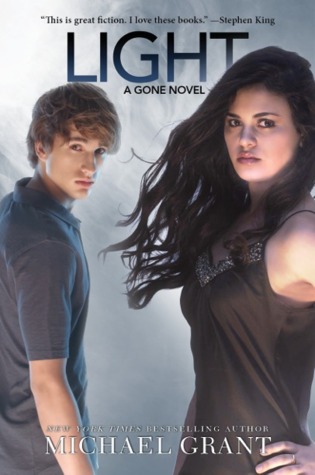
In three days, I read the final installment of the fast-paced and immensely disturbing Gone series. Light was decidedly faster paced than the rest of the books in the series (except perhaps for the first), so fast that I really did get swept up in the action, unaware of time's passing. It was a brisk, violent, emotional end to the series, but I responded more viscerally to the former than the latter. It seems that even though Light is full of action, death, and thematic resonance, it fell short emotionally, as if the author himself had turned off his emotional capacity to better cope with all the suffering he has caused these characters, just as many of them have done with theirs.

**SPOILERS AHEAD**

Obviously, Gaia lives, and grows, as Sam had not managed to kill her completely. And now that the FAYZ wall is transparent, the whole world can see the suffering and trauma that the kids have endured. But as sound cannot travel through the wall, misunderstandings about the goings-on in the FAYZ abound, and our core characters each consider what lies in wait for them at the end. It's not long, however, before Gaia is strong enough to unleash some bloodshed, and several characters, some named and most not, meet a swift and terrible end.

Light retains all the good stuff from the last five volumes, keeping the tone consistent: a fast-moving plot, complex characterization, and intense action. Additionally, all the loose ends get tied up real nicely, with a quick hint that maybe not everything is back to normal. But even as the story moved quickly, it is the same plot that drags on: the battle with Gaia. A couple kids get to throw some punches at her, she massacres a few more, then there is a rest. So there wasn't a whole lot of variety this time around. The plot with Petey was also grossly underutilized, as we only get precious few glimpses into his disembodied psyche before he possesses Caine, and his final battle with Gaia is laughably brief and almost comical to boot.

Interestingly enough, the last 30 or so pages, which go over the aftermath with all the main characters, was the most intriguing aspect of the emotional psychodrama that took place in this volume. The effect of their experience in the FAYZ would definitely be long-lasting, and adjusting to life in the real world would be difficult. I would almost rather have had another volume that went into a bit more detail about these kids' futures; sure, it would be epilogual, tangential to the overarching story of the FAYZ, but it is just another missed opportunity for a YA series to go in depth with the psychological effects of the trauma that the characters experienced and the cruelty of the real world when it comes to sympathizing with such trauma (see also: Hunger Games). But I applaud that Grant devoted more than 10 pages to it and treated the aftermath with deft realism.

One major weak point in the overall emotional arc came from Edilio's end. Edilio quickly became one of my favorite characters over the course of the series, and he has steadfastedly remained a "better person" than even Sam and Astrid (who basically give in to fear of death towards the middle-end), and there were some nail-biting moments when I thought he wouldn't make it to the end. But his grief for Roger, his supposed lover...I couldn't sense it the way I had with Sam and Astrid, or even Dekka's love for Brianna. Maybe Edilio is just good at holding back his emotions, but I did not get that intense fear and sadness that the other aforementioned characters in love had felt. If Grant really wanted to run with this, we should have gotten more set-up, seen Edilio and Roger interact a few more times than the few scenes we got back in Fear. In the end, I was happy for him, but still didn't buy that it was "true love" in the sense of Sam and Astrid or Dekka's love for Brianna.

Which brings me back to emotionality. This book made me gasp, tense, sigh with relief, and even feel happy for the characters towards the end. But I didn't cry. I was shocked that Brianna was killed so quickly, but I didn't feel sad. I felt sorry for everyone who was there to witness it, and the characters who cared about her, but I wasn't sad. I wasn't sad when any of them were killed. I even got angry with Sam and Caine for acting like such selfish cowards while helpless kids were being slaughtered with their powers. (Yeah, sorry Sam fans, but for a minute there I actually wanted him to die. When will a YA author have the guts to kill off the hero?) It wasn't like I didn't care about any of the characters who died. Perhaps there was just so much death, more then in any of the other volumes, I expected just about everyone to die, and not only wasn't surprised, but was desensistized to it. It stopped being shocking and more like, "Welp, now it's time for more kids to die." The killing was getting out of control.

But even through all of this, Sam gets through it all, coming out of the experience amazingly well-adjusted (if more stubborn and headstrong than before) while many others hadn't. As he's been in the thick of the action, you would think that he would leave the FAYZ just a teeny bit more scarred than he had. Ironically, in the end, the big hero of the FAYZ wasn't much of a hero, his life preserved thanks to others and his own selfish instincts, and yet retains that title for his past actions and doesn't seem to suffer a major guilt complex. (Though one would hope that Astrid would give credit where it was due regarding the end of the FAYZ) It was pretty obvious that the author was making it so that he and his closest friends would live...surprise, surprise.

So ends this thrilling ride of a series. Worth checking out, but, like the vast majority of critics say, it could've been better. 3 stars out of 5.

Tuesday, July 2, 2013

A Summer Reading Series: "Game of Thrones," and Why I Hate George RR Martin

I have never been a big reader of epic fantasy. It's not that I dislike the genre, necessarily; I'm just not that interested in it. I have never read the Lord of the Rings books (though I have seen the movies) and do not care to. It wasn't until I heard a lot of my friends talking about Game of Thrones--and raving about it--that I decided to give it a shot. More on that in a minute.

Reading Game of Thrones made me think about why I don't read epic fantasy. It's not because those stories are relegated to the genre ghetto (I still read some genre books)--though that factors into it a bit. But typical epic fantasy takes place in other realms modeled after Medieval Europe--a period of time in that place to which I'd rather not return. The notion of absolute monarchs and nobility is so outdated, and both sexes are allowed so little flexibility in their predetermined roles. And the focus on the higher classes, while a decent escapist route for other people, does not appeal to me in the least. What about all the people they allegedly rule over? And why are the Middle Ages so intriguing? I don't even want to pretend about it. It was a terrible, shameful period in the history of Europe. The promise of magic isn't really enough for me--I can get plenty of magic in Harry Potter-like fare. Even more socially conscious epic fantasy stories don't especially intrigue me--I guess any Medieval trappings in general are bound to turn me off.

So then why, you ask, did I decide to read Game of Thrones? This fantasy world resembles Medieval Europe even more closely than other epic fantasy stories, and even more blatantly racist and misogynistic--to a point teetering on the brink of problematic. And though I found a lot of such content in the first volume, I was nevertheless enthralled in the characters and ever-evolving intrigue as the story progressed.

A brief synopsis, for those who don't know: Game of Thrones follows the Stark family as each member gets pulled into national politics (in modern terms) and uncover a plot to kill the king and secure the cunning Lannister family into greater power. Each chapter follows a different point of view, most of them members of the Stark family, with the exception of the dwarf Lannister son Tyrion and the tangential story of the last Targeryen (the family that had been deposed by the current king) Daenerys, who at 14 is married to a Dothraki khal by her brother and whose experiences compel her to help bring back the age of magic and monsters.

Game of Thrones is obviously meticulously constructed (fyi, I'm obviously just referring to this first book, of course), with each chapter advancing the plot and pov character's arc in some way. Even the seemingly pointless deaths, for which many claim are pervasive in the book, serve the greater narrative in one way or another. And with each event (or almost every event) serving such a purpose, the tension rapidly rises and the stakes raised. And as I got to know each of the p.o.v characters, I came to like them more, or else my feelings toward them changed over the course of the narrative. By the middle of the 800-page tome, I had characters I was rooting for, characters I loathed, and characters I felt pity for.

But George RR Martin seems especially cruel, not just with the grim portrait of a Medieval-esque land, but also in how he constantly beats down his characters the second they have something to hope for. Whether it's murdering characters they care about, allowing them to be tricked or make mistakes for an inordinate amount of time, have them lose, and lose again, or laying bare the misogynistic culture that seems to respect women as much as cattle, Martin is one cruel god. This is not necessarily a bad thing, as it sustains narrative tension, but all the hardship makes me want to put down the book after a while. Sometimes, it gets to be too much.

Another reason to put down the book? It's too long. Now, it's not that the book is uninteresting, but there were moments later in the book where something that happened earlier is referenced and for a second I'd thought it was a previous book. Too much happens--and I'm sure the overall word count could have been reduced in other ways. I can certainly appreciate a lengthy novel that meanders slowly through the plot and soaks itself in details and character studies, but this is epic fantasy we're talking about here. It's meant to be consumed quickly--and for that it was too damn long.

So, while Game of Thrones may not be the best that epic fantasy has to offer, or even my particular cup of tea, but it is an entertaining and often thrilling read. 3.5 stars out of 5.

Tuesday, June 18, 2013

Paddy Clarke Ha Ha Ha ain't so funny

Roddy Doyle's Booker prize-winning novel isn't your typical novel, even among the literary types in which Paddy Clarke Ha Ha Ha fits so well. There's no real overarching plot tying all the episodic occurrences together, rather, a thin thread of feeling and a sense of security that changes over time--a length of time that is imprecise and imperceptible, as we are given only a vague sense of the order of events that occur in the novel. It is also all told from a 10-year-old boy's perspective, who learns a lot but still is very ignorant about much of the world. This structure may be off-putting to a lot of people, but if you take your time with this subtly pensive tale, you may find the story absorbing and enjoyable.

The story takes place in 1968 Barrytown, Ireland, a very specific time and a very specific place, but Doyle presents the context--even in the eyes of a ten-year-old boy--quite adeptly, so one gets a fairly accurate impression of the setting, and even the prevailing attitudes of the time. The titular protagonist gets into fights, picks on his little brother, participates in gross and masochistic dares, steals from certain shops, and looks down upon the boys who live in the newly constructed corporation housing. Like all his friends do. But slowly, over the course of the novel, the boy changes, and no longer fits in with his boorish peers. Coincidentally, or not so coincidentally, his parents' fights come to a breaking point and his father leaves the household for good, and he is drawn to one of the more aloof Corporation boys, Charles Leavy. The change is not much, but profound.

The story is strongest with its authenticity in detail and in Irish manners of speech, transporting to you to this very distinct setting. Roddy Doyle is nothing if not authentically Irish. That said, you'll need to put your context clue sleuthing skills to the test at times if you're not familiar with a lot of Irish-isms, or else have Google handy.

The structure of the novel is a major weak point, however, as each (mostly short) section is individually compelling, and not so much builds up a collectively compelling read. Though the book is under 300 pages, it took me longer than usual for a book of its length to read, largely because I wasn't dying to read more, only reading a few sections in a sitting and satisfied with that. It could be a purposeful device, allowing for deeper ponderation and a more true-to-life look at Irish boyhood, but a few sections likely could have been cut out without impacting the overall story very much. But to each their own.

In sum, Paddy Clarke Ha Ha Ha is an engaging, sometimes funny, and occasionally shocking portrait of one Irish boy's life at the age of ten. 3.5 stars out of 5.

Monday, June 3, 2013

Thoughts on the new season of "Arrested Development"

At long last, I've powered through the debut season of the new Arrested Development. I've been a fan of the show since a year after it went off the air and discovered its wonders from my peers (did somebody say "wonder"?). Now I'm as big a fan as they come, and AD remains one of the greatest comedies of the 2000s. I expected it to be a little different this time around, what with the different format and the longer episodes. I think it's well-suited to the style of AD, with the interwoven narratives that close the knot (and leave some open for another season...which we may in fact have!). It unfolds much like a novel, with unanswered questions that will get you to read the next volume. On a related note, if this format catches on, we could replace the word "season x" with "volume x" like graphic novels.

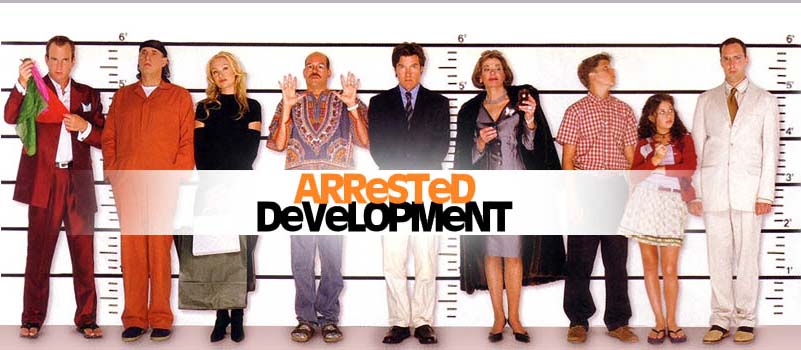
Old promo image...
Warning, spoilers....

In this season, each episode focuses on a different character, and at this point the Bluths have gone their separate ways, more or less. Not all of the Bluths are in every episode, so you may miss a character from time to time (I did), but then you'll also realize which characters you missed the most. (Mine: George Sr. and Lucille, GOB,  Maeby, George Michael) The episodes are also longer than 22 minutes, which sometimes bogs down the funny in service of the story. So it's a little slower-paced, with some overextended gags and yet a great deal of information packed in...with some intriguing incomplete moments acting as missing pieces of the puzzle, as it unfolds. The season definitely starts to pick up as it goes on, though, and it's most fun the moments those pieces fall into place.

There are some moments that are a little silly, like Lindsay's beau the Ostrich Man (and his farm), Maeby staying in high school a few years longer than when she should have realized it was a fruitless endeavor, and Michael's downward spiral (as of right now) feels a little far-fetched. But there are some classic Bluth moments, and the new format, in which we follow the story of a single character (and where their paths cross) works quite well considering the fact that all the characters are inter-linked and will interact with one another from time to time. But don't worry, you'll laugh: I laughed out loud quite a few times every episode, and will probably laugh more the next time I get around to watching this season.

New promo image

A lot of critics have mentioned how dark it is, and how unlikeable Michael has become in this season. And I wonder, have they not been paying attention? This family is as unlikeable as they come, and haven't been able to mask it well over the course of the original series. It would only be a matter of time before each of them "got theirs". On the one hand, we feel bad for them, because thanks to the brilliant writing and acting, we actually kind of like these characters, even if they're selfish and racist and generally horrible people. They redeem themselves every once in a while. But on the other hand, the Bluths as a whole are horrible, and do horrible things to others for their own gain, each Bluth varying on levels of pitiability and horriblility. And in this season, the more things change, the more the Bluths stay the same--to a degree. I do feel bad for Maeby and George Michael, though, since they didn't ask to be a part of this dysfunctional family.

The idea that Michael would turn out to be a failure when he struck out on his own and then get into the movie business in a meta-arc is a stretch, but not entirely implausible--like a lot of the situations presented in this season. Michael has made many Bluth-worthy mistakes in the past. I found George Michael and Maeby to be the more relatable characters, anyway, though maybe that's because I'm a young'un. But the dark, cringe-worthy comedy is hardly alien to intelligent American viewers, and sure, it's not everyone's cup of tea, but you would think the critics would get that.